
7 Signs Your Radiators Need a Power Flush (London Central Heating Guide)
Cold patches at the bottom of radiators, black water when bleeding, boiler kettling — here's how to tell if your London central heating needs a power flush, and what to check yourself first.
The clearest signs are cold patches at the bottom of radiators (not the top — that's air), dark brown or black water when you bleed them, a boiler that rumbles or kettles, and a circulator pump that's failed more than once. In London, where Thames Water supply runs at 302 ppm (very hard), central heating systems accumulate magnetite sludge faster than in soft-water areas. Most systems over 10 years old without a magnetic filter will have measurable sludge buildup.
Most homeowners don't think about their central heating until something obvious stops working. But the signs that a system needs attention usually appear months or years before a boiler gives out or a radiator is replaced. Knowing what to look for — and what the symptoms actually mean — saves you from a rushed decision in the middle of January.
This guide covers the seven clearest signs of sludge buildup in a central heating system, how to tell which symptoms are genuine versus misread, and the simple checks you can do before calling anyone.
What Is the Sludge in Radiators?
Before running through the signs, it helps to understand what you're dealing with. The black or dark brown material that collects in central heating systems is magnetite — iron oxide (Fe₃O₄). The same oxidation process that rusts a car panel happens inside your steel radiators over years of contact with water. The iron oxide particles are fine, black, magnetic, and abrasive.
Magnetite circulates through the system and settles in the lowest-flow areas — usually the bottom of radiators. It builds up on the internal surfaces of the boiler's heat exchanger, reducing efficiency and eventually causing damage. The longer it's left, the denser the buildup and the harder it is to shift.
This is distinct from limescale, which is calcium carbonate from hard water. Limescale forms primarily in the heat exchanger where water is directly heated — it causes a different set of symptoms (kettling, reduced hot water flow). In London, both can be present, but they require different approaches.
Sign 1: Cold at the Bottom — Not the Top
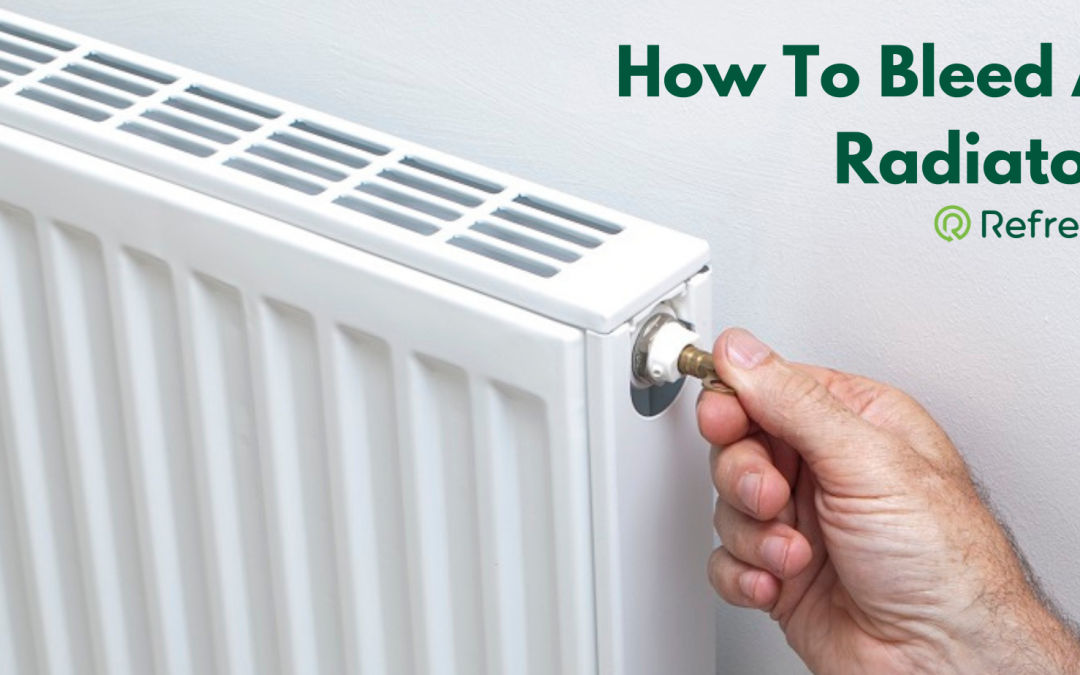
This is the most reliable indicator of sludge. Run your hand across each radiator when the heating has been on for 20-30 minutes. A healthy radiator is uniformly hot — perhaps slightly cooler at the edges, but not dramatically cold at the base.
When magnetite settles in the bottom of a radiator, it creates a layer of insulating debris that hot water can't penetrate. The result is a radiator that's hot at the top and cold at the bottom — sometimes with a clear thermal boundary you can feel with your hand.
The critical diagnostic distinction: cold at the top of a radiator is trapped air. This is fixed by bleeding. Cold at the bottom is sludge. Bleeding will release a small amount of dark water but won't remove the settled magnetite — the flow rate from a bleed key is far too low to shift it. Many homeowners bleed a radiator, see a small improvement, and assume the problem is solved. If the cold patch returns to the bottom within a week, the sludge is still there.
Check every radiator in the property, not just the obvious ones. Ground floor radiators tend to accumulate more sludge because they're at the lowest point in the system and flow velocities are lower there.
Sign 2: Black or Dark Brown Bleed Water
When you bleed a radiator, the water that comes out should be clear or very pale. In a clean system, you'll see a tiny puff of air and then clean water flows out.
If the water is dark — brown, grey, or black — that's magnetite in suspension. The darker it is, the more concentrated the sludge. Pure black water when bleeding is a clear indication that the system has significant magnetite buildup and won't clear without mechanical intervention.
Some homeowners are surprised by this because the radiator might still be heating adequately. A system can function with moderate sludge levels for years before symptoms become obvious — the magnetite is doing gradual damage to the heat exchanger and circulator pump throughout.
If you bleed and get dark water, don't just refill and carry on. The bleed has released some sludge into the bleed bottle but left the bulk of it inside the system. This is a clear referral for a professional power flush in London.
Sign 3: Boiler Kettling or Rumbling Noise
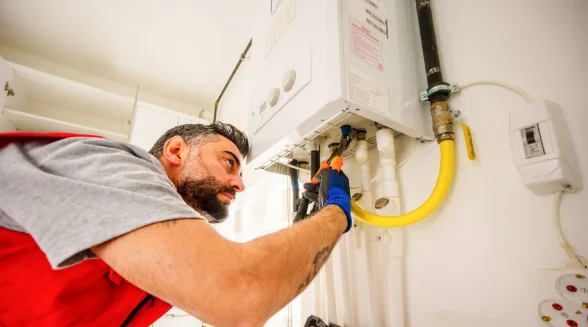
A boiler that makes a low rumbling, whistling, or kettling noise — similar to a kettle boiling — is a serious symptom. The noise comes from water locally overheating in the heat exchanger because flow is restricted. Sludge coating the internal surfaces of the heat exchanger reduces heat transfer and creates hot spots where water flashes to steam.
This is worth taking seriously. Left unaddressed, localised overheating cracks the heat exchanger — a repair that costs £400-£800, or a boiler replacement if the crack is severe enough or the unit is old. A power flush that clears the restriction costs far less.
A note on London specifically: Thames Water supply at 302 ppm (very hard) also contributes limescale deposits to the heat exchanger. Limescale causes similar rattling and kettling, but the fix is a descale of the heat exchanger specifically, not a whole-system power flush. An engineer can assess whether the noise is from system sludge, heat exchanger scale, or both — they're different problems that can coincide.
Sign 4: System Takes Too Long to Heat Up
A healthy central heating system should have all radiators warm within 15-20 minutes of the heating firing up. If your system takes 40 minutes, 60 minutes, or the radiators never reach full temperature even after an hour, circulation is restricted.
Sludge reduces flow through the system in two ways: it physically narrows the bore of pipework and radiator connections, and it increases the viscosity of the water in the system. The circulator pump has to work harder to push water around, and in badly sludged systems it can't maintain adequate flow at all.
Slow heating is often mistaken for an undersized boiler or a thermostat problem. Before replacing anything, a flow test (measuring temperature differential across the boiler flow and return) can confirm whether circulation is restricted. If the return temperature is much lower than it should be relative to the flow, the system isn't circulating properly.
Sign 5: Repeated Circulator Pump Failures
If you've had the circulator pump replaced twice in five years, sludge is the most likely cause. Magnetite particles are fine enough to pass through the system filter but abrasive enough to score the impeller and bearings over time. The pump wears out faster than it should.
Replacing a circulator pump costs £150-£300 fitted. The third replacement should prompt a conversation about why the pumps are failing — and the answer is almost always magnetite. A power flush followed by a magnetic filter installation (MagnaClean Professional2 or similar) breaks the cycle by removing existing sludge and preventing recurrence.
The same applies to motorised zone valves that are sticking — sludge particles can jam the valve mechanism. If zone valves are failing repeatedly on a system that's otherwise maintained, sludge is a probable factor.
Sign 6: Some Radiators Won't Heat at All Despite Being Bled
A radiator that stays cold after bleeding and with the lockshield and TRV valves fully open has either a complete flow restriction or a failed valve. Before calling for a flush, check:
- Is the TRV (thermostatic radiator valve) stuck? Cold weather can cause the pin inside the valve head to stick closed. Remove the TRV head and check if the pin moves freely — press it down and it should spring back up.
- Is the lockshield valve open? These are often wound right down by mistake during decoration or after plumbing work.
- Is the radiator on a spur off a microbore circuit? Some 1970s-80s London homes have 8mm or 10mm microbore pipework connecting individual radiators. Sludge can completely block a microbore spur.
If the valves are open and the TRV head is moving freely, the radiator has a flow restriction that bleeding can't fix. This is where a power flush — or in some cases, a single radiator replacement — is needed.
Sign 7: Heating Bills Increasing With No Explanation
A central heating system working harder to produce the same output uses more gas. Magnetite coating the inside of the heat exchanger acts as an insulator — the boiler has to run longer cycles to achieve the same temperature. Studies by Adey (manufacturers of the MagnaClean filter) have measured efficiency losses of 6-7% in moderately sludged systems compared to clean ones.
On a typical London gas bill of £800-£1,200 per year for central heating, a 7% efficiency loss is £56-£84 per year. Over 10 years without maintenance, that compounds. It's not the primary reason to flush — the equipment damage risk is more immediate — but it's a real cost.
Rising bills with no change in usage or tariff, combined with any of the other signs above, is a reasonable trigger for a system assessment.
Why London Homes Are More Prone to Sludge Buildup
Several factors combine to make central heating sludge more common in London than in many parts of the UK:
Older housing stock
Inner London has a high proportion of Victorian and Edwardian terraces (pre-1914) and interwar housing (1920s-40s). Steel panel radiators in these properties, installed in the 1970s-90s when gas central heating was retrofitted, are now 30-50 years old. Without corrosion inhibitor (Sentinel X100 or Fernox F1 — neither was standard practice until the 1990s) and without magnetic filters (which became mainstream only in the 2000s-2010s), these systems have been producing magnetite continuously for decades.
Hard water effects on system topups
Thames Water supply at 302 ppm is significantly harder than the UK national average of around 200 ppm. Sealed central heating systems are a closed loop and don't normally require topups — but systems lose small amounts of water over time through micro-leaks, pressure relief valve discharges, and expansion vessel issues. When topped up with hard London mains water, some calcium enters the circuit. In the radiator circuit, this calcium can bind with magnetite particles, creating a denser, more adhesive sludge than in soft-water areas.
Microbore pipework
Many London properties built or retrofitted in the 1970s-80s have 8mm or 10mm microbore pipework. These narrow pipes are more susceptible to sludge restriction than standard 15mm or 22mm pipework, and they require longer chemical contact time during a flush to clear. A property with microbore pipework and a 30-year-old system needs a power flush more urgently than the same-age property with standard pipework.
Simple Tests to Check Before Calling
Before booking a power flush, run these three checks yourself:
The radiator feel test
With heating on for 30 minutes, press your palm flat against the bottom third of every radiator. If any feel noticeably cooler at the base than the top, note which ones. Two or more affected radiators on a system indicate system-wide sludge, not a localised valve problem.
The bleed test
Get a white cloth or a clear container and bleed a ground floor radiator. Catch the first few millilitres of water. Clear or very pale — system is probably fine. Dark brown or black — magnetite confirmed.
The magnetic filter check
If a magnetic filter (MagnaClean or Fernox TF1) is already fitted, open the cap and inspect the magnet. A thin grey coating is normal maintenance buildup. A large black clump or a thick coating indicates the system has been producing significant magnetite — time to flush and investigate why.
If any of these tests confirm sludge, the next step is a professional assessment. Our London power flush service includes a pre-flush inspection to confirm the flush is the right solution before any work starts.
What Happens If You Ignore It
Sludge buildup doesn't resolve itself. The progression is predictable:
- Stage 1: Minor cold patches in some radiators. System still functions. This is the cheapest point to act.
- Stage 2: Several radiators not heating properly, boiler working harder, efficiency dropping. A power flush at this stage typically costs £600-£900.
- Stage 3: Boiler kettling, pump failures, circulator replaced. The flush is now more complex and may take longer because of heavier sludge concentration.
- Stage 4: Heat exchanger cracked from localised overheating. At this point the boiler needs repair (£400-£800) or replacement (£2,000-£3,500). A power flush can't reverse damage already done.
At Stage 1 or 2, a power flush is a straightforward financial decision. At Stage 4, you're replacing the boiler anyway — but you still need to flush the system before the new unit goes in, or the magnetite will immediately begin damaging the new heat exchanger.
If you're unsure whether you're dealing with sludge or a different problem — a faulty zone valve, a pressure issue, an undersized boiler — our central heating team in London can diagnose first and confirm whether a flush is warranted before committing to the cost.
London Power Flush — Diagnosis First, No Pressure
We inspect before we flush. If the symptoms don't justify the cost, we'll tell you. Call to arrange a same-day assessment across all London boroughs.
Call 0207 046 1363Frequently Asked Questions
How do I know if I need a power flush or just bleeding?
What is the black sludge in my radiators?
Can I check if my system needs a power flush myself?
Does London hard water cause radiator sludge?
Will a power flush fix a boiler that keeps losing pressure?
Is a power flush worth it before I replace the boiler?
What's the difference between a power flush and a chemical flush?
How do I know the power flush was done properly?
Key Takeaways
- Cold patches at the bottom of a radiator = sludge (magnetite). Cold at the top = air. These need different fixes.
- Black or dark brown water when bleeding is magnetite — iron oxide (Fe₃O₄) from corroding steel radiators. It won't clear with bleeding alone.
- Boiler kettling (rumbling/whistling) is sludge restricting flow through the heat exchanger — ignore it and the heat exchanger cracks.
- Repeated circulator pump failures (two or more in 5 years) are almost always caused by magnetite particles abrading the impeller.
- London Thames Water at 302 ppm means harder water than most of the UK — scale forms in the heat exchanger, magnetite forms in the radiator circuit. These are two different problems with different solutions.
- A magnetic filter (MagnaClean Professional2 or Fernox TF1) on a clean system prevents sludge returning after a flush.
