Can You Power Flush an Old Boiler? What Engineers Check First
Power flush machines operate at 2 bar max — boilers are tested to 4.5 bar. The damage risk is revealing pre-existing weaknesses, not causing new ones. Here's what engineers inspect before deciding.
You can power flush most older boilers. The Kamco machines used professionally operate at a maximum of 2 bar — your boiler was factory-tested to 4.5 bar or more. The real risk is not the flush cracking healthy pipework: it's that the vibration and high flow can dislodge sludge that was previously sealing a pinhole in a corroded radiator or a weeping joint, revealing a leak that was already there. A competent engineer inspects each radiator and visible pipework before starting and advises honestly if anything looks marginal.
The hesitation about flushing old systems is understandable — the fear is that disturbing something that's been undisturbed for 30 years will cause a problem. That fear gets amplified by vague internet advice that says power flushing "can cause leaks" without explaining the mechanism.
Here's the actual picture: what the risk is, what it isn't, and what an engineer checks before deciding whether to proceed.
The Pressure Question: Is It Safe?
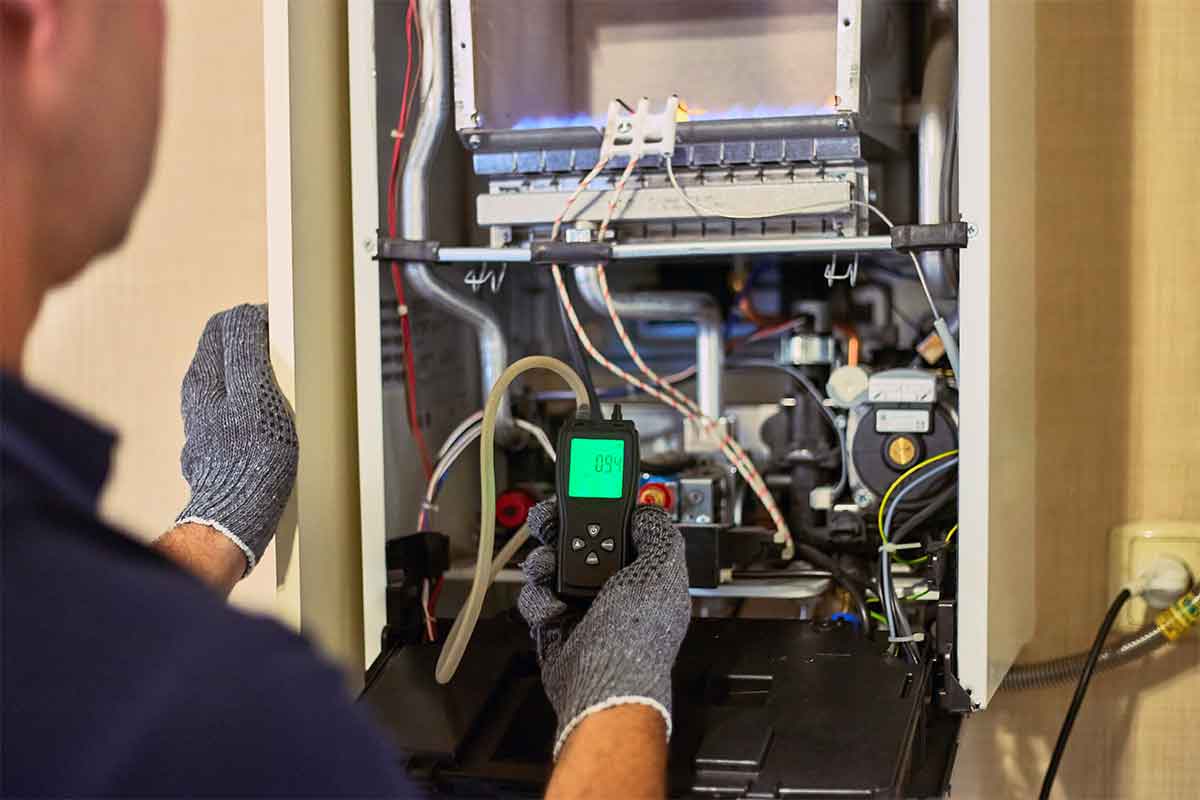
The concern about power flushing old systems almost always comes down to pressure — the idea that forcing high-pressure water through old pipework will rupture something. This misunderstands how power flush machines work.
The Kamco CF40 and CF90 machines used by professionals in the UK operate at a maximum of 2 bar. This is by design — the machines have a built-in pressure limiter. Your domestic pipework and radiators are manufactured to pressure well above this. More importantly, every boiler on the market is factory pressure-tested to at least 4.5 bar before it leaves the factory — more than twice what the flush machine can produce.
The cleaning effect comes from high velocity, not high pressure. The machine pumps 150-170 litres per minute through each radiator in turn. That flow rate physically carries magnetite particles out of the radiator — it's not squeezing harder on the system than the boiler already does during normal operation.
What power flushing can do to an old system is reveal defects that were already there. Magnetite sludge is slightly adhesive. Over years, it coats pinholes in corroded radiators and settles around weeping joints, sometimes masking minor leaks. When the flush dislodges that sludge, a pre-existing pinhole starts weeping. The flush didn't create the pinhole — it was there already, hidden.
This is a meaningful distinction for liability, but not much comfort if water appears on your floor during the flush. Which is why the pre-flush inspection matters.
What Engineers Check Before Starting
A competent engineer will not connect the machine and start pumping before inspecting the system. The pre-flush assessment covers four areas:
1. Radiator condition
The engineer looks for: surface corrosion (rust patches on the radiator face or at valve connections), active weeping (staining around bottom connections or bleed valves), significant physical distortion, or radiators that feel very thin when pressed (indicating internal corrosion has reduced wall thickness). Radiators in poor visible condition are flagged for potential replacement before the flush.
2. Valve and joint condition
Compression joints that have been dripping for years develop a habit of re-weeping when disturbed. The engineer checks visible joints for staining and signs of historical weeping. In period London properties, some compression joints under floorboards may have been dripping slowly for years and sealed themselves with limescale or sludge — a flush can reactivate these. This is the scenario referenced in forum discussions when people say "power flushing can cause leaks in old systems with pipes under floorboards."
3. Boiler heat exchanger
The engineer assesses the boiler condition — particularly the heat exchanger. If a boiler is already exhibiting symptoms of heat exchanger failure (persistent kettling despite adequate system flow, visible cracks, error codes for high temperature), flushing won't fix that and isn't worth the cost. Our boiler repair team in London can assess heat exchanger condition as part of a combined visit.
4. Pipework material
Standard 22mm and 15mm copper: no concerns. Microbore 8mm-10mm copper: requires adjusted approach (see below). Lead pipework (very old properties, rare): flush not recommended. Plastic push-fit connections (common in newer properties): fine for power flushing.
Radiator Assessment in Detail
The radiator decision is the most common source of uncertainty in old system flushes. The guidance engineers use:
| Radiator Condition | Recommendation |
|---|---|
| Surface rust only, no active weeping | Safe to flush — surface rust doesn't indicate internal corrosion severity |
| Staining around valve connections, historical drip evidence | Flush with caution; isolate that radiator first and check for weeping before reconnecting |
| Active drip or weeping at any point | Replace before flushing — the leak will worsen under flush conditions |
| Radiator more than 30 years old with no visible defects | Usually safe; engineer flushes that radiator last and monitors closely |
| Significant visible corrosion pitting | Replace before flushing — the wall has corroded through partially and vibration may open a pinhole |
In practice, replacing a suspect radiator before a flush is often the sensible choice. A standard single panel radiator costs £80-£200 for the unit plus fitting. If two radiators look marginal on a 10-radiator system, replacing them first and flushing the remainder is a more robust approach than either abandoning the flush or flushing and hoping.
Pipework: When Microbore Changes the Approach
Microbore pipework — 8mm and 10mm copper, common in London properties built or extended in the 1970s-80s — requires a modified flushing approach but is not a barrier to the job.
The narrow bore means lower volumetric flow at the same pump pressure. At standard machine settings, a Kamco CF90 pumping 170 L/min through standard 22mm copper produces a very high velocity. Through 8mm microbore, the same pressure setting produces much lower flow — which means less effective sludge removal per pass.
The standard adjustment for microbore:
- Extended chemical soak — 2-3 hours rather than 60-90 minutes — to soften sludge before flushing
- Multiple forward-and-reverse flow cycles per radiator section
- Lower flow rate settings to avoid excess back-pressure at the machine
- Longer total job time — a property with all-microbore pipework typically adds 2-3 hours to the estimate
Completely blocked microbore sections may not clear even with extended treatment. In those cases, the engineer will advise on whether the section needs replacing — usually a short run of new pipe from the manifold to the radiator.
Age Thresholds Engineers Use
These are not rules, but they reflect the typical risk profile by system age:
| System Age | Typical Assessment |
|---|---|
| Under 15 years | Standard flush unless specific defects found on inspection |
| 15-25 years | Pre-flush inspection recommended; may flag 1-2 radiators for replacement beforehand |
| 25-35 years | Thorough inspection; honest conversation about which components are marginal; likely to replace 2-3 radiators before flushing |
| 35+ years | Detailed assessment of all components; in some cases, a phased approach (replace worst radiators first, flush later) is more economical than a single visit |
The boiler's age specifically is less relevant than its condition. A 25-year-old boiler in good working order — no persistent faults, heat exchanger intact, burner clean — doesn't preclude a power flush. A 12-year-old boiler with a cracked heat exchanger does.
London Hard Water and Old Systems
Thames Water supply at 302 ppm is classified as very hard — roughly 50% harder than the UK national average of 200 ppm. This affects old systems in two specific ways:
Heat exchanger limescale
In the heat exchanger, where water is directly heated, calcium carbonate precipitates out of solution and forms limescale deposits. This is a heat exchanger problem, not a system problem — it causes boiler kettling, reduced hot water flow, and eventually heat exchanger failure. Power flushing the radiator circuit won't address this. A separate heat exchanger descale (using a dilute acid solution) is the correct fix.
If the engineer finds that kettling is primarily coming from the heat exchanger rather than system sludge, they'll advise on which intervention is appropriate — or whether both are needed.
Sludge density in the radiator circuit
The radiator circuit is a closed system and doesn't normally accumulate limescale. However, systems that lose water over time (through pressure relief discharges, micro-leaks, or vented system evaporation) and are topped up with hard London mains water introduce calcium into the circuit. Over years, this calcium can bind with magnetite particles and create denser, more consolidated sludge than would form in a soft-water area. This makes a professional power flush more important in London than the same-age system in, say, Manchester — and often makes the chemical soak stage longer.
When to Replace Before Flushing
There are situations where the honest recommendation is to replace a component before booking a power flush:
- Boiler at end of life: If the boiler is exhibiting multiple faults, the heat exchanger is cracked, or it's a non-condensing unit over 20 years old, spending £600-£900 on a flush and then £2,500-£3,500 on a boiler within 12 months is poor value. In this scenario, replace the boiler first and flush the system at the same time — it's a requirement for warranty compliance anyway.
- Multiple suspect radiators: If the pre-flush inspection flags 4 or more radiators as marginal in a 10-radiator system, replacing them all and flushing with new radiators gives a better result than a partial flush with ongoing risk of radiator failures.
- Known buried leaks: If there are known active leaks under floorboards or in inaccessible sections, these need to be fixed before the flush disturbs the sludge that's masking them.
Reach out to our central heating team in London for a pre-flush assessment — we'll give a clear recommendation on whether to flush as-is, replace components first, or phase the work over two visits.
Alternatives If a Full Flush Isn't Appropriate
In cases where the system condition genuinely makes a full machine power flush risky — perhaps because of multiple suspect radiators and buried pipework in a property where access is extremely difficult — there are lower-disruption options:
- Chemical flush only: Sentinel X400 or Fernox F3 dosed and left to circulate for 2-4 weeks. Not as effective for heavy sludge but carries no vibration risk to old joints.
- MagnaCleanse: Adey's process using a temporary magnetic filter inline. Removes magnetite particles from circulation without the high-velocity flow of a machine flush. Appropriate for moderate sludge where the machine approach carries too much risk.
- Phased radiator replacement and flush: Replace the two or three worst radiators, wait a year, then power flush the remaining system once the new components are proven.
The right answer depends on the specific system. There's no universal approach that applies to every 30-year-old London central heating system — which is why pre-flush assessment by an experienced engineer matters more than a remote quote.
Pre-Flush Assessment — Same Day Across London
We inspect first and give a straight recommendation. If the system needs work before a flush, we'll tell you honestly and quote the full scope. Call to book an assessment.
Call 07456 975436Frequently Asked Questions
Can a power flush damage old pipes?
My boiler is 20 years old — can it be power flushed?
What is the risk of a power flush on an old central heating system?
Does my old boiler need to be replaced before a power flush?
Can you power flush microbore pipework?
My radiators are 40 years old — should I replace them before flushing?
Is it worth flushing an old system if the boiler needs replacing soon?
Will a power flush improve an old system that's been working poorly for years?
Key Takeaways
- Power flush machines max out at 2 bar. Boilers are factory-tested to 4.5 bar. The flush machine cannot burst healthy pipework — it doesn't have the pressure.
- The real risk: dislodging sludge that was sealing a pinhole in a corroded old radiator, revealing a pre-existing leak. The pinhole was always there.
- Engineers assess four things before flushing an old system: radiator condition, valve and joint condition, boiler heat exchanger state, and pipework material.
- Microbore pipework (8mm-10mm) common in 1970s-80s London properties requires extended chemical treatment before flushing — standard approach still works.
- Systems over 25 years old in poor visible condition may warrant honest conversation about replacement vs flush — not because the flush is dangerous, but because new equipment may be more economical.
- London's hard water (Thames Water 302 ppm) accelerates limescale in the heat exchanger. If the engineer suspects scale as well as sludge, a heat exchanger descale may also be needed.
