How to Repressurise a Worcester Boiler (2026 Guide)
Fill a Worcester boiler to 1 to 1.5 bar using its keyless link, internal key or external hose. Find yours, follow the steps, and fix repeat pressure loss.
Find your filling method first: a blue-lever keyless link under the boiler, an internal filling key, or an external hose under a sink. Open it slowly, watch the gauge or pressure menu, and stop at 1 to 1.5 bar. Then close it and disconnect any external hose. If the pressure keeps falling, there is a leak to find.
The radiators are lukewarm, the hot tap is fine or has gone cold too, and the little gauge on the front of your Worcester is sitting low. In London that often happens in a flat, where the boiler lives in a utility cupboard or behind a kitchen unit and nobody has looked at the gauge since the last engineer did.
Worcester Bosch describes three ways to top up a sealed heating system, and which one your boiler has decides what you do. Below: how to tell which you have, each procedure as the Greenstar manuals and Worcester's homeowner guide give it, and what to do when the pressure will not stay up. If you want the general version for any make, see our how to repressurise a boiler guide.
⚠️ Two cases are not a top-up job. If you can smell gas, turn the gas off at the meter, open windows and doors, avoid switches and naked flames, and ring the National Gas Emergency Service on 0800 111 999. If water is running from the pressure relief valve discharge pipe, usually outside the property, treat it as hot and keep clear. Do not touch the pipe or try to plug it.
Worcester Boiler Low Pressure: What the Gauge Should Say
Worcester's manuals and homeowner guide put a cold sealed system at around 1 to 1.5 bar. The exact limits change a little between ranges, so use the row for your model in the table, and check your manual if yours is not listed.
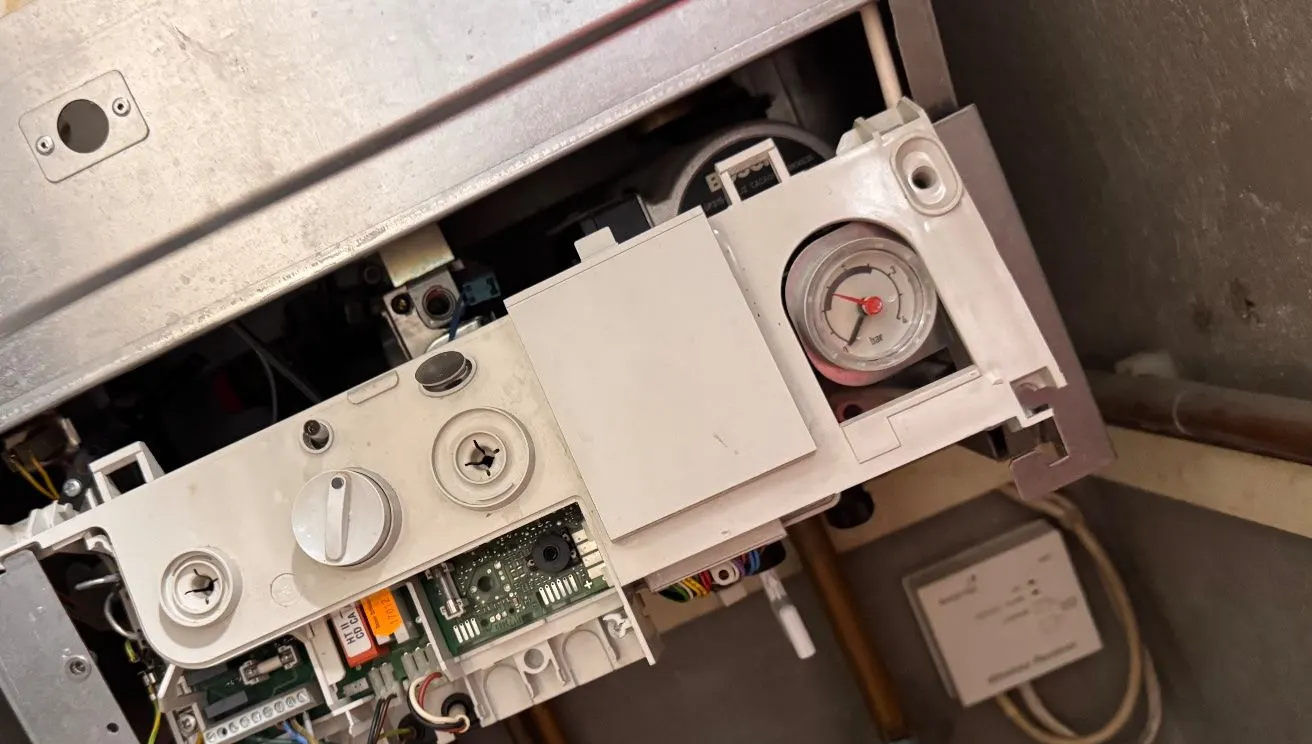
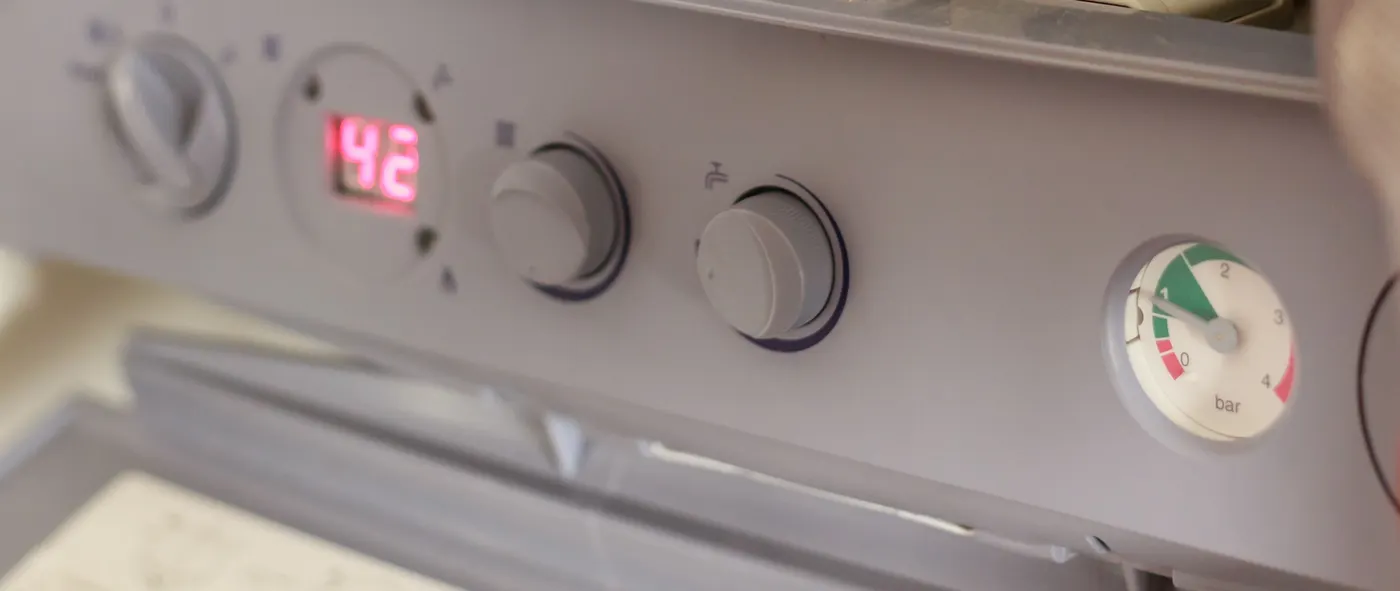
Your boiler will have either an analogue pressure gauge, a digital pressure menu, or both. On a gauge, a needle in the red zone means top up. On a digital model you find the figure in the pressure menu.
| Model | Normal when cold | Top up when | Too high |
|---|---|---|---|
| Greenstar 2000 | Generally 1 to 1.5 bar (1 to 2 bar when operating) | Low-pressure warning shows below 1.1 bar; needle in the 0 to 1 bar zone | Over 1.5 bar: bleed one radiator until it is back at 1 to 1.5 bar |
| Greenstar 4000 | Generally 0.8 to 1.7 bar (1 to 2 bar when operating) | Below 0.8 bar. The pressure menu shows "Fault - 1017 System pressure too low" at 0 to 0.79 bar | Over 1.7 bar: bleed one radiator until it is back at 1 to 1.7 bar |
| Greenstar 8000+ | Indicator in the green zone | Display reads less than 1 bar. Very low pressure (the manual gives 0.2 bar) puts the system out of operation with a warning | Indicator in the right-hand red zone: bleed a radiator until it is back in green |
| Greenstar i | Around 1 bar with the heating off; usually 1.5 bar or more when operating | Below 1 bar | No upper figure on Worcester's page |
Other ranges, including the Si and Junior, have their own figures, and we have only listed numbers we could check in Worcester's documents. For those models, read the pressure section of your manual. The model name is on the front of the boiler or on the data plate.
Which Worcester Filling Loop Do You Have?
Worcester Bosch describes three fill methods: a keyless filling link with a blue lever, an external filling hose, and an internal filling key. They look nothing alike, so a two-minute look settles it. Worcester's homeowner guide, "Maintaining your boiler pressure", and the boiler pressure page on worcester-bosch.co.uk cover all three.
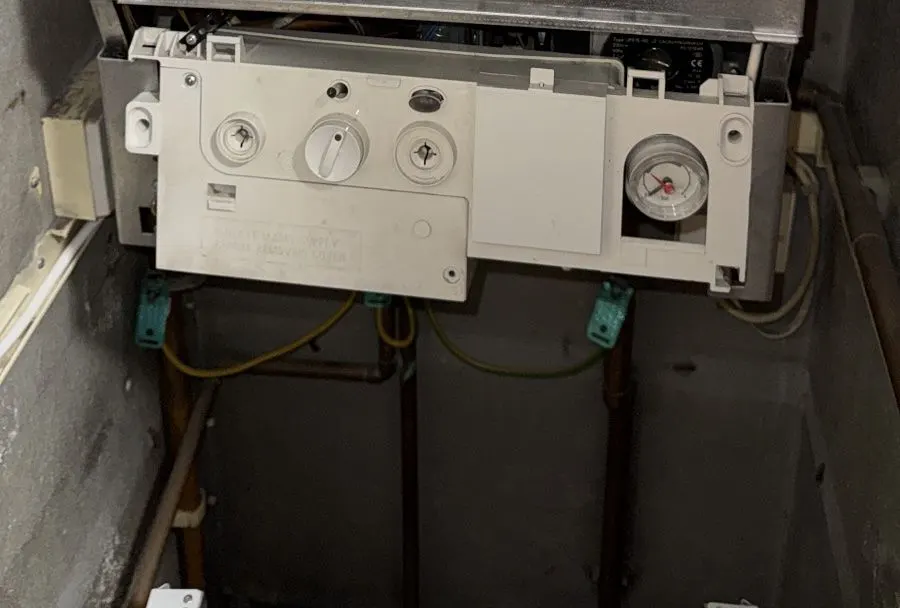
- Keyless link. Remove the bottom cover. The link sits underneath the appliance, usually on the right: a black manifold with a blue lever. It is an optional accessory on the Greenstar 2000 and 4000. The 8000+ has an integral keyless link, plus an optional Intelligent Filling System that refills to a programmed pressure on its own.
- Internal key. The manifold carries a padlock symbol and a slot for a filling key. If the key is missing, spare ones are sold by merchants such as Screwfix and on Amazon. Worcester suggests storing the key in the bottom cover so it is there next time.
- External hose. A hose that screws on to a valve on a copper pipe. The valves can be under a kitchen or utility sink, and there are two: one from the mains cold supply and one going to the heating system.
The documents we checked do not say which loop comes with which boiler, so do not guess from the model name. Look.
In London flats and conversions the boiler often sits in a cupboard with no room for a fill device, so the loop under the kitchen sink is common. If you have lived in the property a while and never seen a hose, the loop may be there but disconnected, which is how it is meant to be left.
How to Repressurise a Worcester Combi Boiler
The steps differ by method, but the idea is the same: fill slowly, watch the gauge or pressure menu, and close up at 1 to 1.5 bar. Each method is below, taken from Worcester's homeowner guide and the Greenstar user manuals.
Keyless filling link
- Remove the bottom cover of the boiler.
- Find the black manifold with the blue lever, usually on the right.
- Pull the lever down. A noise from the water entering is normal.
- Watch the gauge or pressure menu. Release the lever at 1 to 1.5 bar. On the 8000+, release it when the indicator is mid-green and the reading is between 1 and 1.5 bar.
- Check the lever has returned fully, then refit the cover.
Internal filling key
- Find the padlock symbol on the manifold under the boiler.
- Push the key in firmly and turn it 45 degrees left, towards the locked padlock symbol, as the homeowner guide describes it.
- Turn the nut to the left to let water in. The sound of water passing is normal.
- Turn the nut off when the gauge reaches 1 to 1.5 bar, then turn the key back 45 degrees and pull it out.
- A few drips are normal. If it keeps dripping, tighten the nut slightly. Put the key back in the bottom cover.
The Greenstar 4000 manual words the key steps differently, so if the picture on your boiler does not match the above, follow your manual. It has you align the key arrow with the open padlock and turn right to the stop, which is the closed padlock. The white knob turns left to fill and right to close, and it should not be over-tightened. To remove the key, turn it left to the open padlock and pull it straight down.
External filling hose
- Check the two valves on the copper pipes are closed. The slot should lie across the valve.
- Take the cap off the valve on the copper pipe and attach the hose.
- Open one lever, then the second slowly. The Greenstar 2000 manual has you turn each handle through 90 degrees to open it.
- Fill slowly and watch the pressure. At 1 to 1.5 bar, turn both levers back to closed.
- Unscrew the hose. A little water will come out, so have a rag ready. Refit the blanking cap.
💡 Disconnect the hose afterwards. The Greenstar 2000 and 4000 manuals say you must disconnect the external filling loop after re-pressurising, to comply with Water Authority regulations. Do not leave it attached to the heating pipe.
Repressurise a Worcester Boiler Without a Filling Loop
If you cannot see a filling loop, you probably still have one of the other two methods. An external loop is meant to be disconnected after use, so a missing hose is not a sign of anything wrong.
Work through this order:
- Take the bottom cover off and look for the blue-lever keyless link.
- If not, look for the padlock symbol and key slot on the manifold, and for the key in the cover. Worcester says replacement keys are sold by plumbing merchants.
- If not, look under the kitchen or utility sink, and anywhere else along the incoming pipework, for the two valves and the capped copper-pipe valve of an external loop. You need a filling hose to use it.
If none of these exists, stop there. Do not open fittings on the heating pipework to push water in some other way. A system with no way to top it up either has one hidden somewhere or needs one fitted, and both are jobs for an engineer. In a flat where pipes run through shared ducts, ask the managing agent before anyone changes anything on shared supplies.
After You Repressurise
Once the pressure is in range, leave the controls alone for a few minutes and check the reading has held. On the Greenstar 4000 the top-up is done when the pressure menu reads OK and the indicator is in the green zone.
If you overshot, the 2000 manual says to bleed one radiator until the reading falls back to 1 to 1.5 bar. The 4000 manual's limit is 1.7 bar. The 2000 manual also says:
- Do not vent radiators while the central heating is on.
- Wait 30 minutes after venting before you use the heating or hot water.
- Do not let the pressure drop below the green zone while you vent.
If the pressure keeps rising with the boiler off, the filling link is probably not fully closed, so check it. The 2000 and 4000 manuals add that a leaking relief valve pipe can mean the pressure is too high, and bleeding a radiator is the fix they give. For brand-neutral overpressure checks, see the general repressurising guide.
If a fault code stays on once the pressure is back in range, our Worcester Bosch fault codes guide covers EA, E9 and A1.
Worcester Boiler Keeps Losing Pressure
A Worcester that keeps losing pressure has water going somewhere. The Greenstar manuals say constant re-pressurising should be investigated: it is an indicator of potential leaks, and the inhibitor concentration in the system is reduced, which can lead to corrosion.
Start with what you can see:
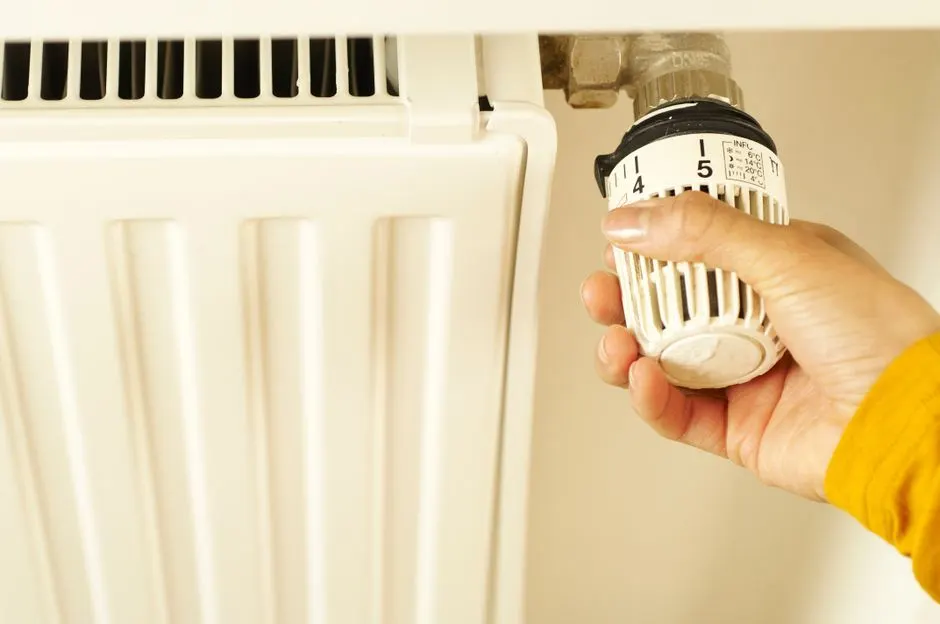
- Visible joints, radiator valves and connections, which is the list on Worcester's Greenstar i page. A stain or a green crust shows a slow weep.
- Any underfloor pipework, if you can see it.
- The pressure relief valve discharge pipe. Worcester's Greenstar i page says it usually ends outside, and that a wet pipe may mean the valve is faulty.
- The filling link itself. If it is not shut fully, pressure can keep rising on its own.
In a flat, a drip from your own pipework may only show up as a stain in the ceiling of the flat below, not as a puddle at home. Treat a downstairs neighbour's complaint as information about your system.
Worcester's manuals say to contact your installer or maintenance engineer when there is a recurring significant pressure change, and the Greenstar 2000 manual adds that failing to maintain the system may affect your warranty. Our guide to why a boiler keeps losing pressure ranks the usual causes from most to least common, and the expansion vessel is one of them.
When to Call a Gas Safe Engineer
Call an engineer when the pressure drops again after you top up, when water is coming from the relief valve pipe, when you cannot find any way to add water, or when the boiler shows the same fault after the pressure is right. Topping up a sealed system is a homeowner job. Finding a leak or repairing the boiler is not.
Worcester Pressure Dropping Again?
Gas Safe engineers across London. £60 call-out fee at any hour for ordinary emergency work, waived for landlords, property managers and scheduled work. We pressure-test the system and find where the water is going.
Call 0207 046 1363You can also message us on WhatsApp at 07456 975436 with a photo of the gauge and the underside of the boiler. Details of the work we do on gas boilers are on our boiler repair London page.
Frequently Asked Questions
What pressure should a Worcester boiler be at?
How do I know if I have a keyless filling link?
Can I repressurise a Worcester boiler without a filling loop?
Do I have to disconnect the external filling hose afterwards?
Why does my Worcester boiler keep losing pressure?
What if the pressure goes too high after filling?
Emergency Repairs London provides same-day and 24/7 emergency boiler repair with Gas Safe registered engineers across all 32 London boroughs. Lines are open 24/7 on 0207 046 1363.
Key Takeaways
- Worcester Bosch describes 3 ways to fill a sealed system: a keyless filling link with a blue lever, an internal filling key, or an external filling hose
- Stop filling at 1 to 1.5 bar, the figure in the Greenstar 2000 and 8000+ manuals and Worcester's homeowner guide, then close the valve or lever fully
- The Greenstar 2000 shows a low-pressure warning below 1.1 bar, and the Greenstar 4000 shows Fault 1017 when the pressure menu reads 0 to 0.79 bar
- An external filling loop must be disconnected after you re-pressurise to 1 to 1.5 bar, to comply with Water Authority regulations (Greenstar 2000 and 4000 manuals)
- Over 1.5 bar on a Greenstar 2000, or 1.7 bar on a 4000, means bleeding one radiator until the reading drops back into range
- Worcester says constant re-pressurising should be investigated: check 3 places first, joints and radiator valves, underfloor pipework, and the relief valve pipe
