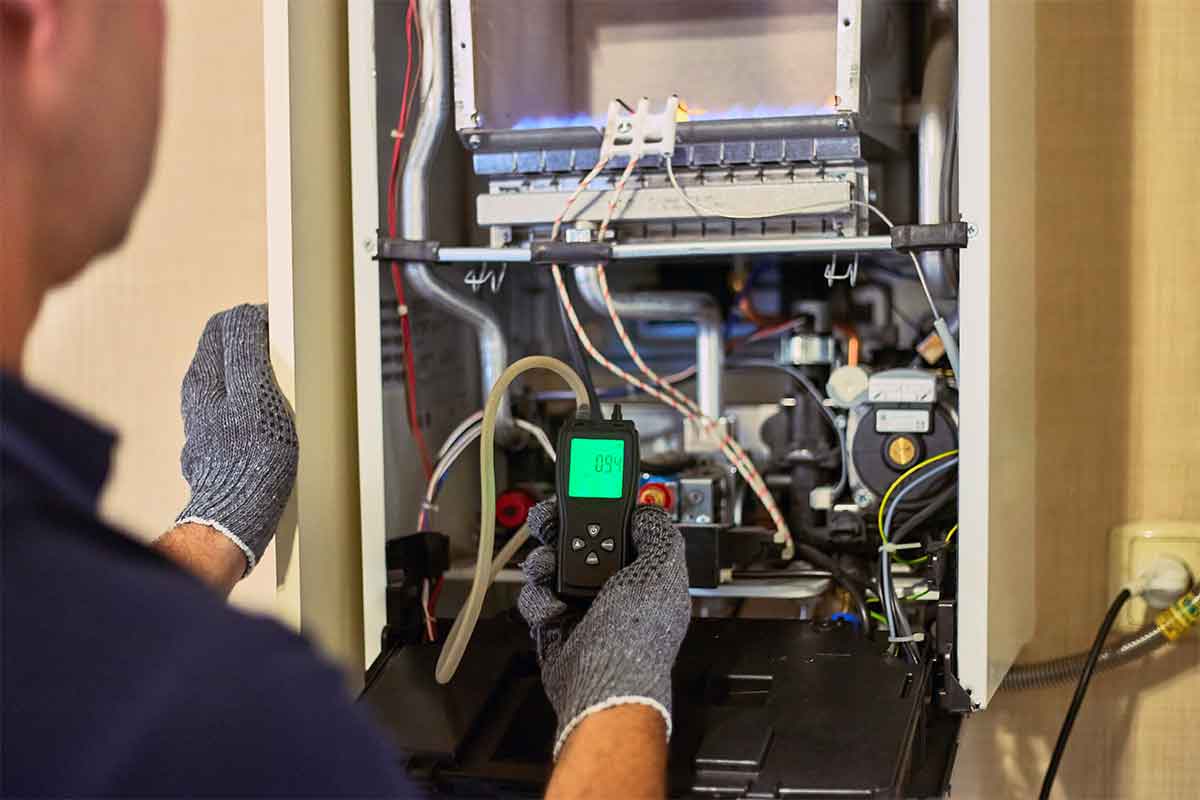
Worcester Bosch Fault Codes Explained: EA, E9 and A1 (Greenstar London Guide 2026)
Worcester Greenstar showing EA, E9, A1 or C6? What each code actually means, the checks you can safely do yourself in five minutes, how to reset a Greenstar, and the exact point where you must stop and call a Gas Safe engineer.
EA means the boiler ran its ignition sequence and no flame was detected, so it locked out. It is the most common Greenstar code in London and the one with the best odds of a homeowner fix: check the gas is on at the meter, check another gas appliance such as the hob still lights, check a prepayment meter is in credit, and in cold weather check the external white condensate pipe has not frozen, because a blocked condensate route is the single biggest cause of a January EA. E9 is an overheat safety shutdown, usually caused by poor circulation, and it is engineer work. A1 means the boiler detected no water movement when the pump ran, so check the pressure gauge and top up to around 1.2 bar if it is low, then stop. C6 is a fan fault and is engineer only. Reset by holding the reset button, or on older Greenstars by turning the control dial to the reset position, and do not do it more than two or three times. Never remove the boiler casing, and if you smell gas, ring the National Gas Emergency Service on 0800 111 999 first.
A Worcester Greenstar that has stopped working and is showing a code on its display has already done you a favour. It has told you which of its internal safety checks failed. The problem is that Worcester's codes are written for engineers, so EA, E9, A1 and C6 mean very little to a homeowner standing in a cold kitchen at seven in the morning wondering whether this is a five-minute fix or a call-out.
This guide translates the codes we attend most often on London Greenstar installations. For each one you get what the boiler is actually complaining about, the checks you can safely do yourself from outside the casing, and the clear point at which you stop and ring a Gas Safe registered engineer. Nothing in here asks you to open the boiler, touch a gas component or defeat a safety device, because none of that is legal or safe for anyone who is not on the Gas Safe Register. It sits alongside our guides to Vaillant fault codes F.75, F.28 and F.22 and Ideal fault codes L2, L1 and F1.
⚠️ Before anything else: if you can smell gas, this is not a boiler repair problem. Turn the gas off at the meter's emergency control valve, open windows and doors, do not touch electrical switches, do not use naked flames, and ring the National Gas Emergency Service on 0800 111 999. It is free and staffed 24 hours. Repairs to the appliance happen after the supply has been made safe.
How Worcester Bosch Fault Codes Work
Worcester does something different from most manufacturers, and it is worth understanding before you look up a single code. On most Greenstar models the display shows two pieces of information: a fault code made of letters and a number, such as EA, and a separate numeric service code alongside it, such as 338.
The letter code tells you the category of fault. The numeric service code narrows it to a specific cause within that category. That pairing genuinely matters, because the same letter code can arise from several different underlying problems, and the number is often what tells an engineer whether to bring a flame sensing electrode or a gas valve. Quote both when you ring. Quoting one without the other throws away half the diagnosis.
The second thing to know is that Worcester has produced a lot of Greenstar ranges over the years: the i, Si, CDi, Ri and Classic families, and the newer 2000, 4000 and 8000 series. Code meanings are broadly consistent across them but not perfectly identical, and the reset method in particular changes between the older and newer generations. Your model's own user guide is the authoritative list. Anything you read online, including this page, is a starting point rather than a substitute for it.
Finally, a fault code names the check that failed, not the part that broke. A1 does not mean "your pump is dead". It means the boiler did not detect the circulation it expected. That could be the pump, a closed valve, a sludged circuit, or simply not enough water in the system. Which of the four it is takes a meter and a set of eyes inside the casing.
💡 Write both codes down before you reset. Some Greenstar models clear the display once the fault resets, and an engineer who knows you had EA with a particular service code three times overnight will arrive with the right parts on the van. It is the single cheapest thing you can do to shorten a call-out.
EA: No Flame Detected (Ignition Lockout)
What the boiler is saying: I ran my ignition sequence and no flame was detected, so I have locked out rather than keep trying.
EA is the code we attend most often on Worcester boilers in London, and you can usually hear it happening: a run of clicks from the ignition electrodes, a pause, another attempt, and then the code. Because the complaint is that the boiler could not light, every productive check is about whether gas is actually reaching the appliance and whether the combustion and condensate paths are clear. All of those checks sit outside the casing, and in a London winter there is a genuinely good chance one of them fixes it without a call-out at all.
What you can safely check and do yourself
Confirm the gas supply is actually on
Find the emergency control valve at the gas meter. When the lever sits in line with the pipe the gas is on; across the pipe it is off. It is more common than you would think for a valve to have been turned off during other work and never turned back.
Test another gas appliance
Try the gas hob. If the hob will not light either, the problem is the supply rather than the boiler, and that is a very different phone call. If the hob lights normally, gas is reaching the property and the issue is at the boiler.
Check the meter is in credit
On a prepayment meter, a boiler that has run out of credit and been topped back up sometimes needs the emergency credit accepted at the meter before gas flows properly again. Worth 30 seconds before you pay a call-out fee.
In cold weather, check the condensate pipe
Find the white plastic pipe leaving the property, usually 22mm or 32mm and often the only white pipe on that wall. After a hard frost it can freeze solid, and a blocked condensate route is the single biggest cause of a January EA in London, frequently accompanied by a gurgling sound as the boiler tries and fails. Pour warm, never boiling water along it, concentrating on external bends and the exposed end. Boiling water can crack the pipe or its fittings.
Reset once, and once more at most
Use the reset method for your model, described in the reset section below. If the boiler fires and stays running, you have found it. If EA returns, stop resetting and book an engineer.
When you stop and call an engineer
If the gas is on, other appliances work, the meter is in credit and the condensate pipe is clear, then the remaining causes all sit inside the appliance. The gas valve, the ignition and flame sensing electrodes, the fan and the flue are Gas Safe territory without exception. Two resets is the limit. A lockout after failed ignition is the boiler doing precisely what it is designed to do, and repeatedly forcing it to retry a start sequence it has already judged unsafe is the one thing you should not do.
✓ If a frozen condensate pipe turns out to be the culprit and it keeps refreezing every cold snap, ask an engineer to re-route it internally or lag it properly. It is a cheap job that saves a winter of call-outs, and we cover the wider picture in our frozen pipes guide for London.
A1: No Water Circulation (Pump or Dry-Run Protection)
What the boiler is saying: I started the pump and did not detect the water movement I expected through the primary circuit, so I have stopped rather than fire the burner into a system I cannot confirm is circulating.
A1 is the Greenstar's dry-run protection, and like every circulation fault across every brand it gets misread as "the pump has failed" by people who then find the pump is fine. The boiler is reporting a mismatch between what it asked for and what it observed. Four causes cover the overwhelming majority of A1 call-outs in London.
- A failed, seized or airlocked pump. Pumps seize after a long summer idle period, which is why the first cold week of October is always the busiest of the year. If the pump genuinely is not moving water, the boiler is right to stop.
- A closed or seized valve in the circuit. A motorised zone valve that has stopped opening, or an isolation valve left shut after other work, produces exactly the same symptom.
- Sludge restricting flow. On older London systems, magnetite build-up narrows the circuit until the boiler can no longer see proper circulation. Cold spots at the bottom of radiators are the corroborating evidence.
- Very low system water. If pressure is already near zero there is little for the pump to act on, and A1 can appear alongside or instead of a low pressure warning.
What you can safely check and do yourself
- Check the pressure gauge first. This is the only one of the four causes you can address from outside the casing. If it reads below about 1 bar cold, top up to around 1.2 bar through the filling loop. Our step-by-step repressurising guide covers the valve types you will find on Worcester installations.
- Check the room thermostat and radiator valves. Confirm the heating is genuinely calling for heat and that thermostatic radiator valves have not all been wound shut. That is a legitimate thing to notice and report.
- Listen. Stand near the boiler on a demand. A pump that hums but produces no flow sound, or a boiler that is silent where you would normally hear circulation, is a useful observation to pass on. Listening is fine. Opening anything to look is not.
- Reset once after topping up, and give the boiler a full start cycle.
⚠️ Stop here. The pump, the flow sensing components and the internal valves all sit inside the boiler casing on every Greenstar model. Under the Gas Safety (Installation and Use) Regulations 1998, opening that casing is restricted to a Gas Safe registered engineer. There is no homeowner test, no bypass, and no reset trick that resolves a genuine pump or circulation fault. If A1 returns at correct pressure, book the visit.
One thing worth knowing before the engineer arrives: if the diagnosis lands on sludge rather than a failed part, the real fix is a system clean and a magnetic filter, not a component swap. Replacing a pump in a system full of magnetite buys you a year at best.
E9: Overheat Safety Shutdown
What the boiler is saying: I measured a temperature above my safety limit and shut down to protect the heat exchanger and the system.
E9 is the code with the shortest homeowner section on this page, because there is not one. A safety limiter has operated, and that is a device doing exactly what it exists to do. Every part of the diagnosis sits inside the casing, so E9 is Gas Safe engineer work every single time.
What is useful to know is why it happens, because it is rarely the safety device itself at fault. E9 nearly always traces back to heat not being carried away from the heat exchanger fast enough. The usual chain is a pump that is failing or airlocked, a circuit restricted by sludge or scale, closed or seized valves, or a primary heat exchanger that has scaled up. That last one is a common finding in London, where hard water across most of the north and west of the capital furs up heat exchangers faster than the national average.
What you can safely do
- Note what you observed. Were the radiators getting hot? Did you hear kettling, banging or a rumbling from the boiler in the weeks beforehand? Was the pressure normal? All three help the engineer arrive with the right expectation and the right parts.
- Do not sit and reset it repeatedly. A boiler that keeps overheating and locking out is not a boiler to keep restarting. One reset to confirm the code is persistent is reasonable. Five is not.
- Turn the boiler off at the switched fused spur if it is making loud banging noises or you can smell scorching, and book the visit as an emergency.
⚠️ E9 is not a code to work around. There is no homeowner check, no external adjustment, and no acceptable way to bypass an overheat safety device. If a Greenstar is repeatedly reaching E9, treat it as an emergency call-out rather than an inconvenience.
C6: Fan Fault
What the boiler is saying: the fan is not running at the speed I expect it to, so I will not run a burner sequence.
The fan drives combustion air in and flue gases out. If the boiler cannot confirm the fan is behaving, firing the burner would risk products of combustion going somewhere they should not, so the boiler stops. That reasoning is also why there is no homeowner check here: the fan is inside the casing, and the flue is part of the sealed combustion route.
C6 is straightforward for an engineer and usually a same-visit fix, since a Greenstar fan is a stock item for anyone who works on Worcester regularly. The only thing worth doing before you ring is noting whether the boiler was noisy in the run-up, because a fan bearing that has been whining for a fortnight tells the engineer to bring the part rather than diagnose and return.
💡 One reset is reasonable to confirm the code is persistent. After that, book the visit. There is no external adjustment, no filter to clean and no safe workaround for a fan fault on a room-sealed condensing boiler.
Low Pressure Warnings on a Greenstar
Low system water pressure is the most common non-emergency reason a Greenstar stops heating, and it is the one situation where a homeowner can genuinely resolve things alone. How the boiler tells you varies across the Greenstar ranges: older units may simply show a low reading on the analogue pressure gauge on the front panel with the boiler refusing to fire, while newer models show a specific low pressure code or warning on the display. Rather than guess at your model's exact code, use the gauge, which means the same thing on every one of them.
- Below about 1 bar cold is low. Normal cold operating pressure is roughly 1.0 to 1.5 bar, rising to about 2.0 bar when the system is hot.
- Top up through the filling loop with the boiler switched off and cool. Open the valve or valves slowly, watch the gauge, and close them the instant it reaches around 1.2 bar. Releasing excess pressure is far more awkward than adding it.
- Do not top up above 1.5 bar cold. If the gauge is already above 2.5 to 3 bar, the answer is to release pressure rather than add it, and that is not a homeowner job.
What matters more than clearing the warning is what happens next. A sealed system that is behaving holds pressure for six to twelve months between top-ups. If you are topping up weekly, the water is going somewhere: a weeping radiator union, a hidden pipe joint, a failed expansion vessel, or a pressure relief valve discharging out through the wall. Repeated topping up masks the fault and pumps fresh oxygenated water into the system, which accelerates corrosion. We rank the four causes by how often we actually see them in why your boiler keeps losing pressure.
✓ Free 30-second diagnostic: step outside and look at the brass pipe that terminates low on the external wall near the boiler. If it is wet, dripping, or streaked with white limescale, the pressure relief valve has been discharging and your pressure loss almost certainly traces back to a failed expansion vessel. Telling the engineer that on the phone can halve the diagnosis time on site.
⚠️ If the pressure is dropping because water is visibly coming out somewhere, isolate the water before you worry about the boiler code. Our guide to turning the water off at the mains in London covers where the stopcock hides in Victorian terraces, 1930s semis and flats, and how to isolate a single radiator or appliance instead of the whole property.
How to Reset a Worcester Greenstar Safely
The reset method depends on the age and model of your Greenstar, and this is one of the places where Worcester genuinely differs from other manufacturers.
Newer Greenstar models: the reset button
Most current models have a dedicated reset button on the control panel. Press and hold it for a few seconds until the display shows the boiler restarting.
Older Greenstar models: the control dial
On many older units the reset is built into the central heating temperature control dial. Turn the dial fully to the reset position, which is marked with its own symbol at the end of the range, hold it there for around five seconds until the display responds, then return the dial to your normal heating setting.
If you are not sure which yours is
The user guide for your specific Greenstar model shows the reset control, and the model name is printed on the front panel. Worcester publish the user guides for current and recent ranges, and it takes less time to check than to guess.
Whichever method applies, the discipline is identical:
- Only reset after you have changed something. Topping the pressure up, thawing a condensate pipe or turning the gas back on are changes. Pressing reset again five minutes later is not.
- Two or three attempts, maximum. Once a fault persists through a small number of resets, stop and get qualified help.
- A code that clears and returns the same day is a persistent fault. Book the visit rather than resetting through the evening.
- Never reset an overheat code repeatedly. E9 is the one code where even a second or third attempt is questionable.
The lockout is not the boiler being awkward. It is a safety mechanism that has decided a start sequence is not safe to repeat, and overriding it by habit is how a cheap sensor fault becomes an expensive one.
Other Codes You Might See
A short reference for the codes covered above, plus honest guidance on everything else. The right-hand column is the real answer about who can act on it.
| Code | What it indicates | Homeowner or engineer? |
|---|---|---|
| EA | No flame detected during the ignition sequence, boiler locked out | Gas, meter and condensate checks only, then engineer |
| A1 | No water circulation detected when the pump ran | Check pressure only, then engineer |
| E9 | Overheat safety shutdown | Engineer only |
| C6 | Fan fault | Engineer only |
| Low pressure warning (code varies by model) | Not enough water in the sealed heating circuit | Homeowner can top up to around 1.2 bar via the filling loop |
| D-prefix codes such as D5 | Conditions reported by the boiler's own controls, typically sensor or control related | Engineer only, and check your model's manual for the exact meaning |
| Any other code, or any code with a service number you cannot find | Unknown. Greenstar ranges use overlapping but not identical code sets | Note the letter code, the service number and the model name, and quote all three on the phone |
We have deliberately kept that table short rather than reproducing a long list of half-remembered codes. Worcester's own installation and servicing instructions for your specific Greenstar model are the authoritative source, and a good engineer will cross-reference your unit rather than work from a generic table. That is also why the genuinely useful thing you can do is write down the letter code, the service number, the model name from the front panel, and the GC number from the data badge.
Where You Must Stop: The Gas Safe Line
This is the part that matters more than any code on this page. Under the Gas Safety (Installation and Use) Regulations 1998, work on a gas appliance in the UK may only be carried out by an engineer on the Gas Safe Register. Removing the casing of a sealed-system gas boiler counts as work on the appliance. It is a criminal offence for anyone else to do it, it invalidates the boiler warranty and often the home insurance, and it puts you alongside live mains electrics, a pressurised water circuit and a gas carrying component simultaneously. It also breaks the room-sealed integrity of the appliance, which is what keeps combustion products in the flue rather than in your home.
So the boundary is simple and it is physical: outside the casing is yours, inside the casing is not.
💡 Outside the casing, and yours to do: reading the pressure gauge, using the external filling loop, checking the gas meter's emergency control valve and other gas appliances, confirming prepayment credit, thawing an external condensate pipe with warm water, checking the outside pressure relief discharge pipe for drips, checking the room thermostat and radiator valves, using the reset control, and writing the fault code and service code down.
⚠️ Inside the casing, and never yours to do: the pump, the gas valve, the ignition and flame sensing electrodes, the fan, the overheat limiter, the expansion vessel, the pressure relief valve, the diverter valve, the heat exchanger, the PCB and the flue. There is no exception to this for "just having a look", and there is no circumstance in which bypassing or defeating a safety device is acceptable.
When an engineer does attend, ask to see their Gas Safe ID card and check the registration number at gassaferegister.co.uk. The card shows which appliance types they are qualified to work on, and the number on the card should match the one on your invoice.
What These Repairs Typically Cost in London (2026)
Indicative London pricing. The call-out covers travel and the first 45 minutes on site including diagnosis, and any parts are quoted before fitting rather than after.
| Job | Typical London cost (2026) | Notes |
|---|---|---|
| Call-out + diagnosis (any hour, including out-of-hours and weekends) | £60 | Includes first 45 minutes on site |
| Engineer labour after the first 45 minutes | £110/hr weekday, £140/hr out-of-hours | Charged in 15-minute increments, plus parts |
| Repressurise, reset or minor fix (no parts) | £60–£120 | Often completed inside the call-out window |
| Frozen condensate re-route + lag | £90–£160 | Stops the EA recurring every cold snap |
| Expansion vessel / pressure relief valve | £120–£280 | The usual cause behind repeated pressure loss |
| Diverter valve replacement | £150–£320 | Common combi hot-water fault |
| Pump replacement | £180–£380 | Part and labour, one of the A1 outcomes |
| Fan replacement | £200–£420 | The usual C6 outcome; part price varies by model |
| PCB (circuit board) replacement | £350–£650 | Often the repair versus replace tipping point |
| Primary heat exchanger | £450–£750+ | Scale-related, and a frequent E9 outcome; may favour replacement |
Two things are worth knowing before you book. First, the call-out is not dead money: on most fault code jobs the diagnosis and a minor fix both happen inside that first window, so plenty of visits finish at the £60 to £120 mark. Second, if the diagnosis lands on a PCB or a heat exchanger on a boiler that is already 12 to 15 years old, pause and price a replacement before committing. Our emergency boiler repair guide for London sets out the full repair versus replace maths.
Landlords: A Fault Code Is a Repair Clock Starting
If you let the property, a locked-out boiler is a legal matter as well as a practical one. Under Section 11 of the Landlord and Tenant Act 1985 you must keep the installations for space heating and hot water in repair and proper working order. Under the Homes (Fitness for Human Habitation) Act 2018, a home left without heating or hot water, particularly in winter or where a child, an elderly or a vulnerable tenant lives, can be judged unfit for human habitation.
There is no single statutory deadline, but the accepted benchmark is to act within roughly 24 hours for a total loss of heating or hot water, and same day where a vulnerable person is affected. Two practical points: ask the tenant to photograph the display showing both the fault code and the service number, which speeds up the dispatch and gives you a dated record, and never coach a tenant into opening the boiler. Separately, the annual Gas Safety Record (CP12) from a Gas Safe engineer is required for every gas appliance in the property regardless of whether anything has broken.
Frequently Asked Questions
What does EA mean on a Worcester Bosch boiler?
How do I fix EA on a Worcester Greenstar myself?
What does A1 mean on a Worcester Bosch boiler?
What does E9 mean on a Worcester Bosch boiler?
How do I reset a Worcester Bosch Greenstar boiler?
What is the number shown next to the Worcester fault code?
Is a Worcester Bosch fault code an emergency?
Can I take the cover off my Worcester Bosch boiler to look inside?
The Bottom Line
Of the four codes, EA is the one worth your time: four checks (gas on, other appliances, meter credit, frozen condensate) and a decent chance of fixing it yourself in a London winter. A1 gives you one check worth doing (the pressure gauge) before the diagnosis moves inside the casing. E9 and C6 give you none, because an overheat limiter and a fan are safety-critical components in a sealed combustion system and there is no homeowner version of that job. A low pressure warning is the one situation where a top-up genuinely resolves things, and a repeating one is a leak or an expansion vessel telling you something.
Note the letter code, the service number and your model name, do the outside-the-casing checks, reset no more than twice, and if you smell gas ring 0800 111 999 before anything else.
Emergency Repairs London provides same-day and 24/7 emergency boiler repair with Gas Safe registered engineers across all 32 London boroughs, including Worcester Bosch Greenstar diagnostics and fan, pump, gas valve and expansion vessel replacement. Fixed £60 daytime call-out, quoted before work starts. Lines are open 24/7 on 0207 046 1363.
Key Takeaways
- Worcester Bosch displays a fault code and, on most Greenstar models, a separate numeric service code alongside it. Quote both when you ring, because the pair narrows the diagnosis far more than the letter code alone.
- EA means no flame was detected during the ignition sequence and the boiler locked out. It is the most common Greenstar fault we attend in London.
- In winter, a frozen external condensate pipe is the biggest single cause of EA in London, and thawing it with warm water is a legitimate homeowner fix.
- A1 means the boiler detected no water movement when the pump ran. Check the pressure gauge and top up to around 1.2 bar if it is low, then stop, because everything else is inside the casing.
- E9 is an overheat safety shutdown. The boiler got hotter than its safety limit allowed and stopped. It is engineer work every time, and it usually traces back to circulation.
- C6 is a fan fault. There is no homeowner check and no safe workaround.
- Do not press reset more than two or three times, and only after you have actually changed something. Repeated resets on an unresolved gas fault are exactly what the lockout exists to prevent.
- Never remove the boiler casing. Under the Gas Safety (Installation and Use) Regulations 1998 that work is restricted to a Gas Safe registered engineer, and it is a criminal offence otherwise.
- Any smell of gas is not a boiler repair call. Turn the gas off at the meter, ventilate, and ring the National Gas Emergency Service on 0800 111 999.
- A London Gas Safe call-out is £60 at any hour, covering travel and the first 45 minutes including diagnosis; labour after that is £110/hr weekday and £140/hr out-of-hours.
