Immersion Heater Not Working? Causes and Fixes (UK)
Immersion heater not working? Check switch, timer and fuse, then the reset button. Repeat RCD trips or no heat usually mean the element has failed.
An immersion heater usually stops working because the power isn't reaching it (switch, timer, fuse or breaker), the thermostat's over-temperature cut-out has tripped, or the element itself has failed from scale. Check the switch, timer and consumer unit first. If it still won't heat, or an RCD keeps tripping, switch it off and call an engineer.
The switch light is on, the timer says it should have been heating for hours, and the hot tap runs cold. Or you get a lukewarm bath that's gone cold halfway through. Or the breaker clunks off every time the immersion comes on.
In many London flats the cylinder sits in an airing cupboard with a single immersion element and nothing else to fall back on. When it fails, the hot water goes with it. Below: the order we'd check things in, what the reset button does, how an element is tested, why it might trip the RCD, and when to stop.
⚠️ Isolate before you touch anything. The switch alone isn't enough: turn the immersion off at the double-pole switch and at the consumer unit, then prove it dead. If you see steam, hear bubbling, or hot water is discharging from the tundish or pipework, switch the immersion off and keep clear. If anyone is scalded or there is a fire, call 999. For anything else, call us on 0207 046 1363.
Why an Immersion Heater Stops Working
An immersion heater stops working for one of three reasons: no power is reaching it, the thermostat's over-temperature cut-out has tripped, or the element itself has failed.
The table shows what each symptom usually points to.
| Symptom | Likely cause | What to do |
|---|---|---|
| Switch light off, water cold | No power: breaker, fuse or switch | Check the consumer unit and timer |
| Switch light on, water cold | Tripped cut-out, failed thermostat or burnt-out element | Let it cool, then call an engineer to find the cause and reset the cut-out |
| Water lukewarm, never properly hot | Scaled element, thermostat set too low, or one element of a twin failed | Check the thermostat dial, then have the element inspected |
| Heats, then goes cold quickly | Small cylinder, heavy use, or thermostat cutting out early | Allow the full heat-up time, then have the thermostat tested |
| RCD or breaker trips when it switches on | Element or thermostat fault to earth | Switch off at the double-pole switch. Call an engineer |
| Water leaking at the immersion boss | Failed seal, or a corroded element | Isolate the power. Call an engineer |
| Element won't unscrew | Seized by scale | Don't force it. Call an engineer |
| Water far too hot, or steam from the discharge | Stuck thermostat or a cut-out that hasn't done its job | Switch off at the double-pole switch. Keep clear. Call an engineer |
If your hot water comes from the boiler and the immersion is only a back-up, a cold tap with the boiler running is a different problem. See our guide to no hot water but the heating works.
Check the Switch, Timer and Consumer Unit
Start with the power: confirm the immersion switch is on, the timer is calling for heat, and the breaker or fuse in the consumer unit hasn't tripped.
Many "broken" immersions turn out to be switched off, or on a timer that was bumped. Work through these in order:
- The immersion switch. It's usually a double-pole switch with a neon light, either in the airing cupboard or on the wall nearby. The light should come on when the heater is calling for heat. No light means no supply, or the thermostat is satisfied.
- The timer. Check it has the right time, is set to "on" or an on-period that covers now, and hasn't been knocked to "off". If there's an override, try it.
- The consumer unit. Look for a tripped breaker, RCBO or RCD labelled for the immersion or hot water. A breaker that has dropped once can be switched back on once. Don't reset it again and again.
The switch must be double-pole. Heatrae Sadia's installation manual says the heater must be wired through a double-pole isolating switch with a 3mm contact gap. If yours is a plain single-pole switch, or there's no isolating switch at all, tell an electrician.
If the light is on but nothing heats, the supply is reaching the heater. That points to the cut-out, the thermostat or the element, and it's what the next three sections cover.
The Immersion Heater Reset Button
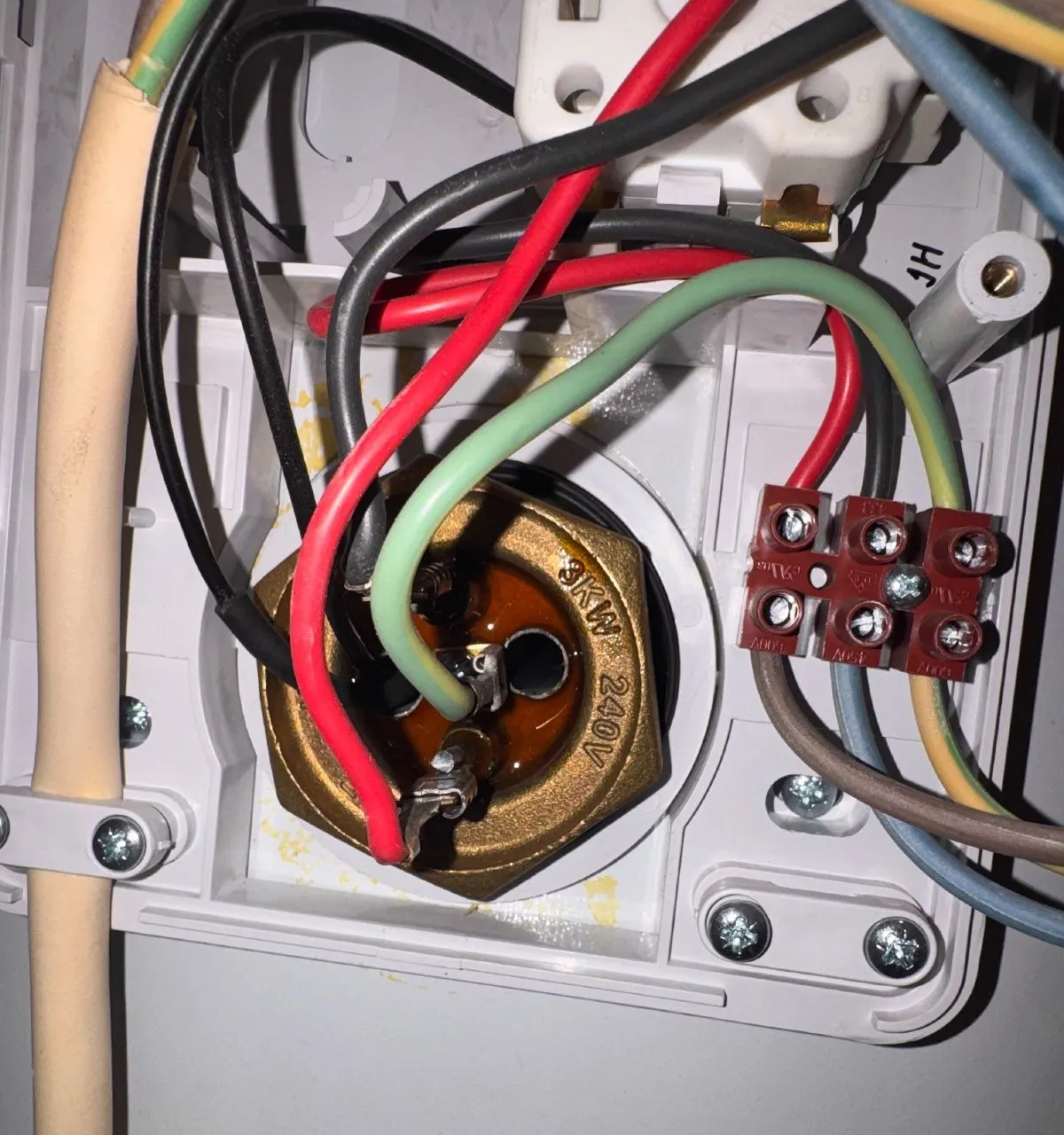
The reset button is a small pin under the thermostat cap. Pushed in lightly until it stops, it resets the over-temperature cut-out. Heatrae Sadia says that should be done by a competent person, after the cylinder has cooled and the reason for the trip has been found.
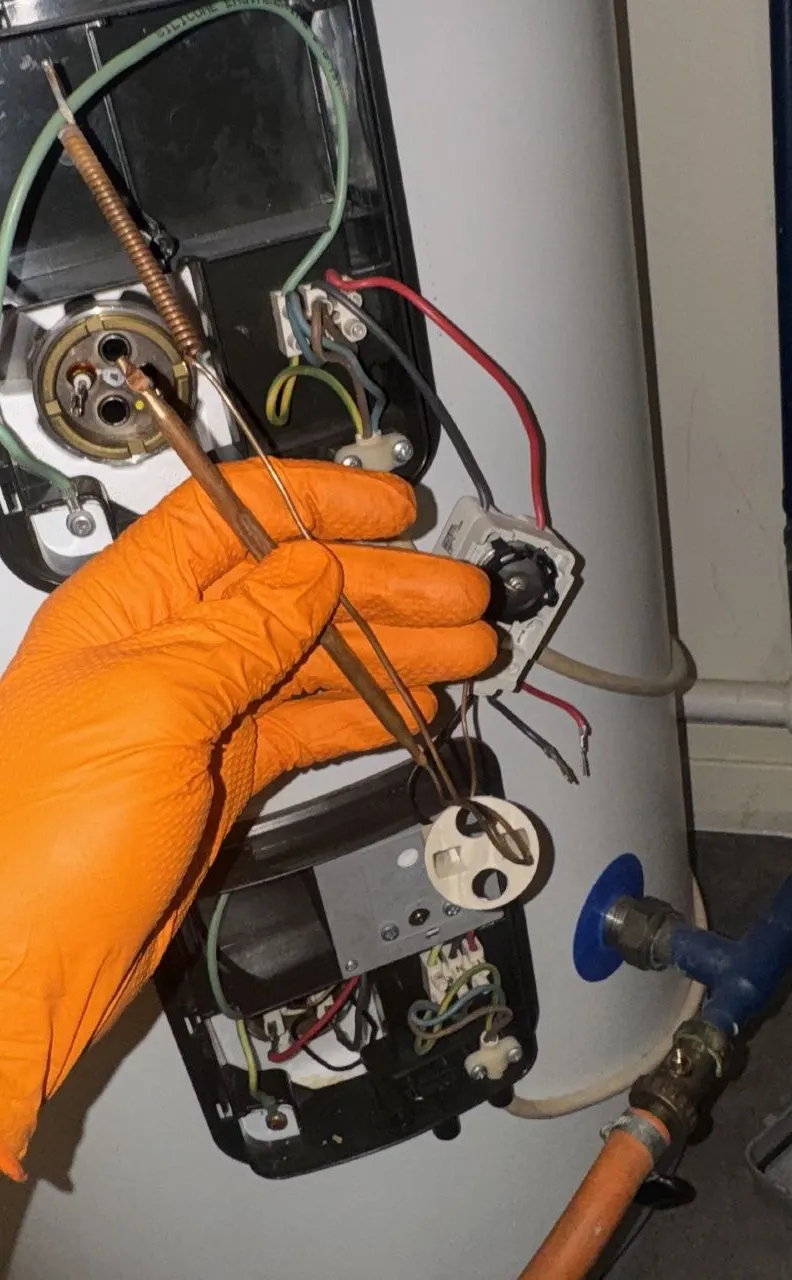
The thermostat sits on top of the element where it screws into the cylinder, under a plastic cap or cover. Inside is a temperature dial and the reset pin. A Heatrae Sadia thermostat is adjustable from 10C to 60C and factory set to 60C. The cut-out is a separate safety device inside the same unit. It operates if the water temperature gets excessive, to stop the cylinder boiling.
This is the sequence an engineer follows, and the reason it matters:
- Switch off at the double-pole switch and at the consumer unit. Prove it dead.
- Wait for the cylinder to cool. Heatrae Sadia's manual says the cause must be investigated and rectified before the cut-out is reset.
- Take the cap off. A tripped pin sits level with, or slightly proud of, the surface.
- Push it in lightly until it stops.
- Refit the cap, switch the power back on and see if the heater runs.
If it trips again, something is wrong. Don't press it repeatedly. Call an engineer to find out why it operated.
Building Regulations back this up. Approved Document G (2024 amendments, para 3.13) says vented hot water storage systems should incorporate a non-self-resetting energy cut-out for all direct heat sources. The manual reset is deliberate. It makes sure a fault gets noticed.
How to Test an Immersion Heater Element
An element is tested by measuring its resistance with a multimeter once the power is isolated and proved dead and the element disconnected. A 3kW element should read roughly 17 to 19 ohms, and an open circuit means it has burned out.
Most elements are around 3kW. Which? describes a typical immersion as "typically 3kW", and Heatrae Sadia rates its element at 2.8kW at 230V and 3.0kW at 240V. The resistance follows from the maths: 230 volts squared divided by 3,000 watts is about 17.6 ohms. Treat that as an approximate figure. Real elements vary a little, and a reading in that area is a healthy element.
What the readings suggest:
- About 17 to 19 ohms: the element's heating coil is intact. The fault is more likely the thermostat or the wiring.
- No reading, or a wildly different one: an open circuit. The element has failed and needs replacing.
- Normal reading, but the breaker trips: the element may still be leaking to earth, which a resistance test across the terminals won't show. An engineer checks earth separately.
We'd leave this to an engineer. The terminals are at mains voltage, the cylinder is full of hot water, and the thermostat has to be matched to the element. Heatrae Sadia's manual says any replacement thermostat must be of the same type.
What a failed element looks like
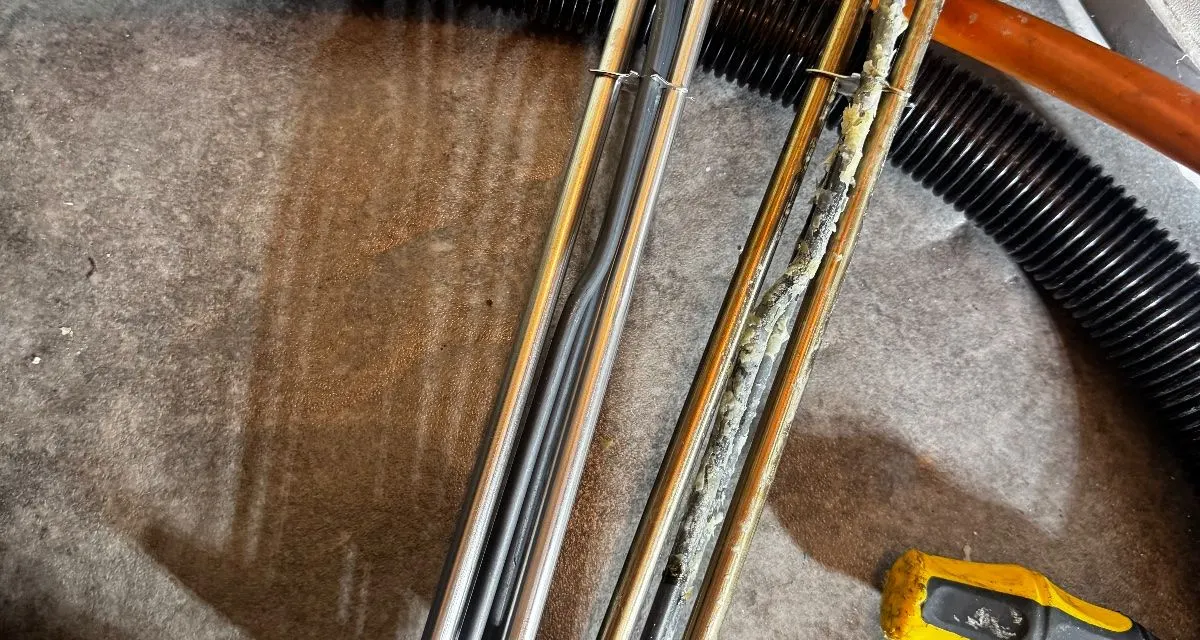
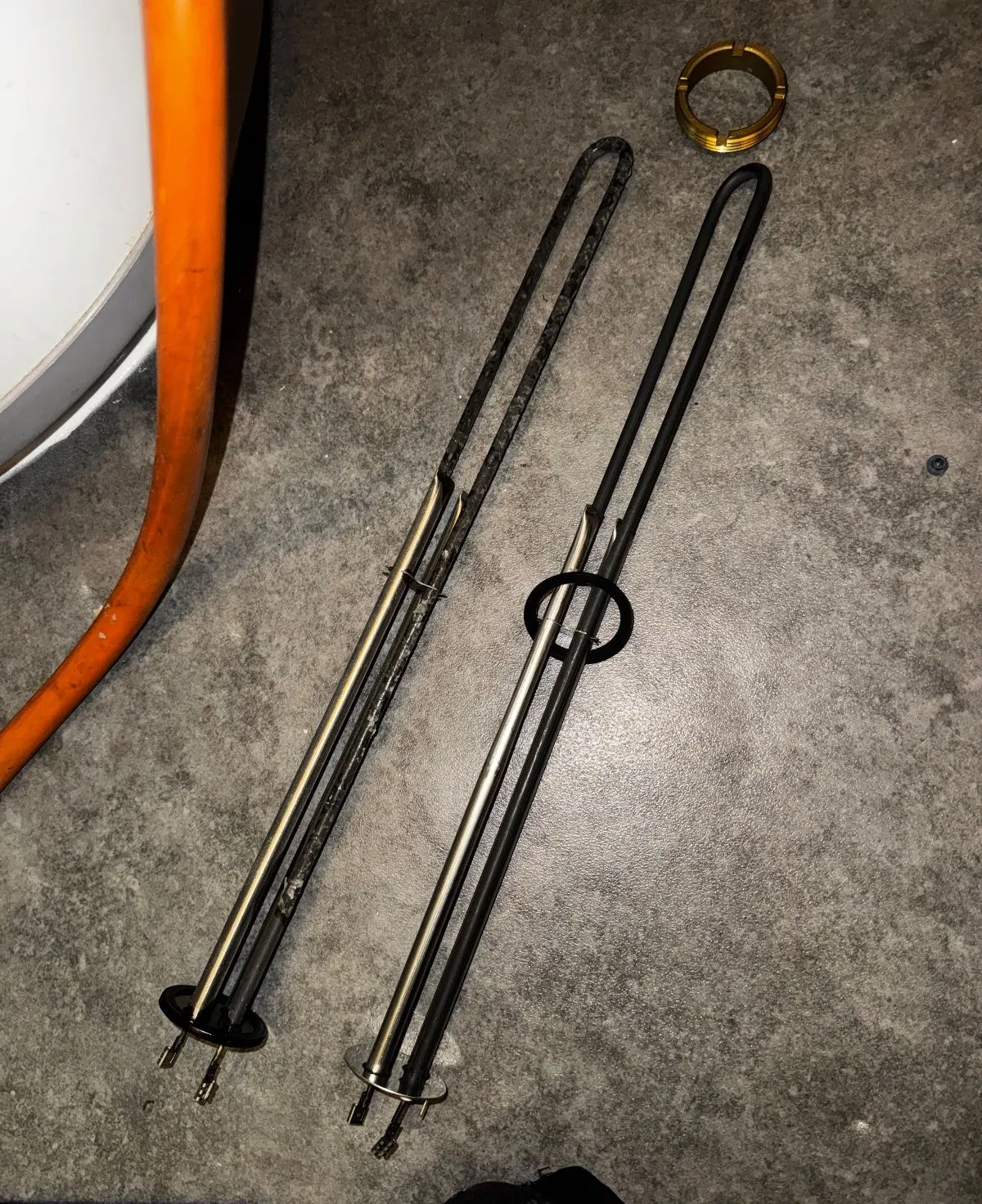
Hard water is the usual reason. Thames Water says most of the water in South-East England is hard, and scale builds up on a hot surface like an element. Scale insulates the element and makes it work harder to push heat into the water, so it runs hotter and heats more slowly. An old element can end up coated along most of its length, and eventually it can burn out. Our guide to hard water and hot water cylinders in London covers prevention.
Scale can also seize the element in the boss. If it won't unscrew with the right immersion spanner, stop. Forcing it risks damaging the cylinder boss, and that turns a small repair into a cylinder replacement.
Immersion Heater Keeps Tripping the RCD
An immersion heater that keeps tripping the RCD almost always has a fault to earth, usually in a worn element or in water that has got into the thermostat housing. Stop resetting it and have it tested.
An RCD trips when current leaks to earth. On an immersion, that tends to be one of these:
- A cracked or scaled element where the heating coil is touching the sheath, leaking current into the water.
- A damp thermostat or terminal housing from a weeping seal or condensation on the boss.
It can trip at once when the immersion switches on, or after a few minutes when the element is hot. Either way, the fix is the same. Switch the immersion off at the double-pole switch, leave it off, and call someone to test it.
Our guide to cylinder thermostat faults explains how to tell a thermostat fault from an element fault.
Is it a Part P job?
Approved Document P (2013, England) says replacements, repairs and maintenance aren't notifiable, but the work must still comply with BS 7671 and be tested. A new circuit or a consumer unit replacement is notifiable. So swapping an element isn't something you report to building control, but it isn't a free-for-all either. If the immersion needs a new circuit, that changes.
How Long Does an Immersion Take to Heat Water?
An immersion heater takes around three hours to heat a 180-litre cylinder from cold to 60C, according to Which?. Smaller cylinders are quicker, and scale or poor insulation slows it.
You can check the scale of this with a rough calculation. Heating 140 litres of water by 50C takes about 140 x 4.18 x 50 = 29.3 megajoules. A 3kW element delivers 10.8 megajoules an hour, so that's about 2.7 hours with no heat lost. Real cylinders lose some, so it takes longer. The same sum for 180 litres gives nearer 3.5 hours, so treat the Which? figure as a rule of thumb.
The time depends on:
- Cylinder size. More water means more energy.
- Starting temperature. A cylinder that's still warm needs far less.
- Scale on the element. A furred element transfers heat badly, so heat-up times creep up over the years.
- Insulation. A cylinder with a good jacket or factory foam holds the heat. A bare one loses it as fast as you put it in.
If yours takes much longer than it used to, scale on the element is the first suspect. It's also worth checking the thermostat. Heatrae Sadia sets them to 60C. HSE's legionella guidance says hot water should be stored at least at 60C and reach 50C at the outlets within a minute. That guidance is aimed at duty-holders such as employers and landlords, not householders, but a thermostat turned right down to save energy will leave the water lukewarm.
When to Call an Engineer
Call an engineer if the element tests as open circuit, if the cut-out or an RCD keeps tripping, if the element is seized or leaking, or if the cylinder is unvented.
Specifically, stop DIY and call if:
- The reset has tripped again after you pressed it once.
- The RCD or breaker trips whenever the immersion comes on.
- The switch light is on but the water stays cold, and the power checks are fine.
- Water is weeping around the immersion boss, or the element won't unscrew.
- You hear bubbling, see steam or have hot discharge from the tundish. Switch off and keep clear.
- The cylinder is unvented. Approved Document G says unvented systems are notifiable unless the installer is on a competent person scheme (3.41 and 3.42). The user notice (3.24) says: "Do not remove or adjust any component part of this unvented water heater; contact the installer". Fixed immersion heaters on these cylinders should comply with BS EN 60335-2-73 (3.43). An unvented cylinder is G3 work: call a G3 engineer.
No Hot Water From Your Immersion?
We test, replace and re-wire immersion heaters, thermostats and cut-outs across all 32 London boroughs, 24/7. £60 call-out fee at any hour for ordinary emergency work, waived for landlords, property managers and scheduled work.
Call 0207 046 1363Or WhatsApp a photo of the thermostat and switch to 07456 975436. For prices, see our guide to immersion heater replacement cost in London. If your cylinder is unvented and you want to know what the rules mean, read G3 unvented cylinders explained.
Frequently Asked Questions
Why is my immersion heater not heating the water?
Where is the reset button on an immersion heater?
How do I test an immersion heater with a multimeter?
Why does my immersion heater keep tripping the RCD?
How long does an immersion heater take to heat water?
Can I replace an immersion heater myself?
Emergency Repairs London provides same-day and 24/7 emergency plumbing and hot water repairs across all 32 London boroughs. Lines are open 24/7 on 0207 046 1363.
Key Takeaways
- A typical immersion element is rated at 3kW, so it should show a resistance of roughly 17 to 19 ohms when tested by an engineer with the power isolated. An open circuit reading means it has failed
- Heatrae Sadia thermostats are factory set to 60C and adjustable from 10C to 60C. HSE guidance for duty-holders (employers, landlords) is to store hot water at 60C or above, not a householder rule
- Heatrae Sadia says the over-temperature cut-out should only be reset by a competent person, after the cylinder has cooled and the cause is found. The reset is a light push on the pin until it stops
- An immersion heater must be wired through a double-pole isolating switch with a 3mm contact gap. Isolate at the switch and the consumer unit, then prove it dead
- Which? says heating 180 litres from 10C to 60C takes around three hours. Scale on the element makes that longer
- Part P does not make repair or replacement notifiable, but the work must still comply with BS 7671 and be tested. An unvented cylinder is G3 work: call a G3 engineer
