Why Do Drains Smell in Summer? London Causes and Fixes
Heat, low river flow and slow trade-effluent breakdown make drains smell worse from June. The London-specific causes, the Thames Water rules, and the real fix.
Central London drains smell worse from late May onward for three reasons stacked on top of each other: warmer water in the combined sewer accelerates anaerobic bacterial breakdown of organic matter (which releases hydrogen sulphide — the rotten-egg smell), Thames flow drops and tidal lock-in extends the time effluent sits in the system, and grease-trap and septic-tank emptying schedules that were set for winter loads cannot keep up with summer footfall in restaurants, hotels and short-let flats. The fix is a combination of cleaning gulleys and traps, switching commercial grease-trap empties from quarterly to monthly through July–September, and (for the residual private tanks in Pimlico, De Beauvoir Town, Crouch End and the rural fringe boroughs) bringing the annual de-sludge forward to May–June rather than autumn.
From mid-May onward, our phone line shifts. Through winter we get burst pipes, frozen condensate, and boilers that lost pressure overnight. From the third week of May until late September, the dominant call becomes some variant of "there's a smell coming from the drain in the back kitchen and it's getting worse." The street might be Lupus Street in Pimlico, Tradescant Road in South Lambeth, Lordship Park in Stoke Newington, Park Road in Crouch End, or one of the rear yards behind Upper Street — but the pattern is identical. Temperatures rise into the high teens, the wind drops, and the drains start announcing themselves.
This guide explains what is actually happening, what is London-specific about it, and what you should do — domestic and commercial — to stop the smell from becoming the defining feature of your summer.
The Three Reasons Summer Is Worse
The summer drain smell is not a single problem. It is three independent mechanisms that compound. They are:
- Higher water temperature in the sewer — accelerates the anaerobic bacterial breakdown that produces hydrogen sulphide (H2S), the molecule responsible for the rotten-egg smell.
- Lower Thames flow and longer dwell time — the volume of dilution water in the combined system drops sharply between June and September, so any odour-producing material stays in the pipe longer before it reaches the treatment works.
- Higher load on commercial premises that have not adjusted their schedules — restaurants, hotels and short-let flats run 30–60% more covers in summer, generating proportionally more grease, food waste and sewage, while most operate the same quarterly empties they set up in February.
Add a fourth, purely domestic driver — the evaporation of water seals in rarely-used traps — and you have most of the calls we take from June onward.
The Hydrogen Sulphide Mechanism
Hydrogen sulphide is the gas you smell when a drain smells "bad". It is produced by sulphate-reducing bacteria (mostly genera Desulfovibrio and Desulfotomaculum) which sit on the inner wall of sewer pipes and on the surface of the sludge layer inside septic tanks. Those bacteria are anaerobic — they live without oxygen — and their metabolic rate roughly doubles with every 10°C rise in water temperature, a relationship chemists call the Q10 coefficient.
In a London context, the temperature of the water flowing through the combined sewer follows the air temperature with a lag of about two weeks. In February, water at trunk-sewer depth is typically around 12°C. By the middle of August it sits closer to 19°C in central zones. That is a 7°C rise, which translates to roughly a 60–70% increase in the rate of hydrogen sulphide production for the same organic load. The same volume of food waste flushed in August produces noticeably more smell than it did in February.
Combine that with the fact that hydrogen sulphide is heavier than air — it pools at floor level rather than dissipating — and you have the precise reason your kitchen sink starts smelling worst when the back door is open on a still hot evening.
Thames Flow and the Tidal Lock-In
Central London's drains are still largely the system that Joseph Bazalgette built between 1859 and 1875 — a combined sewer that carries both rainwater and sewage in the same pipe. Modern infrastructure, including the Thames Tideway Tunnel which became fully operational in 2025, has reduced raw discharges into the river, but the dominant flow logic has not changed. The system depends on a steady supply of dilution water (rain, plus drinking-water leakage, plus river inflow) to keep odours moving downstream toward Beckton and Crossness.
The relevant number is Thames flow at Teddington — the last upstream gauge before the tidal section starts. Through a typical winter that runs at around 80 cubic metres per second (cumecs). By August the median drops to about 25 cumecs. In a dry summer it can fall below 15 cumecs. That is a fivefold reduction in dilution water, and it lines up exactly with the season in which odour complaints peak.
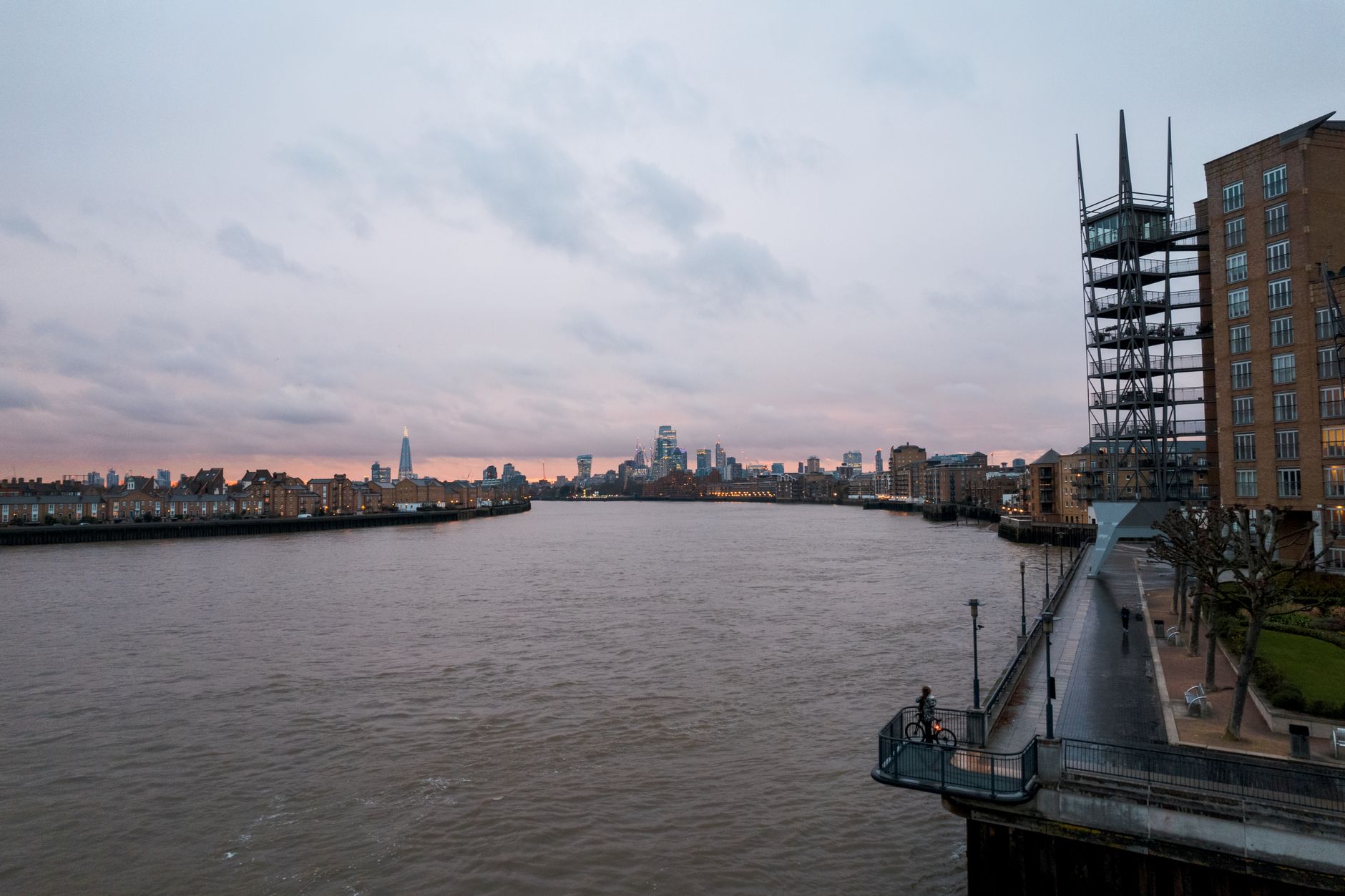
Inside the tidal Thames, the situation is worse. On a slack high tide, the river briefly stops flowing downstream and the brackish boundary creeps west. For central boroughs — Westminster, Lambeth, Southwark, Tower Hamlets — that means effluent in the local combined sewer occasionally backs up against the tide for 30–60 minutes per cycle. During that window, odour-producing residence time inside the system can triple. The Westminster waterfront from Vauxhall Bridge to Battersea Power Station is particularly affected; complaints from Pimlico riverside flats spike on still days with high midday tides.
The Thames Water Trade-Effluent Rule
If you operate a commercial kitchen anywhere inside the Thames Water region, you discharge under a trade-effluent consent. That consent has two practical numbers that matter for summer odour:
- Fat, oil and grease (FOG) limit — typically 100 mg/litre at the point of discharge. A standard 4-burner London restaurant grease trap will hold 30–80 litres of FOG before it starts overflowing into the sewer. Once it does, the FOG line on Thames Water's monthly sample sheet spikes immediately.
- Empty-by-25%-capacity rule — your grease trap must be emptied before it reaches 25% of total capacity by volume. In a 400-litre trap that is 100 litres of accumulated grease. In a busy Warwick Way kitchen running 80 covers a day in July, a 400-litre trap reaches 100 litres in about 4–5 weeks.
The practical implication is straightforward. A quarterly grease-trap contract that works perfectly in February (where covers might run 50 a day) routinely fails in July (where the same kitchen might run 80–110). The trap fills mid-contract, FOG escapes into the local sewer, and by week 10 the smell on the pavement outside is undeniable. Thames Water issues warning letters from £400; formal trade-effluent enforcement starts at £1,200 per breach and rises sharply if the same address re-offends in the same calendar year.
Most kitchens we work with along Warwick Way, Pimlico Road, Upper Street, Borough Market, and the Soho restaurant grid switch to a monthly grease-trap empty from June through September, then drop back to quarterly from October. The annual cost difference is roughly £900 per site — far less than a single enforcement notice.
Empty-Trap Evaporation in Basements and Second Bathrooms
The single most common purely domestic cause of summer drain smell is not a fault at all. It is evaporation.
Every plumbing fixture in your property — every sink, bath, shower, toilet, washing-machine standpipe and floor gulley — has a water trap. The trap holds 50–100 ml of water in a U-bend or P-trap shape, and that water is the only barrier between you and the sewer venting. When water is in the trap, sewer gas cannot rise into the room. When the trap is dry, sewer gas comes straight up the drain into the room.
Through July and August, with kitchen and bathroom windows open, ambient humidity inside a London flat often drops below 40%. A trap holding 75 ml of water with that humidity, plus a slight draught from the open window, can evaporate empty in 7–10 days. Once it is empty, the smell appears overnight.
The classic culprits are: the second-bathroom shower in a townhouse where one person lives alone; the utility-room floor drain that is only used when the washing machine overflows; the basement-conversion shower in a Pimlico, Belgravia or Notting Hill mews flat that hosts short-let guests irregularly; the en-suite toilet in a spare bedroom only used at Christmas; and the kitchen sink in a holiday flat let through Airbnb in alternate weeks.
The fix is one minute of work per week through summer: pour a litre of water down each of those drains, then add a teaspoon of vegetable oil. The oil floats on top of the water and slows evaporation by about 60%. A single application typically holds the seal for three to four weeks.
The Boroughs That Smell First
Not every part of London suffers equally. The five categories of address most likely to complain first are:
- Tidal-lock-affected central waterfront — Pimlico SW1V (riverside Grosvenor Road, Churchill Gardens), Westminster Millbank, Lambeth South Bank, Southwark Bankside, Tower Hamlets Wapping. These addresses lose dilution flow earliest on slack high tides.
- High-density restaurant grids — Soho, Borough Market fringe, Upper Street Islington, Brick Lane, Pimlico Road. Where multiple grease-trap contracts share a single local sewer, one over-capacity trap can taint the whole street.
- Pockets of off-mains drainage in inner London — De Beauvoir Town N1 (Hackney fringe), Crouch End N8 (Haringey), South Lambeth SW8, mews properties behind Cambridge Street and Aylesford Street in Pimlico. Private septic tanks here run hot in summer and need bringing forward from autumn de-sludge to May–June.
- Outer-borough green-belt residential — Hillingdon UB7 / UB9 around Heathrow and Harefield, Bromley BR1 / BR2 / BR5, Havering RM4 / RM14 rural fringe, Bexley DA17, Croydon CR5 / CR3 fringe. These addresses sit on cesspits and small treatment plants that all benefit from late-spring servicing.
- Listed Victorian terraces with cast-iron internal stack pipes — Westminster, Kensington & Chelsea, Camden, Islington conservation areas. Cast iron corrodes from the inside as anaerobic acid attack accelerates with heat; pinhole leaks high on the stack often appear first as a faint smell upstairs in June.
What to Do — Domestic and Commercial
If you are a London homeowner or tenant:
- Walk the property and flush every drain — sink, bath, shower, toilet, floor gulley, washing-machine standpipe — with a litre of water once a week through July, August and the first half of September.
- Add a teaspoon of vegetable oil on top of each U-bend trap to reduce evaporation. Re-apply monthly.
- If a single drain smells persistently after you have refilled the trap, the issue is downstream — either a partial blockage producing trapped solids, a faulty soil-vent pipe terminating below the roofline, or (for properties on private drainage) a tank near the end of its emptying cycle.
- For properties with a septic tank or cesspit, bring the annual de-sludge forward to May or June rather than the more common October booking. A tank emptied in late spring runs noticeably cleaner through the peak odour months.
If you operate a commercial kitchen, hotel, or short-let portfolio:
- Audit your grease-trap contract before 1 June. If it is quarterly, switch the July–September block to monthly empties. Renegotiate the annual price as a bundled monthly/quarterly mix.
- Confirm the volume of fat, oil and grease your trap is currently producing. Thames Water's online trade-effluent portal shows your last six sample readings; if FOG is creeping above 70 mg/litre in any month, you are at risk of breach.
- For hotels and short-let blocks, schedule a 30-minute monthly walk-through of every guest bathroom and kitchenette to flush traps that may have evaporated empty between bookings.
- Document everything. The Section 34 duty-of-care waste transfer note from every grease-trap empty is the same paperwork Thames Water's inspectors ask for during an enforcement visit. Keep it for two years minimum.
When to Stop Spraying Air-Freshener and Call a Plumber
Most summer drain smells resolve with a refilled trap, a flushed gulley, or a brought-forward tank empty. There are four situations where you should not try to fix it yourself:
- The smell is concentrated outside on the pavement, especially near a gulley or manhole cover. That usually means a blocked or partially collapsed lateral connection between the building and the main sewer. A CCTV drain survey takes 60–90 minutes and locates the issue precisely.
- The smell appears suddenly across multiple rooms after heavy rain. That points to a flooded lateral or a back-surcharge from the combined sewer — both require immediate investigation to prevent contamination of internal floor structures.
- Toilets gurgle when sinks drain elsewhere in the property. This is the classic sign that the soil-vent pipe is blocked. The smell follows because waste gas cannot vent at the roof, so it vents through the nearest open trap.
- The smell is accompanied by visible damp patches on internal walls, particularly on the side of the building facing the main soil stack. Cast-iron pinhole failures on Victorian properties leak both water and gas; you need a stack inspection.
The Regulatory Backdrop You Should Know
Three pieces of regulation set the boundaries of what landlords, tenants and commercial operators have to do about drain odour. None of them are obscure; all three are routinely referenced in disputes.
- Building Regulations Part H (2010 amendment, in force across England) — requires every internal drainage system to be ventilated through a soil-vent pipe terminating at least 900mm above any window within 3 metres. Most pre-1965 conversions in central London do not comply, which is one reason older Victorian terraces smell more in summer than newer-build apartments.
- Environmental Protection Act 1990 section 79(1)(d) — defines drain or sewer odour as a statutory nuisance. A neighbour, tenant or local authority environmental-health team can serve an abatement notice; failure to comply is a criminal offence with fines from £5,000 per occurrence.
- Thames Water's trade-effluent consent (issued under the Water Industry Act 1991 and amended by the 2014 Water Act) — sets the FOG, suspended-solids, pH and dissolved-oxygen limits for commercial discharges. Breach triggers a written warning at first instance, formal enforcement and fines from £1,200 from the second.
None of this is unusual or punitive — it is the framework that keeps central London's combined sewer functional through 35°C heatwaves and 25-cumecs Thames flow. Working with it (and not against it) is the difference between a smell-free summer and a £5,000 invoice.
If your drains have started speaking to you and you cannot identify the source, the simplest first step is a phone call. Most causes are diagnosable inside ten minutes from a description, and most fixes — for both homes and commercial premises — are cheaper in May than in August.
Key Takeaways
- Water in the London combined sewer warms from ~12°C in February to ~19°C in August — that doubles the rate of anaerobic breakdown that releases hydrogen sulphide
- Thames flow at Teddington drops from a winter median of ~80 cumecs to ~25 cumecs in August, extending the dwell time of effluent in the system by 2–3x
- Restaurants on Warwick Way, Pimlico Road, Upper Street and the Borough Market fringe see 30–60% more covers June through August — grease-trap volumes rise proportionally but contracts often stay quarterly
- Bazalgette's combined sewer carries both rainwater and sewage; in dry summers there is no rain dilution and odours concentrate at trap and gulley level
- Empty-trap evaporation in seldom-used basement showers, utility-room floor drains and second-bathroom toilets is the single most common domestic cause — water seal disappears in 7–10 days of summer heat
- Thames Water trade-effluent consents require monthly grease-trap empties for any kitchen producing more than 60 litres of fat-oil-grease per month — a number most central London kitchens cross in July
- London Building Act 1939 section 65 and the more recent 2010 Building Regulations Part H still require all internal drainage to be ventilated through a soil vent pipe terminating above the roofline
