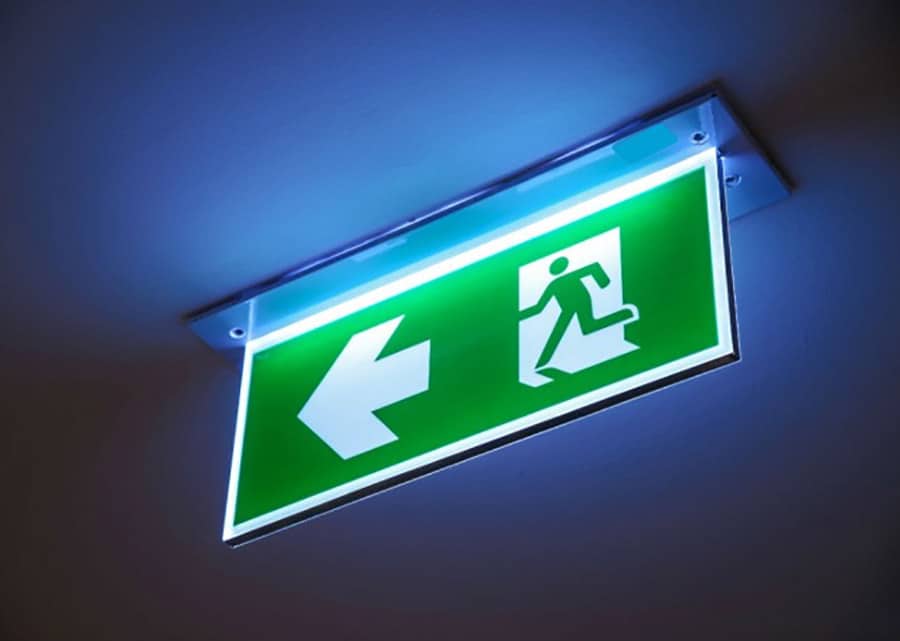
The Annual 3-Hour Discharge Test: Why and How It's Done
Step-by-step explanation of the annual emergency lighting full duration test under BS 5266 — what the engineer actually does, what the certificate must show, and what happens if a luminaire fails the discharge.
The annual 3-hour discharge test is a full-duration emergency lighting test required by BS 5266-1 and BS EN 50172. Every self-contained luminaire and central battery system is isolated from its normal supply for the full rated duration (3 hours is standard for escape-route and open-area fittings in most London commercial and HMO properties), and each fitting must remain at or above its rated output for the entire period. The certificate must record the test date, the duration achieved by each circuit or fitting, any failures, the actions taken, the next test date, and the name and signature of the competent person. Call Emergency Repairs London on 0207 046 1363 or WhatsApp 07456 975436 to book.
Of all the fire-safety compliance items a London landlord, managing agent or commercial Responsible Person has to keep on top of, the annual 3-hour discharge test is the one most often skipped, deferred, or quietly substituted with a 30-second flick of the test key. It is also the only test that actually proves the emergency lighting system will do its job during a real mains failure. The monthly function test confirms that the lamp lights; the annual discharge confirms that the lamp will still be lit, at rated output, three hours into a power cut at 11pm in February when the building is full of people trying to find a fire exit.
This article is the practical walk-through: what the test is, why it is 3 hours, exactly what the engineer does when they arrive on site, what the certificate has to record, and what happens when a luminaire fails. It is written from the field experience of running this test across the 32 London boroughs — HMOs in Tower Hamlets, leasehold blocks in Camden, small offices in EC1, restaurants in Soho, and licensed premises across the West End.
What the 3-Hour Discharge Test Actually Is
The annual full-duration discharge test is the obligation set out in BS 5266-1:2016 + A1:2022 (the Code of Practice for the emergency lighting of premises) and reinforced by BS EN 50172:2004 (the European standard for emergency escape lighting systems). Both standards require that, once every 12 months, every self-contained emergency luminaire and every central-battery-fed luminaire is operated on its battery supply alone for the full rated duration of the system, and that each fitting is verified to remain at or above its rated lumen output for the whole of that period.
The rated duration is whatever the system was designed and certified to — most commonly 3 hours in the UK, occasionally 1 hour in small and tightly-scoped premises. The test does not pass if the lamp is "still lit but dim" at the end of the duration; the requirement is that the fitting remains at rated output, not at "something visible."
Crucially, this is a destructive test on the battery in the sense that it fully discharges it. After the test, the system needs a recharge window — typically 24 hours to return to a full state of charge for a healthy battery — and the premises are not considered to have full emergency lighting cover during that recharge period. That has practical scheduling consequences that we cover further down.
Why 3 Hours — and Where 1-Hour Applies
The 3-hour duration is the default in BS 5266-1 for the vast majority of premises types: shops, offices, restaurants, bars, HMOs, residential blocks, hotels, care premises, places of assembly, and any premises where occupants may remain in the building for an extended period after a mains failure (for example because they are residents, or because the building requires extended evacuation time, or because the local fire authority requires it).
The 1-hour duration is permitted only where:
- The premises is small and the escape routes are short
- The building will be fully evacuated within 1 hour of a mains failure
- The system is then allowed to recharge before re-occupation
In practical London terms, almost everything we test is on a 3-hour duration. The original commissioning certificate states the design duration, and every luminaire carries a label or a moulded marking indicating its rated duration (commonly "3h" or "1h" inside a circle near the test-key port). If those references disagree, the engineer's first job is to resolve which one governs the system — typically by reference to the original fire risk assessment under the Regulatory Reform (Fire Safety) Order 2005 and PAS 79.
Not sure what duration your system is rated to? Send a photo of one of your emergency luminaires and a photo of the fire log book to WhatsApp 07456 975436 and we will tell you inside the hour. If it is overdue, we can usually book the test the same week.
Before the Engineer Arrives — Preparation
A small amount of preparation makes the difference between a 4-hour visit and a 6-hour visit:
- Identify the system type — self-contained luminaires (each fitting has its own battery) or central battery system (CBS — a central inverter feeds all the fittings). The procedure differs.
- Locate the test key or test switch — for self-contained systems with a key-switch test facility, the key or switch position must be accessible. For systems with a building-wide test switch in the consumer unit or distribution board, the engineer needs safe access to it.
- Pull the previous certificate and the fire log book — so the engineer can confirm the asset register matches what is actually on the wall, and so any luminaires added or removed since the last test are flagged.
- Notify occupants — the test deliberately turns off mains supply to the luminaires for 3 hours and is best done after the building is closed for the day. Residents in HMOs and blocks of flats should be told the test is happening so they understand the lighting is being deliberately switched.
- Have a recharge window agreed — the building does not have full emergency lighting cover for roughly 24 hours after the test. This matters most in 24/7 premises and licensed late-night venues; the test is then staged so that not every fitting on a single escape route is offline at once.
The Test Procedure, Step by Step
For a typical self-contained system in a London commercial or residential block, the procedure runs as follows:
- Visual inspection of every luminaire — physical damage, clean lens, correct mounting, no obstruction, charging indicator showing healthy green. Any luminaire with a flashing or red indicator is flagged before the discharge begins.
- Verify the asset register — every fitting on the original commissioning certificate is checked off against what is physically present. Missing fittings, added fittings and re-located fittings are recorded.
- Initiate the discharge — by operating the test key on each fitting, or by switching the dedicated emergency lighting test switch (where the wiring uses a key-switch or a fireman's switch arrangement), or by isolating the supply to the lighting circuits at the distribution board for centrally-tested systems.
- Record the start time — to the minute. The 3 hours runs from the moment the mains is removed, not from the moment the engineer notes it down.
- Walk the building at intervals — typically at 30 minutes, 1 hour, 2 hours and 3 hours. At each interval the engineer confirms every fitting is still lit and at rated output. Photographs and lux meter readings are taken on escape routes where the certificate or the fire risk assessment requires illuminance evidence.
- The 3-hour reading — at exactly 3 hours from the start, every fitting is checked again. A fitting that is dim, flickering or extinguished is logged as a failure with its location, fitting reference and observed failure mode.
- Restore mains supply — the test key is released or the supply is re-energised. Every fitting's charging indicator is observed to return to a healthy state.
- Record and certify — the certificate is completed on site, the fire log book is signed and dated, and any failures and remedial actions are recorded.
For central battery systems the procedure is the same in principle but the discharge is initiated and monitored at the central inverter, and the lux readings on the escape routes become the primary verification mechanism rather than per-fitting inspection.
What the Certificate Must Show
BS 5266-1 and BS EN 50172 set out the minimum content of the test certificate. A certificate that is missing any of the following items is not, strictly speaking, a compliant record:
- The address of the premises and the part of the building tested
- The date of the test
- The duration achieved by the system (3 hours, 1 hour, or the actual measured duration if the system failed early)
- An asset register or schedule of luminaires tested, by location and reference
- The result for each luminaire — pass or fail, with failure mode where applicable
- The remedial action taken or recommended for any failure
- The date of the next scheduled test (12 months from this test)
- The name, signature and qualifications / registration of the competent person who carried out the test
- The name of the company carrying out the test, with insurance details available on request
For London landlords and managing agents the certificate is the single document that the London Fire Brigade, the Local Authority licensing officer (for HMOs and Houses in Multiple Occupation), or an insurer will ask to see in the event of a fire or an inspection. A test that was done well but documented badly is, for compliance purposes, the same as a test that was not done at all.
What a Failure Looks Like and What Happens Next
Failures fall into a small number of patterns:
- Battery exhaustion before 3 hours — the most common. The lamp dims and then extinguishes somewhere between the 90-minute and 2.5-hour mark. The fix is a replacement battery pack — usually a NiCd or NiMH stick that clips into the fitting body. We carry the common Hugo Brennenstuhl, Channel, Aurora and JCC battery packs on the van.
- Lamp failure — the LED has failed entirely, or in older fluorescent fittings the tube has reached end-of-life. Replacement of the lamp or the LED module.
- Driver failure — the fitting briefly illuminates on discharge then drops out within seconds because the emergency driver electronics have failed. Replacement of the driver or, for older fittings where the driver is not separately serviceable, replacement of the whole fitting.
- Charging fault — the fitting passes the discharge once but the green charging indicator does not return to healthy when mains is restored. Diagnosis of the charging circuit, typically a failed charging board.
- Missing or damaged fittings — a luminaire on the original commissioning schedule has been removed, painted over, or damaged by works. The Responsible Person must reinstate cover.
Under the Regulatory Reform (Fire Safety) Order 2005, the Responsible Person has a positive duty to maintain general fire precautions — which explicitly includes emergency escape lighting. A known failure that is not rectified is not a paperwork issue; it is a regulatory breach. The fire authority's enforcement powers run from informal advice through enforcement notices to prohibition notices that can close premises.
If we find failures, we rectify on the visit wherever possible. Battery packs and lamps are standard van-stock. Drivers and full-fitting replacements may need a follow-up appointment, but the failed location is logged, the interim risk is recorded for the fire risk assessment, and the re-test is scheduled. Call 0207 046 1363 or email [email protected] to book the annual test before the certificate expires.
Scheduling and Recharge Windows
BS EN 50172 recommends that the annual discharge test is carried out at a time when the premises is least at risk during the recharge period — practically, end-of-day for an office or shop, late evening for a restaurant once service has ended, or staged across multiple visits for residential and 24/7 premises so that escape routes are never wholly without cover.
For a typical block of flats in Camden or a HMO in Newham, the staging looks like: half the luminaires on each escape route are discharged on Visit A; the other half on Visit B once the first set has recharged for at least 24 hours. The fire risk assessment under PAS 79 should specify the staging approach for any premises where a single visit would leave an escape route without cover.
Common Mistakes We See in London Properties
- Substituting the monthly flick test for the annual discharge — by far the most common. The monthly test proves the lamp lights; it does not prove the battery delivers duration. They are not interchangeable.
- Stopping the discharge early — "the lamp is still on at 30 minutes so we are fine." No: the test must run to the full rated duration.
- Not recording per-fitting results — a certificate that says "all fittings tested, all pass" without a schedule is not a compliant record under BS 5266-1.
- Testing during occupancy — leaving the building without emergency lighting cover for the recharge period while occupants are still inside.
- Ignoring fittings added after commissioning — a kitchen extension, a re-modelled stairwell, a converted basement: any change to the building fabric should trigger an update to the emergency lighting design and the asset register.
- Treating the test as separate from the fire alarm regime — emergency lighting compliance under BS 5266 sits alongside fire alarm compliance under BS 5839-6 (for domestic and HMO premises) or BS 5839-1 (for non-domestic premises). Both regimes feed into the same fire risk assessment under PAS 79 and the same Responsible Person duties under the RRO 2005. See also our schedule for fire alarm testing across the year and our full breakdown of BS 5266 for London landlords.
If you are a landlord, freeholder or managing agent and you are uncertain whether your last annual discharge test is recorded properly — or whether one was ever done — book a compliance audit through our landlord compliance hub. We will pull the log book, cross-check it against BS 5266, BS 5839-6, PAS 79 and the RRO 2005, and tell you what is in date, what is overdue, and what needs rectifying before the next licensing renewal or inspection.
FAQs
The FAQ section at the foot of this page (rendered from the schema above) covers: what the annual 3-hour discharge test is, why the duration is 3 hours, whether a 1-hour test is ever acceptable, what happens when a luminaire fails, when in the day the test should be run, and who counts as a competent person to sign it off.
Book the test before the certificate expires. Call 0207 046 1363, WhatsApp 07456 975436, or email [email protected]. We test self-contained and central-battery emergency lighting across the 32 London boroughs and rectify failures on the same visit wherever possible.
— John Alexander N. - Emergency Repairs London
Key Takeaways
- The annual 3-hour discharge test (also called the full-duration or annual full-rated test) is required by BS 5266-1 and BS EN 50172 once every 12 months
- It is the only test that proves the battery can actually deliver its rated duration — the monthly 'flick test' only proves the lamp lights up
- Every escape-route and open-area luminaire must remain at or above its rated lumen output for the full 3 hours; the test cannot be cut short
- The premises must be re-occupied or recharged before the property can be considered safe again — most engineers schedule the test for end-of-day so the recharge happens overnight
- A failed luminaire is not optional rework — under the Regulatory Reform (Fire Safety) Order 2005 the Responsible Person must rectify and re-test before the next occupancy event
- The certificate must be retained in the fire log book and made available to the London Fire Brigade or the Local Authority on request
- For HMOs, blocks of flats, and commercial premises, this annual test is the single most common item missed in pre-letting and licensing compliance
