BS 5266 Emergency Lighting — A Landlord's Guide
BS 5266 plus BS EN 50172 explained for London landlords managing properties with escape route lighting. What to test, when, how to record it, and what enforcement looks like.
BS 5266-1 is the UK code of practice for emergency escape lighting in non-domestic premises and the common parts of HMOs and blocks of flats. It sits alongside BS EN 50172 (which sets the testing regime) and is enforced through the Regulatory Reform (Fire Safety) Order 2005 and the landlord's fire risk assessment under PAS 79. Landlords are required to carry out a monthly visual function test, an annual full 3-hour discharge test, and to keep a written log available for the fire authority. Emergency Repairs London carries out BS 5266 testing, certification and remedial works across all 32 London boroughs — call 0207 046 1363 or WhatsApp 07456 975436.
Emergency lighting is the part of the fire safety regime that gets the least attention until an inspector asks for the logbook. Then it becomes the single fastest way to fail a fire risk assessment. The standard is BS 5266-1, the testing schedule is BS EN 50172, and both are enforced through the Regulatory Reform (Fire Safety) Order 2005 with the landlord's PAS 79 fire risk assessment as the working document. This page is the working landlord's guide to what each of those means in practice, what you must test, when, who can do it, and what the London Fire Brigade actually looks at when they walk through a building.
If you manage a London HMO, a converted block of flats, a small commercial unit or a mixed-use property with a residential entrance, the regime below applies to you. The Responsible Person under Article 3 of the RRO 2005 cannot delegate the legal duty — only the work.
What BS 5266 Actually Is
BS 5266-1:2016 is the British Standard Code of practice for the emergency lighting of premises. It defines two functional categories that landlords need to understand:
- Escape route lighting — illuminates the path of escape from any point in the building to a place of ultimate safety outside it. Stairwells, corridors, exit doors, changes of direction, intersections, final exits.
- Open area (anti-panic) lighting — illuminates rooms larger than 60m² or any space where occupants might be disoriented in the dark, so they can reach the escape route safely.
The standard sets minimum illuminance levels (1 lux on the centre line of an escape route, 0.5 lux in open areas), maximum response time (luminaires on full output within 5 seconds of mains failure, full output within 60 seconds), and a minimum duration of three hours for most non-domestic premises and the common parts of HMOs.
Three hours is the figure most landlords know but few understand. It exists because the standard assumes that, after a mains failure caused by fire, the building may not be re-entered for the full evacuation, fire service operation and any subsequent investigation window. Battery-backed luminaires must hold their rated output for the full three hours — not 90 minutes, not "long enough to evacuate".
The Legal Framework — RRO 2005, PAS 79, BS EN 50172
The legal framework sits in three layers, and you need all three on file:
- Regulatory Reform (Fire Safety) Order 2005 — the statute. Article 14 requires emergency routes and exits to be illuminated; Article 17 requires the premises and any facilities, equipment and devices provided to be maintained in efficient working order and good repair. The Responsible Person is criminally liable for breach.
- PAS 79-1:2020 (residential) / PAS 79-2:2020 (non-domestic) — the published methodology for a fire risk assessment. The FRA is the document that records which emergency lighting is needed where, based on the building's geometry, occupancy and risk profile. Without an FRA there is no documented basis for the emergency lighting design at all.
- BS EN 50172:2004 / BS 5266-8 — the European standard adopted into UK use, which sets the testing intervals (monthly function test, annual full-duration test) and the requirement to keep a logbook. This is the document an inspector quotes when they ask for the records.
If you have an FRA done under PAS 79 that lists emergency lighting as a control measure, you are legally on the hook for the BS 5266 / BS EN 50172 regime. There is no quiet way out of it.
Need a quote for annual BS 5266 testing on a London property? Call 0207 046 1363 or WhatsApp 07456 975436 — we cover all 32 London boroughs with a fixed-fee schedule and same-week appointment availability.
Where Emergency Lighting Is Required
BS 5266-1 is non-domestic in scope but the RRO 2005 extends the duty to the common parts of premises that contain dwellings. In practice this catches:
- HMOs licensed under the Housing Act 2004 — every London borough licences large HMOs and most licence smaller ones
- Converted and purpose-built blocks of flats — the stairwells, corridors and lobbies, not the individual flat interiors
- Mixed-use buildings — flat above a shop with a shared residential entrance
- Commercial premises — offices, restaurants, retail, workshops, gyms, salons
- Care, sheltered and supported housing
- Any building where the fire risk assessment concludes that mains failure during an evacuation would put occupants at risk
The single-family rented house (a tenancy under the Housing Act 1988, not licensed as an HMO) is the main exclusion. Even there, smoke and heat alarms under the Smoke and Carbon Monoxide Alarm (England) Regulations 2015 still apply.
The Testing Regime — Monthly & Annual
BS EN 50172 sets the schedule and the schedule has two intervals:
Monthly function test. Every luminaire and every illuminated exit sign is briefly switched to battery (typically by operating the test key switch or, on older installations, by isolating the local circuit). The test confirms the lamp illuminates and the changeover happens. Duration is short — 5 to 30 seconds is normal. Any luminaire that does not illuminate, illuminates dimly, or shows a fault LED is recorded in the logbook and scheduled for repair.
Annual full-duration test. The entire system is switched to battery and held there for the full rated duration — three hours for most premises. Every luminaire must hold its rated illuminance for the full duration. Battery packs that drop below specification before the three hours are up are recorded as failures and replaced. The system is then returned to mains and recharged (a full recharge takes 24 hours, during which the emergency function is effectively absent — most contractors schedule the test for early in a working day so the recharge is complete before the building is unoccupied overnight).
The monthly test can be done by any competent person nominated by the Responsible Person; the annual test should be done by a competent electrical contractor who can issue a signed certificate and update the logbook to standard. We cover both at the BS 5266 emergency lighting testing service page.
The Annual 3-Hour Discharge Test
The 3-hour test is the one that catches landlords out, because it is the only test that genuinely proves the system works for the full duration the standard requires. A monthly 30-second flash tells you the lamp is in circuit and the relay changes over. It tells you nothing about the battery's actual remaining capacity.
Battery degradation is progressive. A NiCd or NiMH pack that gave a clean three hours in year one will typically give two-and-a-half by year three and may fail entirely in year four or five. The annual test is what detects this trajectory before it becomes an inspection failure or, worse, an actual fire where the lighting fails twenty minutes into the evacuation.
For a longer walk-through of what the annual test looks like on a typical London block, including the timing, the documentation and the common failure modes, see our companion article on the 3-hour discharge test.
Records, the Logbook & What Inspectors Ask For
BS EN 50172 requires a logbook to be kept on the premises. The logbook records:
- The date the system was commissioned and the commissioning certificate reference
- The date of each monthly function test and the result for each luminaire (or an "all luminaires tested, all pass" entry if the inspection sheet supports it)
- The date of each annual 3-hour discharge test, the engineer's name and registration, the test result, and any failures rectified
- Any defects identified between tests and the date of rectification
- Any modifications to the installation (added luminaires, replaced battery packs, circuit changes)
An inspector from the London Fire Brigade or a local authority fire safety officer will ask for the logbook before they look at anything else. A missing or sparse logbook is treated as evidence that the testing regime is not actually being run, regardless of what the engineer's certificates say.
The logbook can be paper or digital. We supply a digital logbook with the annual certificate as standard; landlords who prefer paper get a printed copy on request.
Common Failures and Remedial Work
The faults we see most often on London inspections, in rough order of frequency:
- Battery pack at end of service life — the single most common failure. NiCd and NiMH packs last 4-5 years; LiFePO4 packs (newer installations) last 8-10 years. Replacement is a same-day job per luminaire.
- Failed lamp on a non-LED luminaire — fluorescent tubes age and the inverter ballast stops striking them. Most older installations are being progressively retrofitted to LED.
- Test key switch broken or missing — without it the monthly function test cannot be performed without isolating the circuit at the consumer unit.
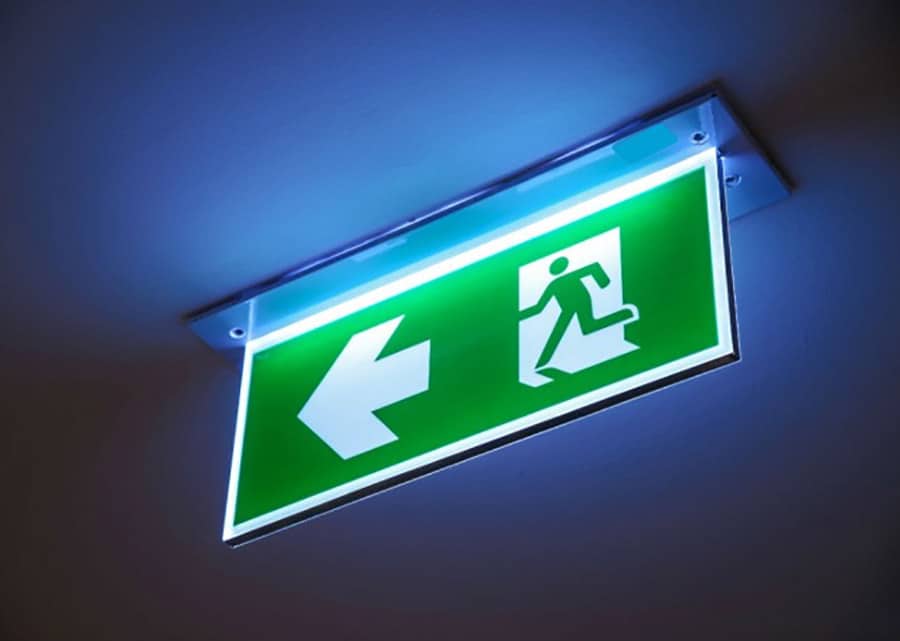
- Exit sign legend faded, dirty or obscured — BS 5266 sets minimum luminance and contrast for the pictogram; a faded green-running-man over a stairwell door is a fail.
- Luminaire installed but not on the FRA inventory — common after a small refurbishment. The installation is fine; the documentation is not.
- No luminaire where one is required — typically at a change of direction in a long corridor, at the foot of a stair, or above an external final exit. This is a design-level remediation, not a battery swap.
Defects must be rectified without undue delay. The phrase is not defined in days in the RRO 2005, but the working interpretation is that an unlit escape route in an occupied building is an immediate-action item; a single failed luminaire on a redundant section can run to the next test cycle if the FRA agrees.
Found a failed luminaire on your monthly walk? Email [email protected] with the address and a photo, or call 0207 046 1363 — same-week rectification across London.
Self-Test and Addressable Systems
Two newer technologies are common on London installations completed in the last decade:
Self-test luminaires run their own monthly function test on an internal timer and signal a fault by flashing an LED on the luminaire body. They reduce the manual monthly walk to an inspection of the LEDs rather than a key-switch operation. They do not replace the annual full-duration test — BS EN 50172 still requires a documented three-hour discharge, and the engineer's certificate is what the inspector wants to see.
Addressable systems connect every luminaire to a central panel over a data bus and report status, including a programmable full-duration test that the panel logs automatically. The panel printout is excellent evidence and we accept it as part of the annual records — but a competent contractor still needs to verify the printout against the physical luminaires and issue a signed certificate. The panel report is a supplement, not a substitute.
What Enforcement Looks Like in London
Enforcement runs through three routes. The London Fire Brigade Fire Safety team carries out audits under the RRO 2005 and can issue an Enforcement Notice or, for an imminent risk, a Prohibition Notice closing the premises. The local authority housing team inspects HMOs and licensed properties and uses the Housing Health and Safety Rating System (HHSRS) to score fire-safety failures — a category 1 hazard on means of escape triggers mandatory enforcement. The local authority building control team picks up emergency lighting on new conversions and material alterations.
The pattern we see on enforcement notices is consistent: missing or out-of-date logbook, no annual certificate, failed luminaires not rectified, or an installation that does not match the FRA inventory. Almost never is the issue a technically defective design — it is always documentation and maintenance.
Penalties under the RRO 2005 are unlimited fines on conviction and, for the most serious breaches, up to two years' imprisonment. Insurance cover for a fire-related loss is also routinely refused where the emergency lighting regime has not been maintained — the policy wording will reference compliance with the relevant British Standards.
For the wider compliance picture — gas, electrical, fire alarm, EPC, legionella, emergency lighting — see the landlord compliance hub, which sets out the full annual calendar and the standards that govern each item.
FAQs
The FAQ section below the article body covers whether BS 5266 is legally binding, how often testing is required, who can carry it out, what happens on a failed 3-hour test, whether self-test luminaires remove the annual requirement, and what annual testing costs for a typical London HMO.
If you are due an annual BS 5266 discharge test, or you have inherited a property with no logbook and no recent certificate, call 0207 046 1363 or WhatsApp 07456 975436. We cover all 32 London boroughs, hold NICEIC registration on the electrical side, carry £5m Public Liability cover, and bundle BS 5266 with BS 5839 fire alarm testing where both are due — see also our schedule guide on fire alarm testing for landlords.
John Alexander N. — Emergency Repairs London
Key Takeaways
- BS 5266-1 is the UK code of practice for emergency escape lighting; BS EN 50172 sets the testing schedule that the standard relies on
- The Regulatory Reform (Fire Safety) Order 2005 is the legal hook — the Responsible Person must ensure emergency lighting is provided, maintained and recorded
- Monthly: short-duration function test of every luminaire and exit sign (typically 5-30 seconds)
- Annually: full 3-hour discharge test under simulated mains failure, with results logged and certified
- A written log of tests, defects and rectifications must be kept on site and produced on demand to the London Fire Brigade or local enforcement officer
- Self-test and addressable systems still require a documented annual discharge — the panel printout is evidence, not a substitute for the test itself
- Failed luminaires must be rectified without undue delay; an unlit escape route in an occupied HMO is an immediate enforcement risk
