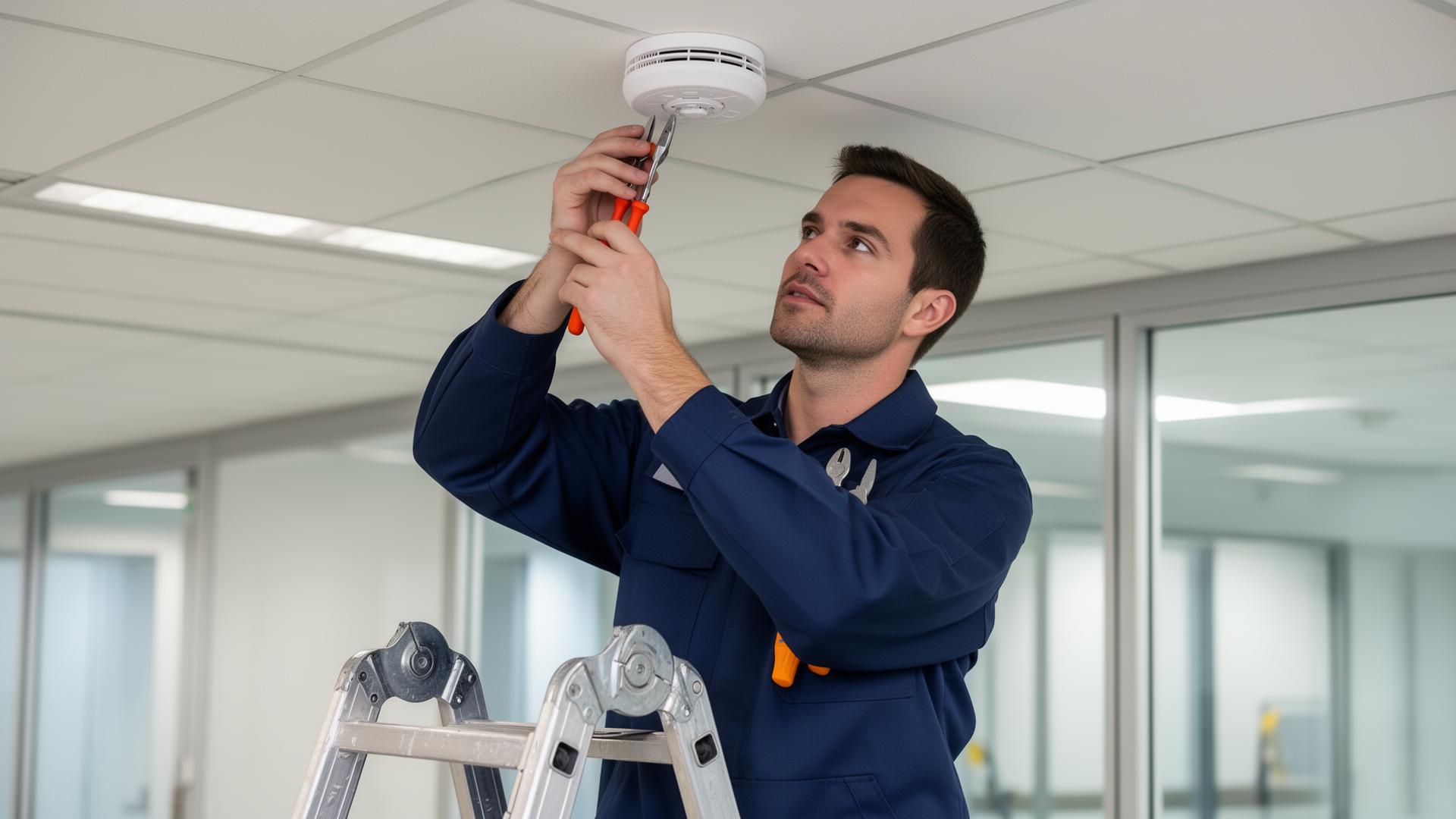
Fire Alarm Testing & Safety Certificate in London
Annual BS 5839 fire alarm testing across London from £89. Same-day digital certificate, function and interconnection test of every detector, sound-pressure check, control panel and manual call point activation for Grade A systems.
£5m Public Liability + £5m Employer's Liability Hiscox · NICEIC approved engineers · BS 5839-6 and BS 5839-1 · 24/7 booking line
Prefer a landline? Call 0207 046 1363.
Annual fire alarm testing in London costs £89 for a typical 1-2 bed flat with up to 3 detectors, £99 for an HMO or larger property with 4+ alarms, and £129 for a Grade A commercial panel system up to 12 detectors. Every visit covers BS 5839 function and interconnection testing, sound-pressure check at every bed-head, and a signed digital certificate within 24 hours.
What is fire alarm testing?
Fire alarm testing is the documented annual service of every smoke, heat and carbon monoxide detector on a property — not the weekly test-button push the occupier does themselves, but a full BS 5839 engineer service that proves the system still meets the standard it was designed to. It covers function, sound pressure, interconnection, battery condition and, on Grade A systems, the control panel and every manual call point on the escape routes.
The relevant standards are BS 5839-6 for domestic installations — single-dwelling houses, flats and HMOs of up to three storeys with interconnected Grade D or Grade F detectors — and BS 5839-1 for commercial control-panel systems. Both standards require an annual engineer test, a written log entry and a service certificate that the responsible person can produce on request to a local authority officer or insurer.
The engineer carries calibrated test equipment — Solo 365 aerosol smoke heads, Solo 461 heat testers, CO test gas, sound-pressure meters calibrated annually — and works through every detector in turn. Each reading is recorded against the design value: 75 dB at the pillow on BS 5839-6 Grade D, 65 dB at the bed-head on BS 5839-1 Grade A. Failures are corrected on the spot wherever possible.
Who needs fire alarm testing in London
Annual engineer-tested fire alarms sit on a long list of property duty-holders. The 2022 amendment to the Smoke and CO Alarm Regulations widened the duty into private rented accommodation; HMO and commercial duties were already in place under separate legislation.
- Private landlords — under the Smoke and Carbon Monoxide Alarm (Amendment) Regulations 2022 every rented property in England must have a smoke alarm on each storey and a CO alarm in any room with a fixed combustion appliance. Alarms must be tested by the landlord on the first day of each tenancy, with annual engineer-tested servicing the practical compliance evidence boroughs accept.
- HMO operators — Houses in Multiple Occupation licensed under the Housing Act 2004 have always required a documented fire alarm service. Larger HMOs and any HMO above three storeys typically need a Grade A panel system to BS 5839-1, tested and certificated annually by a competent engineer.
- Commercial premises — the Regulatory Reform (Fire Safety) Order 2005 places a duty on the responsible person to maintain fire safety equipment. Section 17 specifically requires routine and engineer testing of fire detection and warning systems — BS 5839-1 is the recognised standard, enforced by London Fire Brigade fire safety officers.
- Short-term lets — Airbnb, Booking.com and Vrbo hosts in England fall under the 2022 Regulations because each guest stay is a short tenancy. Smoke and CO alarms must be present, working and serviced annually; a current BS 5839 certificate is increasingly requested by hosting platforms' host standards.
- Block managers and freeholders — communal area fire alarms in purpose-built blocks of flats are commercial systems under BS 5839-1 and need an annual service. The duty sits with the freeholder, RMC or managing agent under the Fire Safety Order and the Fire Safety (England) Regulations 2022.
Our fire alarm testing service across London
Every visit is carried out by a NICEIC approved fire alarm engineer holding current BS 5839 competence — fire detection and alarm system testing under FIA Unit 4 or equivalent, plus 18th Edition for any mains-powered Grade D work. Test equipment is calibrated annually and the calibration certificate is on the van for inspection.
Bookings are typically attended within 2-4 working days across London. Priority landlord accounts and end-of-tenancy turnarounds get same-day or next-day slots. Commercial inspections that need out-of-trading-hours access — restaurants, retail, salons, offices — are scheduled for evenings or weekends at no extra cost. Digital certificates land in the responsible person's inbox within 24 hours of the visit.
Detectors that fail the test are usually swapped on the same visit from working van stock at a fixed parts charge — Grade D1 mains-interlinked smoke, heat and CO units, sealed 10-year Grade F1 alarms and standard backup batteries. Portfolio landlords on our landlord compliance plan get 12-month expiry reminders so renewals never catch the calendar cold.
Fire alarm testing cost in London — transparent pricing
Pricing is by number of detectors and system type. A fixed figure is confirmed on the call from the count of alarms, the grade (D1 / D2 / F1 / A) and whether a control panel and manual call points are in scope. No VAT add-ons, no parking charges, no out-of-hours premium on scheduled commercial work.
| System Type | What's Covered | Price |
|---|---|---|
| 1-3 alarms (typical 1-2 bed flat) | BS 5839-6 function test, sound-pressure check, certificate emailed within 24h | £89 |
| 4 or more alarms (HMO / larger property) | Function + interconnection test of every detector, escape-route audibility audit | £99 |
| Up to 12-detector panel system (Grade A / commercial) | BS 5839-1 panel test, manual call point activation, full log entry | £129 |
* Prices include VAT. Combined rates available with EICR and emergency lighting testing on the same visit.
What's included in every test
- Function test of every smoke, heat and CO detector on site
- Sound-pressure measurement at the head of every bedroom (75 dB at the pillow under BS 5839-6)
- Interconnection test — trigger one detector, confirm every linked unit sounds
- Battery condition check (sealed 10-year lithium or replaceable 9V/AA)
- Visual inspection of detector siting, ceiling clearance and obstruction zones
- Control panel functional test for Grade A systems — zone indication, fault simulation, silence/reset
- Manual call point activation (commercial / BS 5839-1)
- Standby battery check on mains-powered Grade A and Grade D systems
- Service log entry signed and dated (BS 5839 requirement)
- Digital BS 5839 certificate emailed within 24 hours, hard copy on request
Get an instant quote for fire alarm testing
Tell us the number of detectors, the system grade and the borough — a fixed price is confirmed on the call. Most London bookings attended within 2-4 working days, certificate emailed within 24 hours of the visit.
Understanding fire alarm grades
BS 5839-6 classifies domestic systems into grades and categories. The grade describes the power source and the level of monitoring; the category describes the coverage. Getting the right grade for the property type is what passes the borough licensing inspection — the wrong grade is the most common failure we see on first-visit HMOs in London.
Mains-powered with sealed 10-year battery backup
Standard for new and rented domestic property in England under the Smoke and Carbon Monoxide Alarm (Amendment) Regulations 2022. Each alarm is hard-wired to a permanent 230V supply with a sealed tamper-proof lithium backup that lasts the life of the alarm. Interconnected so that one triggered detector sounds every other detector on the system.
Mains-powered with replaceable battery backup
Acceptable in existing dwellings under BS 5839-6. The 9V or AA backup is user-replaceable and should be changed annually — most function-test failures we see in London rentals are flat or missing backup batteries on Grade D2 detectors fitted before 2015.
Battery-only with sealed 10-year lithium
Allowed in single-storey flats and short-let properties under BS 5839-6. Self-contained, no wiring needed, but the whole unit is replaced at end of life rather than the battery. Common in Airbnb conversions and HMO bedrooms where pulling cable is impractical.
Commercial control panel system to BS 5839-1
Required for HMOs above three storeys, larger HMOs, commercial premises, and any property with a Fire Risk Assessment recommendation for a panel-monitored system. Addressable or conventional zoned panel, manual call points at every escape route, sounders distributed for 65 dB minimum at the bed-head, weekly user test logged and annual engineer test certified.
A property that has been upgraded grade-on-grade — for example, a Grade F1 battery unit added to a Grade D1 mains system — does not give a higher overall grade. The lowest device on the system dictates the grade recorded on the certificate. Mixed systems are flagged on the report with a remedial recommendation.
What we check on every visit
The BS 5839 service is a structured checklist — every detector is reached and tested, not just the ones near the door. Sound pressure is measured at the bed-head in every bedroom because that is where the alarm has to wake a sleeping occupier. Interconnection is proven by triggering one detector and confirming every linked unit sounds within 10 seconds.
- • Every smoke, heat and CO detector function-tested with Solo aerosol or test gas.
- • Sound pressure measured at the head of every bedroom (75 dB BS 5839-6, 65 dB BS 5839-1).
- • Interconnection proven — trigger one, confirm every linked unit sounds.
- • Battery condition (sealed 10-year lithium or replaceable 9V/AA backup).
- • Detector siting — ceiling clearance, distance from walls, distance from cooking and shower zones.
- • Sensor end-of-life dates checked against manufacture date (7-10 year ceiling).
- • Grade A control panel — zone indication, fault simulation, silence/reset, standby battery.
- • Manual call points activated and reset on every BS 5839-1 system.
- • Service log entry signed and dated, in the format BS 5839 requires.
- • Digital BS 5839 certificate emailed within 24 hours of the visit.
Still have questions?
Speak to a fire alarm engineer directly — most calls answered inside 30 seconds, fixed price confirmed on the line.
Landlord and commercial benefits
For landlords with multiple properties and for block and commercial managers the fire alarm test is not an isolated visit — it sits inside a compliance calendar that also holds EICR, CP12, fire risk assessment and emergency lighting checks. Bundling the visits keeps cost and disruption down across the portfolio.
- • Portfolio discount — 10-20% off fire alarm tests from three properties, scaling with volume.
- • Combined visit rate with EICR and emergency lighting.
- • Compliance calendar — anniversary reminders keyed to the property.
- • No call-out fee on scheduled work — you pay for the test, not the journey.
- • Consolidated monthly invoicing with VAT breakdown per property.
- • Out-of-hours commercial scheduling — evenings and weekends at no premium.
Penalties for non-compliance
Enforcement of fire alarm duties sits across multiple regimes — local authority housing teams for rented and HMO property, the London Fire Brigade for commercial premises under the Fire Safety Order, and Trading Standards for short-term let platforms.
- Fines up to £5,000 per breach under Regulation 13 of the Smoke and Carbon Monoxide Alarm (England) Regulations 2015 (as amended 2022). Each missing or untested alarm can be a separate breach.
- Remedial notices at the landlord's cost — local authorities can install or service alarms directly and recover the full cost from the landlord plus an administrative fee.
- Commercial prosecutions under the Regulatory Reform (Fire Safety) Order 2005 — the London Fire Brigade continues to prosecute responsible persons where a fire incident is linked to an untested or defective fire detection system. Unlimited fines on indictment.
- HMO licence revocation — boroughs routinely cite missing or out-of-date fire alarm certificates as grounds for refusing an HMO licence renewal, with all the rent repayment consequences that follow.
- Insurance implications — most landlord and commercial policies require an in-date fire alarm service as a policy condition. A fire claim on a property with an expired or untested alarm is commonly refused.
- Rent Repayment Orders — on a licensed HMO a missed fire alarm test feeds straight into a First-tier Tribunal application, recovering up to 12 months of rent for the tenant.
Areas covered
Fire alarm testing is carried out across all 32 London boroughs and the City of London. Heaviest booking volumes come from Camden, Westminster, Islington, Hackney, Tower Hamlets, Southwark, Lambeth, Wandsworth, Hammersmith & Fulham, Kensington & Chelsea, Haringey and Greenwich.
Frequently Asked Questions
How much does fire alarm testing cost in London?
How often should fire alarms be tested in a rented property?
What is the difference between BS 5839-6 and BS 5839-1?
Do you issue a fire alarm certificate the same day?
What grade of fire alarm do I need in my rental?
Will you replace failed alarms during the visit?
Is a fire alarm certificate a legal requirement for landlords?
Does the testing cover carbon monoxide alarms?
How long does the inspection take?
Can you test fire alarms in an occupied HMO?
Still have questions?
Speak to a NICEIC approved fire alarm engineer directly — most calls answered inside 30 seconds. Fixed price confirmed on the line, digital BS 5839 certificate within 24 hours, combined visit discounts with EICR and emergency lighting testing.
Fully insured (£5m PL + £5m EL Hiscox) • NICEIC approved engineers • BS 5839-6 and BS 5839-1 • VAT-registered invoices