BS 5839-6 Explained: Which Fire Alarm Grade Does Your Property Need?
Grade A through F decoded — what each grade means, which property types need which, and the 2025 standard updates. Plain-English guide from Emergency Repairs London.
BS 5839-6 is the British Standard for fire detection and fire alarm systems in domestic premises. It defines six grades (A, B, C, D, E and F) describing the type and reliability of the system, and four categories (LD1, LD2, LD3 and LD4) describing how much of the property is covered. A single-family owner-occupied house typically needs Grade D2 / LD3 as a minimum. A standard rented flat in London needs Grade D2 / LD2. A larger HMO of three or more storeys usually needs Grade A / LD2. Get the wrong grade and your EICR-equivalent fire-safety check fails, your insurer can refuse a claim, and a Responsible Person can be prosecuted under the Regulatory Reform (Fire Safety) Order 2005. Call Emergency Repairs London on 0207 046 1363 or WhatsApp 07456 975436 for a site-specific grade assessment.
BS 5839-6 is the British Standard most landlords, managing agents and HMO operators in London have heard of but very few have actually read. It is the code of practice for fire detection and fire alarm systems in domestic premises — houses, flats, HMOs, sheltered housing — and it is the document the council enforcement officer, the fire-risk assessor and the buildings insurer all use as the benchmark. The Smoke Alarms (England) Regulations 2022 set the legal floor at one alarm per storey; BS 5839-6 sets the engineering recommendation that a competent landlord is expected to meet.
The standard organises systems along two axes: grade (the type and reliability of the system, A through F) and category (how much of the property is covered, LD1 through LD4). The two axes are independent. You can have a Grade D system installed to LD3 category in a small flat, or a Grade A system installed to LD1 category in a large HMO. This page decodes both axes, walks through the 2019 amendment that split Grade D and Grade F, and tells you which combination your property actually needs.
What BS 5839-6 Actually Is
BS 5839-6 is one part of the BS 5839 family. The other part most people encounter is BS 5839-1, which is the equivalent standard for non-domestic premises — offices, shops, hotels, schools. The two standards share concepts but the design rules and certification routes differ, and a mixed-use building (a Victorian terrace with a shop on the ground floor and flats above) can have both standards applying to different parts of the same structure.
The current edition is BS 5839-6:2019 with subsequent corrigenda. The 2019 release was the most significant rewrite since 2013 — it split Grade D into D1 and D2, split Grade F into F1 and F2, and tightened the recommendations on heat alarms in kitchens and on interlinking between dwelling units in HMOs. The standard sits alongside BS 5266 (emergency lighting), PAS 79 (the methodology for a fire-risk assessment) and the Regulatory Reform (Fire Safety) Order 2005 ("the RRO"), which is the underlying statute that makes compliance with the standard practically mandatory in rented and HMO property.
Grades vs Categories — The Two Axes
The single biggest source of confusion we see is people conflating grade and category. They are independent.
- Grade describes the type and reliability of the fire alarm system — is it a mains-wired control-panel system (Grade A), is it interlinked mains alarms with battery back-up (Grade D), is it battery-only (Grade F). Six grades total: A, B, C, D, E, F.
- Category describes the extent of coverage — does the system cover every room (LD1), every room on the escape route plus the principal habitable room (LD2), only the escape route (LD3), or the principal habitable room only (LD4). Four categories total: LD1, LD2, LD3, LD4.
A specification is always a pair: "Grade D1 LD2" or "Grade A LD1". Specifying just the grade or just the category is incomplete. We have a dedicated breakdown of the four LD categories in our LD1 vs LD2 vs LD3 guide — read that alongside this page.
The Six Grades (A, B, C, D, E, F) Decoded
From most sophisticated and most reliable, to least:
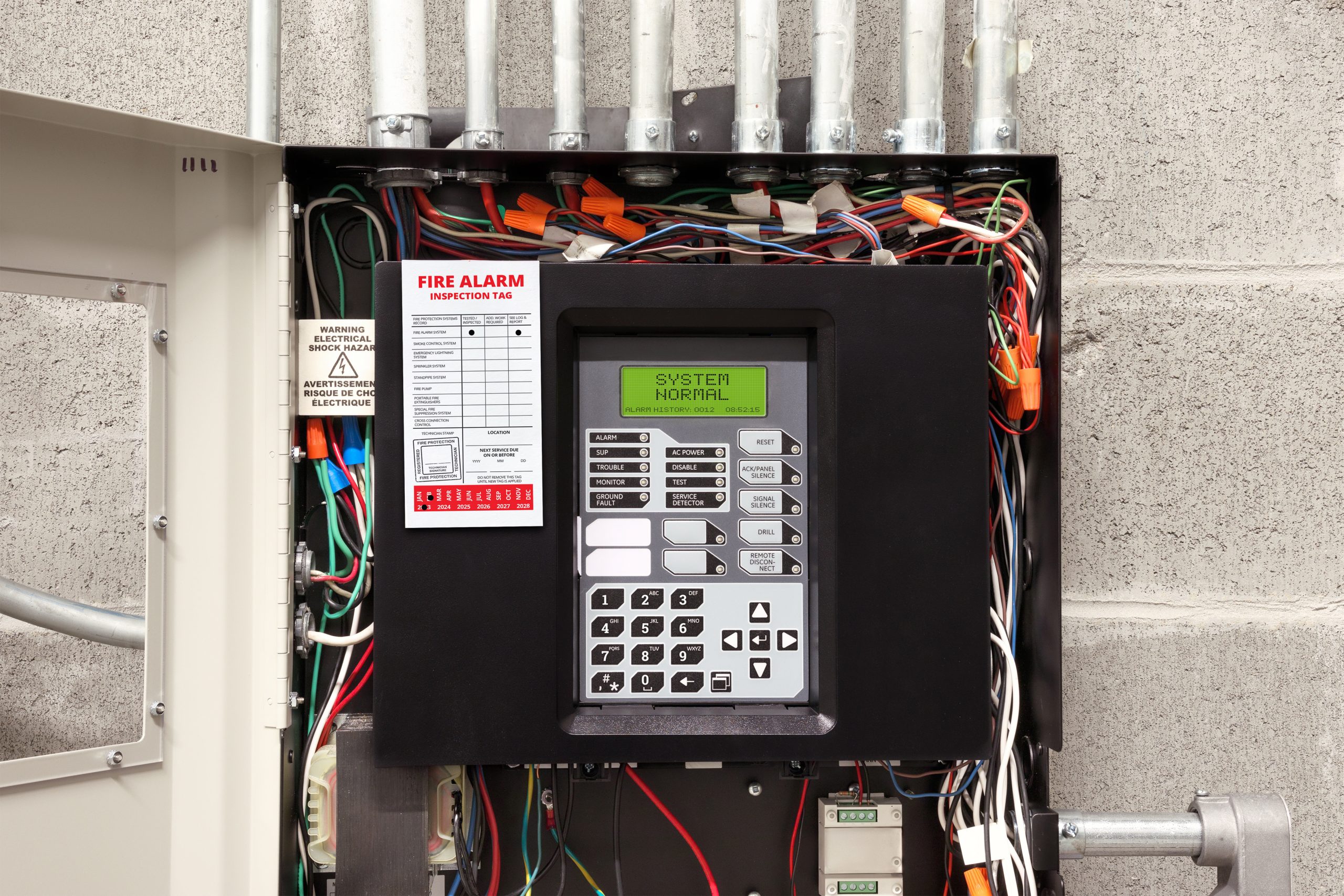
- Grade A — A full BS 5839-1-style system designed for domestic application. Separately certified detectors, manual call points, sounders and a central control and indicating panel. Mains-powered with a standby battery sized for at least 72 hours of quiescent operation and 30 minutes of alarm. This is the grade typically required in larger licensed HMOs in London and in any property where the fire-risk assessment identifies a high-risk occupancy.
- Grade B — A reduced version of Grade A using fire detectors and sounders but with a simpler control panel. Rarely specified in modern London property; we see it occasionally in legacy installations.
- Grade C — A system of detectors and sounders with central control equipment, but the detectors are not separately certified to BS EN 54. Effectively obsolete for new install — nobody specifies Grade C from scratch today.
- Grade D — A system of one or more interlinked mains-powered smoke alarms (and heat alarms in kitchens) with an integral battery back-up. This is the single most common grade in rented London property. Split in 2019 into D1 (sealed tamper-proof 10-year battery) and D2 (user-replaceable battery). For any new install in a rental, specify D1.
- Grade E — Mains-powered interlinked alarms without a battery back-up. Rare and not recommended; a power cut leaves the property unprotected.
- Grade F — Battery-powered interlinked alarms, no mains supply. Split in 2019 into F1 (sealed 10-year tamper-proof battery) and F2 (replaceable battery). F2 is no longer adequate for rental property in most London boroughs under HMO licence conditions, and F1 is acceptable only where running a mains supply is impractical.
The shorthand most fire-risk assessors use: Grade A for licensed HMOs, Grade D1 for rented self-contained homes, Grade F1 for owner-occupier where mains wiring is not feasible, and avoid C, E and F2 entirely on new work. Our companion article Mains vs Battery Smoke Alarms in HMOs goes deeper on the Grade D vs Grade F decision for landlords.
Not sure which grade your property needs? Call Emergency Repairs London on 0207 046 1363 or WhatsApp 07456 975436 with the property type, number of storeys, and tenancy arrangement. A site-specific grade recommendation takes about five minutes over the phone.
The Four LD Categories Decoded
Category describes how much of the property is covered. From most coverage to least:
- LD1 — Detection in every circulation space (hallways, landings, stairs) and every habitable room and any room where a fire is likely to start (kitchen, living room with open fire, room with electrical accumulation). The most comprehensive category, specified for higher-risk occupancies such as larger HMOs and sheltered housing.
- LD2 — Detection in every circulation space on the escape route and in every room or area presenting a high fire risk (kitchen, principal habitable room). The most common specification for rented property in London.
- LD3 — Detection in every circulation space on the escape route only. The minimum recommended category for an owner-occupied single-family home.
- LD4 — Detection in the principal habitable room only. Below the standard recommendation; effectively never specified in modern UK practice.
Which Property Type Needs Which Grade
The pairings below are the common-sense starting point. The authoritative answer for any specific property is the fire-risk assessment carried out under PAS 79 by a competent person — but in the absence of one, these are the defaults we install to across London:
- Owner-occupied single-family home, two storeys — Grade D1 LD3 minimum, Grade D1 LD2 preferable. Heat alarm in the kitchen, smoke alarms on each storey landing, all interlinked.
- Owner-occupied single-family home, three or more storeys — Grade D1 LD2.
- Rented self-contained flat or maisonette — Grade D1 LD2. Sealed 10-year battery alarms interlinked on the escape route plus the principal habitable room, heat alarm in the kitchen.
- Rented house in single-family occupation (not HMO) — Grade D1 LD2.
- Small HMO (up to 4 occupants forming more than one household, 1–2 storeys) — Grade D1 LD2, with interlinking between all sleeping rooms and circulation spaces.
- Licensed HMO (5+ occupants, more than one household, 3+ storeys) — Grade A LD2 minimum under most London-borough licence conditions. Some boroughs require Grade A LD1.
- Bedsit-style HMO with shared kitchens and bathrooms — Grade A LD1, with detection inside each let room and interlinked sounders.
- Sheltered housing and supported-living premises — Grade A LD1 with a monitored panel.
If a property has changed use — for example a Victorian terraced house that was a single-family let and has been split into a four-bedroom HMO — the grade requirement changes with the use, and the existing Grade D installation almost certainly needs upgrading to Grade A before the council will license the HMO.
The 2019 Amendment — D1/D2 and F1/F2 Split
The 2019 revision of BS 5839-6 addressed a long-standing failure mode: tenants removing the battery from a chirping alarm and never replacing it. The committee's response was to introduce sealed, tamper-proof, 10-year battery variants of the two most common grades:
- Grade D1 — Mains-powered, with a sealed 10-year tamper-proof battery back-up that the occupant cannot remove. When the battery reaches end-of-life, the entire alarm head is replaced. This is now the recommended default for any new install in rented property.
- Grade D2 — Mains-powered, with a user-replaceable battery back-up. Still permitted by the standard but no longer recommended for new install in rental.
- Grade F1 — Battery-powered (no mains), with a sealed 10-year tamper-proof battery. Acceptable only where running a mains supply is impractical — e.g. a listed-building cottage with no realistic cable route to upstairs landings.
- Grade F2 — Battery-powered with a user-replaceable battery. No longer adequate for rental property under most London-borough HMO licence conditions.
If your property was last fitted before 2019 and the alarm heads have user-replaceable 9V batteries, you are almost certainly running a Grade D2 or Grade F2 installation. Any next replacement cycle should upgrade to D1 or F1 — the unit cost differential is small and the compliance gain is significant.
The Legal Framework Around the Standard
BS 5839-6 itself is a code of practice, not a statute. It becomes practically mandatory through three legal instruments:
- Regulatory Reform (Fire Safety) Order 2005 ("the RRO") — Places a duty on the Responsible Person (typically the landlord, freeholder or managing agent) to take "general fire precautions" to ensure the safety of relevant persons. A fire-risk assessment is mandatory under Article 9. The standard the assessor and the courts measure against is BS 5839-6 (for domestic) and BS 5839-1 (for non-domestic). Fines are unlimited; custodial sentences are on the statute book.
- Smoke and Carbon Monoxide Alarm (England) Regulations 2015, as amended by the Smoke Alarms (England) Regulations 2022 — Requires at least one smoke alarm on every storey of every rented home, and a CO alarm in every room with a fixed combustion appliance (excluding gas cookers under the 2022 amendment's wording). This is the legal floor — BS 5839-6 sets the engineering recommendation above it.
- Housing Act 2004 and the local HMO licensing schemes operated by each London borough — Conditions attached to an HMO licence almost always require compliance with BS 5839-6 to a specified grade and category, with annual third-party commissioning certification. The condition is in the licence schedule and is legally binding.
BS 5266 (emergency lighting) becomes relevant in any HMO with a protected escape route — a Grade A fire alarm system without compliant escape-route lighting still fails the licensing inspection.
Commissioning, Certificates and Annual Service
A system is not compliant simply because the right equipment was installed. BS 5839-6 requires design, installation, commissioning and maintenance certificates, each signed by a competent person. The relevant third-party scheme is BAFE SP203-6 for domestic fire alarm work. The certificates we issue cover:
- Design certificate — Confirms the design meets BS 5839-6 to the specified grade and category, signed by the designer.
- Installation certificate — Confirms the system was installed in accordance with the design and with BS 7671 (the wiring regulations) for mains-wired components.
- Commissioning certificate — Confirms the installed system has been functionally tested — every alarm sounds, interlink propagates, battery back-up holds the required duration, panel events log correctly. This is the certificate the council and the insurer want to see.
- Annual service record — BS 5839-6 recommends annual servicing of Grade A systems by a competent person, six-monthly inspections of Grade D and Grade F systems by the landlord or competent person, and weekly user-test of every alarm.
Need a fresh BS 5839-6 commissioning certificate or an overdue annual service? Our fire alarm testing and certification service covers all six grades across the 32 London boroughs. Call 0207 046 1363 or email [email protected] with the property address and current grade.
The Five Most Common Failures We See on Inspection
In rough order of how often we see them on a first-attendance inspection in London property:
- Wrong grade for the use class — A Grade D installation in a property that has been converted to a five-person HMO and needs Grade A. The conversion happened, the alarm did not get upgraded, and the licence inspection failed.
- Missing heat alarm in the kitchen — Smoke alarms throughout but no heat alarm in the kitchen, where most domestic fires actually start. A heat alarm is a BS 5839-6 specification for kitchens; a smoke alarm in a kitchen produces nuisance alarms and gets disabled.
- Interlink not functional — Alarms wired or specified to interlink, but the wireless link has dropped or one head has been replaced with a non-compatible model. Each alarm sounds individually but the whole-property alarm chain is broken. Only detectable on a functional commissioning test.
- Battery removed by occupant — Pre-2019 Grade D2 installation, occupant has removed the 9V battery to silence a chirp and never replaced it. Mains alarm still works on mains, fails on a power cut. Upgrading to Grade D1 with sealed 10-year batteries eliminates this failure mode permanently.
- No commissioning paperwork on file — System physically present and apparently functional, but no design, installation or commissioning certificate exists. The landlord cannot demonstrate compliance to the council or the insurer. Effectively the same as having no system, in legal terms.
Items 1, 2 and 5 alone account for roughly two-thirds of the BS 5839-6 inspection failures we attend across London each year. None of them are expensive to fix when caught early; all of them are expensive to fix after a serious incident or a licence revocation.
FAQs
The FAQ schema at the foot of this page covers: the difference between BS 5839-6 and BS 5839-1, which grade a rented London flat needs, whether HMOs need Grade A, what changed in the 2019 amendment, who can legally install BS 5839-6 alarms, and the consequences of getting the grade wrong.
For a wider view of how fire detection sits alongside the rest of the landlord-compliance picture — EICRs, gas safety certificates, EPCs and HMO licensing — our landlord compliance hub for London is the single page that ties the regimes together.
Save the number now — 0207 046 1363 or WhatsApp 07456 975436. Get the grade right at install and you will never need to read this page again.
John Alexander N. — Emergency Repairs London
Key Takeaways
- BS 5839-6 covers domestic premises — houses, flats, HMOs, sheltered housing. BS 5839-1 is the commercial-buildings counterpart and is a separate standard
- There are six grades (A, B, C, D, E, F) describing the type and reliability of the alarm system, and four categories (LD1, LD2, LD3, LD4) describing how much of the property is covered
- Grade A is a full commercial-style system with a central control panel, separately certified detectors and a backed-up power supply. Grade D is mains-powered interlinked alarms with battery back-up — the most common grade for rented homes and small HMOs
- Grade D was split into D1 (sealed 10-year battery back-up) and D2 (user-replaceable battery back-up) in the 2019 amendment. Grade D1 is now the recommended default for any new install in a rented property
- Grade F was split into F1 and F2 in the same amendment. F2 (replaceable battery, no mains) is no longer considered adequate for rental property in London under most local authority HMO licensing schemes
- Smoke Alarms (England) Regulations 2022 mandate at least one smoke alarm on every storey of every rented home, and a CO alarm in every room with a fixed combustion appliance — this is a legal floor, not a ceiling
- London-borough HMO licensing conditions almost always require Grade A or Grade D LD2 minimum for licensed HMOs, with annual third-party commissioning
- Getting the wrong grade is a Responsible-Person liability under the Regulatory Reform (Fire Safety) Order 2005 — fines are unlimited and custodial sentences are on the statute book
