Mains-Wired vs Battery Smoke Alarms: What Does Your HMO Need?
Why HMO smoke alarms must be mains-wired and interlinked under BS 5839-6, and a practical guide for landlords on upgrading an old battery system without ripping the ceilings out.
Almost every licensed HMO in London needs a mains-wired, interlinked smoke alarm system to at least Grade D1 LD2 under BS 5839-6:2019+A1:2020 — battery-only alarms (Grade F) are not acceptable for shared houses and bedsits. Standalone 9V or sealed-10-year battery alarms fail the interlinking requirement: a fire detected in the ground-floor kitchen must sound the alarm in the second-floor bedroom at the same instant. Upgrading from a battery system to a compliant mains-wired LD2 install is a 1-to-2-day job in most 3-to-5-bed HMOs and does not require lifting every floorboard. Call 0207 046 1363 or WhatsApp 07456 975436 for a fixed-price quote.
If you have just bought an HMO, taken one on to manage, or had a re-licensing letter from the borough land on your desk, the question of what smoke alarm system the property actually needs sits near the top of the compliance pile. The honest answer, for almost every shared house and bedsit in London, is the same: mains-wired, interlinked, Grade D1 LD2 to BS 5839-6:2019+A1:2020. Battery-only alarms do not pass — not legally, not practically, not at inspection.
This guide walks through what that actually means, why the standard is written the way it is, and what an upgrade from an old battery system looks like in a real London terraced HMO without the marketing fluff. If you want a fixed-price quote on the work after reading, the number is at the bottom — or jump straight to our smoke alarm installation service page.
The Short Answer for HMO Landlords
Every licensed HMO in Greater London that we have certified in the last three years has needed a system that is:
- Mains-wired — alarm heads powered from the property's electrical supply, not from a 9V or sealed-cell battery as the primary source
- Interlinked — one alarm head triggering means every alarm head in the property sounds at the same time, end of
- Backed up — sealed tamper-proof battery in each head, rated for the working life of the alarm (typically 10 years)
- Covering at least LD2 — heads in the escape route AND in every room presenting a significant fire risk
- Certified — a commissioning certificate in the FIA/BAFE-recognised format, kept on file, available for the borough licensing officer
That specification is Grade D1 LD2. Anything below it — battery-only alarms, isolated mains alarms without interlink, or coverage only on the landing — will not pass a 2026 HMO licensing inspection. Some London boroughs are now asking for Grade A LD1 in HMOs above three storeys; that is a panel-based system with manual call points, broadly closer to what you would see in a small office block. The default specification for the typical 4-to-6-bed converted house remains D1 LD2.
What BS 5839-6 Actually Says
BS 5839-6 is the British Standard for the design, installation, commissioning and maintenance of fire detection and fire alarm systems in domestic premises. The current edition is BS 5839-6:2019, amended in 2020. It is the document a competent installer designs against, and it is the document a borough HMO licensing officer will reference when assessing your property.
The standard does two things at once. First, it grades the type of system from Grade A (the most sophisticated — panel, manual call points, multiple zones) down to Grade F (the least — battery-only alarms suitable for the lowest-risk owner-occupied premises). Second, it categorises the coverage from LD1 (every room) through LD2 (escape route plus high-risk rooms) to LD3 (escape route only). The grade and the category are not the same axis and you need both to fully specify a system — see our LD1/LD2/LD3 explainer for the coverage side of that and our BS 5839-6 grades explainer for the system-type side.
BS 5839-6 is not law in itself — it is a standard. But the Regulatory Reform (Fire Safety) Order 2005 (RRO 2005) is law, and it requires the Responsible Person to provide "appropriate" fire detection. In any prosecution or licensing dispute, "appropriate" is interpreted by reference to BS 5839-6. Designing to the standard is therefore not optional in any meaningful sense.
Get a fixed-price quote. If you want to know what a compliant system costs for your specific property before you commit, ring 0207 046 1363 or WhatsApp 07456 975436 with the address and a rough room count. We will send an engineer for a free site visit and a written quote inside 48 hours.
Grades A to F — What the Letters Mean
Briefly, because the detail sits in the dedicated guide above:
- Grade A — Central control panel, manual call points, mains-powered detectors on a dedicated circuit with battery backup at the panel. Designed to BS 5839-1 in practice for the panel side. Used for larger HMOs (typically 3+ storeys, 6+ occupants in some borough schemes) and for purpose-built blocks of flats common parts.
- Grade B — Effectively obsolete in current practice and rarely specified.
- Grade C — Mains-powered with a central control unit but without manual call points. A middle tier; uncommon in HMO specs today.
- Grade D1 — Mains-powered alarm heads, each with a sealed tamper-proof backup battery rated for the life of the alarm. This is the HMO default for the typical converted house.
- Grade D2 — Same as D1 but with a user-replaceable backup battery. Acceptable in lower-risk specs but a riskier bet in HMOs because tenants can and do pull the battery to silence a chirping unit.
- Grade F — Battery-only. Not acceptable for HMOs. Suitable only for the lowest-risk owner-occupied premises.
The reason D1 has become the default for HMOs is the sealed-backup-battery point. A landlord cannot guarantee that a tenant will not silence a chirping alarm by yanking the 9V out of it. With D1 the cell is welded into the housing for the working life of the unit. Once the alarm hits end-of-life, the entire head is replaced — not the battery — and the certificate clock resets.
LD1, LD2, LD3 — What Gets Covered
Coverage category is the other axis:
- LD1 — Detectors in every room and every circulation space in the property. The most comprehensive cover. Sometimes required by boroughs in larger or higher-risk HMOs.
- LD2 — Detectors in all circulation spaces forming the escape route AND in all rooms presenting a significant fire risk. In a typical converted house that means: landing, hallway, every bedroom, the lounge, plus a heat alarm in the kitchen. This is the HMO default.
- LD3 — Detectors only in the circulation spaces forming the escape route. Acceptable for the lowest-risk single-household dwellings and not generally accepted for HMOs.
The "significant fire risk" point in LD2 catches landlords out. A bedroom with a sofa in it (some HMO bedsit-style rooms) counts as a significant fire risk for the same reason a lounge does — the soft furnishings are a high fuel load. Anywhere a tenant is likely to be sleeping or sitting near a high-fuel-load item gets a head. The kitchen gets a heat alarm rather than a smoke alarm because smoke alarms in kitchens nuisance-trip on toast and steam and end up being silenced or bagged-over, which defeats the entire point.
Why Battery-Only Systems Fail HMO Inspections
There are five honest reasons a Grade F battery-only system does not work in an HMO, in roughly the order we see them fail in real properties:
- Interlinking — A battery alarm sounds in the room it is mounted in. A tenant asleep two floors up with the door shut may not hear it. The whole point of interlink is that the alarm in the kitchen also sounds in the second-floor bedroom at the same instant. Standalone battery alarms do not deliver that.
- Tenant tampering — The single most common finding on an HMO fire-safety inspection is a battery alarm with the battery removed, the cover missing, or the unit pulled off its ceiling-rose. With a Grade D1 mains-wired system there is no removable cell and no easy disable.
- Verification of working order — On a battery-only system there is no way to centrally verify that every head is still alive without walking the property and pressing the test button on each unit. On a properly commissioned mains-wired interlinked system, one test button sounds the lot — which is also the test the borough officer will run.
- Documentation — A battery alarm has no commissioning certificate to issue. The borough licensing team wants paper — a designed and commissioned system to BS 5839-6, with an installer's certificate in the FIA/BAFE format, six-monthly user tests logged.
- Insurance — A landlord building-insurance policy will almost always cite "appropriate fire detection" in the obligations. A loss-adjuster on a fire claim will ask for the alarm certificate. Without one, the insurer has a legitimate route to reduce or reject a claim.
Upgrading an Old Battery System — Practical Steps
The fear most landlords have about upgrading is that it will mean lifting every floorboard, replastering ceilings, and turning the property into a building site for a week. That is, in the great majority of cases, not what it looks like. Here is the actual sequence we run for a typical 4-bed converted-terrace HMO:
- Site survey — One engineer, two hours. Walks the property, marks up the alarm-head locations on a floor plan against the LD2 schedule, identifies the lighting-circuit spur points, checks the consumer unit for a free way if a dedicated circuit is preferable, and notes any obstacles (low ceilings near light fittings, RCBO arrangement at the CU).
- Quote and design pack — Fixed price, with the design sketch, the proposed product (we default to a recognised UK-manufactured Grade D1 RF-interlinked range), and the timescale. Sent inside 48 hours of the survey.
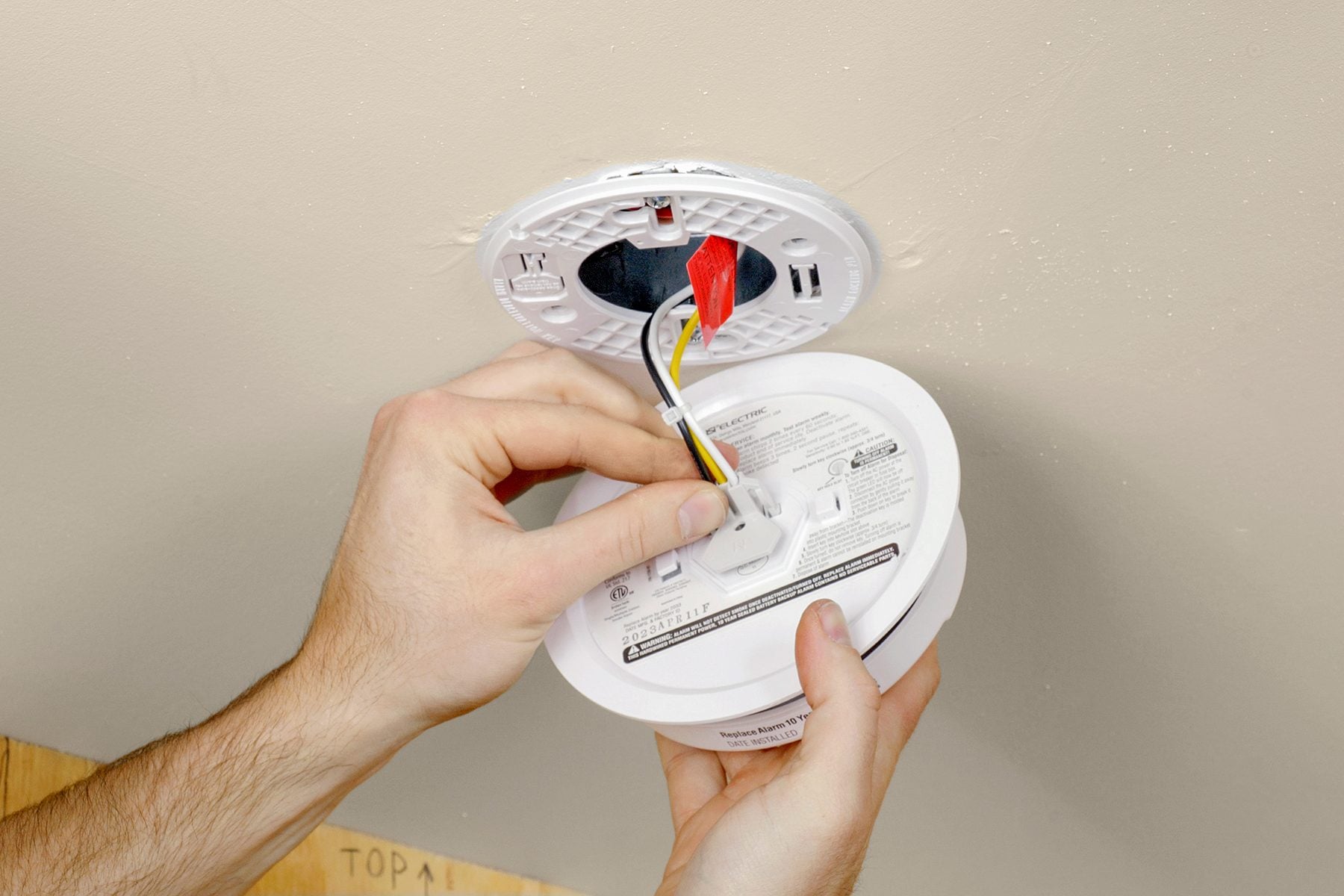
- Install day one — Two engineers. Old battery alarms come down. New alarm-head bases go up, spurred either from the upstairs and downstairs lighting circuits or from a dedicated circuit at the consumer unit depending on what the survey indicated. RF interlink modules paired room by room. Heat alarm in the kitchen, smoke alarms in the hallway, landing, every bedroom and the lounge.
- Commissioning — Test from every head. Each alarm head sounded individually triggers every other head within the property inside the BS 5839-6 latency requirement. Commissioning certificate issued in the FIA/BAFE format.
- Documentation pack — One PDF for the landlord file: the design sketch, product datasheets, the commissioning certificate, the recommended six-monthly user-test log template, and a one-page tenant notice explaining what the alarm sounds like and what to do.
Plaster damage is usually limited to a small patch around each alarm-head base — which the base itself covers — plus the consumer-unit cable entry if a dedicated circuit was used. The property remains habitable. Tenants are not displaced.
Booking the work. Most HMO smoke-alarm upgrades run inside a 1-to-2-day window with two engineers on site. If you want us to take a look first, call 0207 046 1363 or email [email protected] with the address and the number of bedrooms — we will come out and write you a fixed-price quote with no obligation.
Cost, Time and What's Actually Disruptive
A few honest numbers for context. They are typical ranges from the work we have done in 2025-2026 across London boroughs; your property may sit either side depending on cable-run length, consumer-unit condition and the number of heads required.
- 3-bed HMO, LD2 upgrade — 1 day on site, 5 alarm heads (3 smoke + 1 heat + 1 hallway), RF interlink
- 4-bed HMO, LD2 upgrade — 1-2 days, 6-7 alarm heads, RF interlink
- 5-bed HMO across 3 storeys, LD2 upgrade — 2 days, 8-9 alarm heads, RF interlink, possible dedicated CU circuit
- 6-bed-plus HMO, LD1 or Grade A panel install — 2-4 days, depends entirely on layout — site visit required to scope
Set those numbers against the cost of a failed HMO licence renewal — typically £700-£1,500 in licensing fees alone, plus the legal exposure if the borough downgrades the licence or refuses a renewal — and the upgrade is the easy maths. The disruptive bit is choosing the date with your tenants, not the install itself.
Emergency lighting (covered under BS 5266) and fire-risk-assessment review under PAS 79 often get scoped at the same survey visit — it is a sensible economy if the licensing renewal is on the same clock. We package these together as part of our HMO fire risk assessment service rather than billing the survey twice.
Who Is Legally Responsible Under RRO 2005
The Regulatory Reform (Fire Safety) Order 2005 places the duty on the Responsible Person. For an HMO that is one of three people in almost every case:
- The landlord, where the landlord manages the property directly
- The managing agent, where one has been appointed and the management contract gives them the day-to-day duty
- The freeholder or block management company, for the common parts of a converted block of flats
It is almost never the tenant. Tenants have a duty not to obstruct or disable the system, but they are not the Responsible Person.
The Responsible Person's duties include providing appropriate fire detection (read: a compliant BS 5839-6 system), maintaining it in working order, testing it on a documented schedule, and ensuring a fire risk assessment under PAS 79 is in place and reviewed when conditions change. Emergency lighting under BS 5266 is part of the same compliance bundle for any HMO above two storeys.
The penalty for breach of RRO 2005 on indictment is, under the current regime, an unlimited fine. Custodial sentences are reserved for the most serious cases — typically where a death has resulted — but the financial exposure on a routine licensing breach is significant and the reputational damage in a small portfolio is worse.
For the full picture across alarms, EICRs, gas safety, EPC, water hygiene and the rest, see our landlord compliance hub — it indexes the certificate types, the renewal cycles, and the borough-specific quirks we see on the ground.
FAQs
The FAQ schema rendered above this section covers the six questions we get asked most often by HMO landlords on the alarm topic: whether battery-only is ever acceptable, the difference between D1 and D2, whether interlinking must be hard-wired or can be wireless, how long an upgrade takes in a typical 4-bed HMO, whether the kitchen needs a heat or a smoke alarm, and who is legally responsible under RRO 2005.
If your HMO licence is up for renewal or you have just bought a property that you think might have an old battery-only system in it, the answer is the same — get it surveyed. A 2-hour site visit gives you a written specification and a fixed quote. Ring 0207 046 1363, WhatsApp 07456 975436, or email [email protected].
John Alexander N. — Emergency Repairs London
Key Takeaways
- Battery-only (Grade F) smoke alarms are not compliant for licensed HMOs — BS 5839-6:2019+A1:2020 requires at least Grade D1 LD2 for almost all shared houses and bedsits
- Interlinking is non-negotiable: a detector in any room of origin must sound every alarm head in the property simultaneously, by hard-wire or by RF/wireless interlink
- Grade D1 means mains-wired with a sealed tamper-proof backup battery rated for the life of the alarm — typically 10 years
- LD2 coverage means alarm heads in the escape route AND in any room presenting a significant fire risk (kitchen with heat alarm, lounge, any room with a sofa)
- A typical 4-bed HMO upgrade from battery to mains-wired LD2 takes 1-2 days, costs less than a single failed HMO licence renewal, and does not require lifting every floor
- Certificates issued in the FIA/BAFE-recognised format are accepted by every London borough HMO licensing team we have dealt with
- RRO 2005 places the duty on the Responsible Person — for an HMO that is almost always the landlord, not the tenant — and the penalty for non-compliance is unlimited
