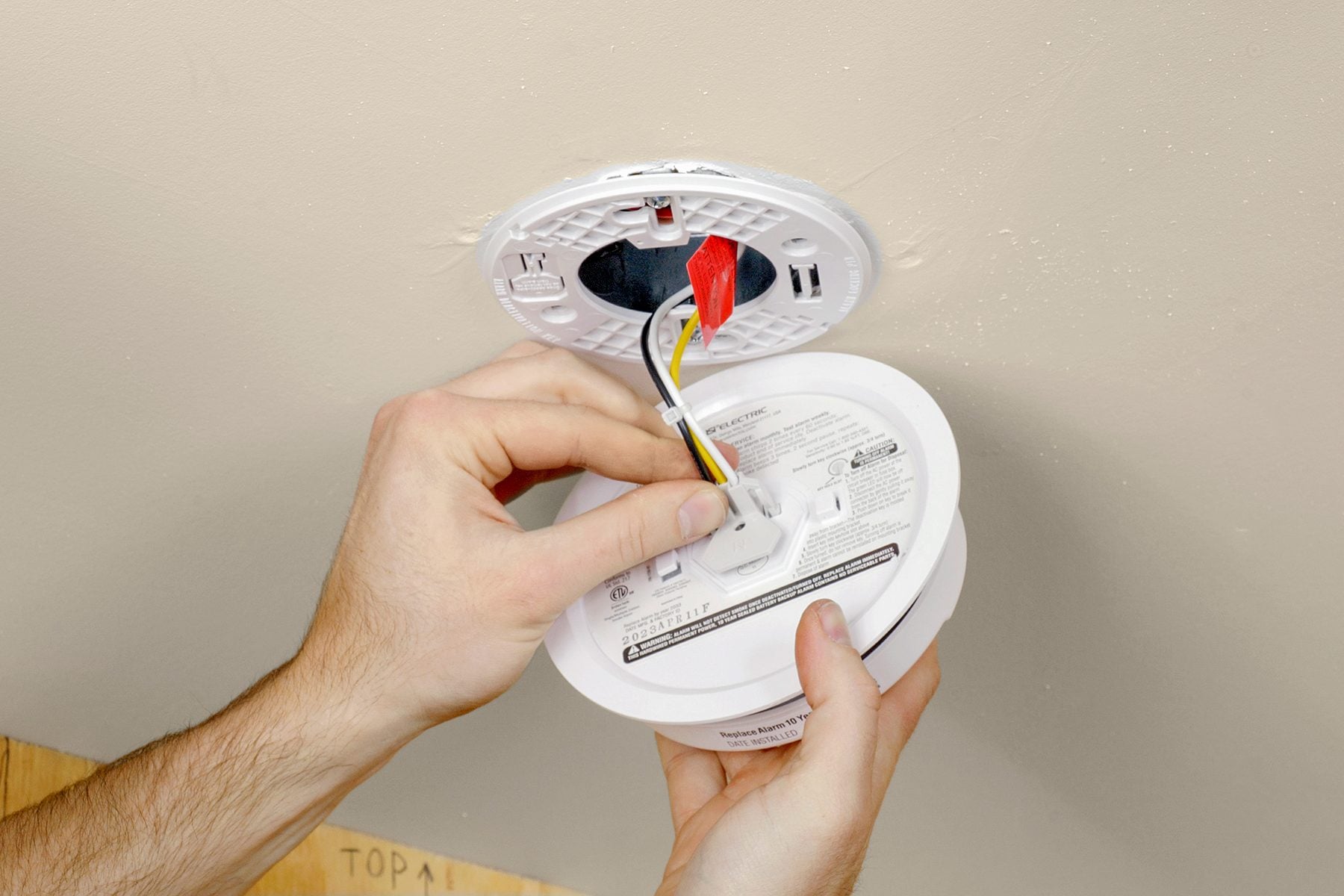
Smoke & Heat Alarm Installation in London
Mains-wired interlinked smoke alarms, heat alarms and carbon monoxide alarms installed across London. Grade D1 £220 per point, BS 5839-6:2025 compliant, council-accepted certificate on completion. Free survey for HMOs over 6 alarms.
Grade D1 sealed-battery mains-wired heads. LD1, LD2 and LD3 layouts designed to your borough's HMO licence conditions or Fire Risk Assessment.
Mobile/WhatsApp: 07456 975436
Mains-wired Grade D1 interlinked smoke alarm installation in London is £220 per alarm point. Coverage is designed to BS 5839-6:2025 in an LD1, LD2 or LD3 layout depending on whether the property is a single-let, HMO or higher-risk building. Every install ends with a council-accepted Design, Installation and Commissioning Certificate. HMOs with more than six alarms get a free survey first.
Smoke and heat alarm installation, done properly
A smoke alarm system is only as good as the survey behind it. Two heads in the wrong rooms, or a single battery alarm at the top of the stairs, will pass a quick glance and fail any serious inspection. Every install we do starts with a building survey to the current BS 5839-6:2025 design rules — number of storeys, escape route geometry, principal habitable rooms, kitchen and combustion appliance positions, and the licensing category of the property.
Heads are mains-wired Grade D1 with a sealed 10-year lithium back-up battery. The supply is taken as a permanent live from the lighting circuit on each floor — not from a switched spur — so the alarm cannot be inadvertently isolated. Interlinking is either wireless (no extra cable run) or hardwired through the alarm interconnect, depending on cabling access and finish on the property.
Smoke alarms in circulation areas are BS EN 14604 optical sensors. Kitchens get BS 5446-2 fixed-temperature heat alarms so cooking doesn't false-trigger the system. Rooms with a fixed combustion appliance (boiler closet, gas hob, solid fuel) also get a BS EN 50291 carbon monoxide alarm, fitted to the same wiring strategy.
Who needs a smoke alarm install in London
The legal floor moved up sharply in October 2022. Today the duty sits on a wide circle of property operators and the standard the boroughs accept has tightened to mains-wired interlinked systems on every renewal.
- Private landlords — under the Smoke and Carbon Monoxide Alarm (England) Regulations 2015, as amended by the 2022 Regulations in force from 1 October 2022, every rented property must have a working smoke alarm on every storey used as living accommodation and a CO alarm in every room with a fixed combustion appliance. Battery-only alarms still technically comply for single-lets, but boroughs increasingly request mains-wired evidence on every new tenancy.
- HMO landlords — Houses in Multiple Occupation almost always need a full BS 5839-6 LD2 system written into the licence conditions. Boroughs including Newham, Tower Hamlets, Hackney, Brent and Haringey require interlinked mains-wired alarms with a current commissioning certificate at every five-year licence renewal.
- Property managers and block freeholders — communal areas in residential blocks fall under the Regulatory Reform (Fire Safety) Order 2005 and the standard imposed by the building's Fire Risk Assessment. Most London blocks need automatic detection in corridors, plant rooms and ancillary cupboards.
- Short-term let operators — Airbnb, Booking.com and Vrbo hosts in London fall under the same Smoke and CO Regulations as long-term lets, and most platforms now require a current commissioning certificate as host evidence. Borough enforcement against short-lets with battery-only smoke alarms has stepped up sharply since 2023.
- Post-Fire Risk Assessment remedials — wherever the building's Fire Risk Assessment has called out missing or non-compliant smoke detection, we install to the layout grade specified in the FRA and return a certificate that closes the action out for the responsible person.
Our install service across London
Every install is carried out by an electrician on the NICEIC scheme, 18th Edition (BS 7671:2018+A2:2022) qualified, working to the current BS 5839-6:2025 design rules. The wiring is run as part of a Minor Electrical Installation Works Certificate where it is added to an existing circuit, or under an Electrical Installation Certificate where a new dedicated circuit is installed.
A typical 3-bed flat with three interlinked mains-wired alarms is fitted in around half a day. A 5-bed licensed HMO with eight alarms across three floors is a full day. For any property requiring more than six alarms we run a free design survey first — measuring the building, marking each alarm position on a floor plan, confirming the layout grade required for your borough's licence, and issuing a fixed written quote before the install is scheduled.
Most jobs are booked within the same week. Out-of-hours installs are available for tenanted HMOs and short-term lets where the building cannot be vacated during normal working hours. Portfolio landlords on our landlord compliance contracts get scheduled re-tests and replacement reminders keyed to the 10-year alarm life.
Smoke alarm installation cost in London
Pricing is per alarm point and includes everything for that point — the head, the cabling, the connection to a permanent live, the test and the certificate entry. No call-out fee, no parking premium, no separate "commissioning" line. For HMOs and commercial sites requiring more than six points the design survey is free and the total is fixed in writing before any work starts.
| Alarm Type | What's Covered | Cost |
|---|---|---|
| Grade D1 smoke alarm (per point) | Sealed tamper-proof 10-year lithium back-up battery, mains-powered, wirelessly or hardwired interlinked — current best-practice spec for HMOs and rented housing | £220 |
| Grade D2 smoke alarm (per point) | Mains-powered with user-replaceable back-up battery, BS EN 14604 compliant | £180 |
| Mains-wired heat alarm (per point) | BS 5446-2 fixed temperature heat detection for kitchens, interlinked | £180 |
| Carbon monoxide alarm (per point) | BS EN 50291 compliant, fitted alongside or independently | £180 |
* Prices include VAT and are per alarm point. Full pricing list on the call-out fee & pricing page.
Get an instant fixed quote
Tell us how many storeys and rooms — we'll price it on the call. HMOs over 6 alarms get a free survey before the quote.
What's included in every install
- Site survey of every storey, escape route, principal habitable room and high-risk room
- Layout designed to BS 5839-6:2025 LD1, LD2 or LD3 grading for the building category
- Mains-wired Grade D alarms with 10-year sealed lithium back-up battery
- Permanent 230 V supply on a dedicated lighting circuit, not a switched spur
- Interlinking between all alarms — wireless or hardwired — so one trigger sounds every head
- BS EN 14604 optical smoke sensors for circulation areas, BS 5446-2 heat sensors for kitchens
- Mounting heights, ceiling spacing and obstruction clearances per BS 5839-6 Section 12
- Functional test of every head, sound pressure check at the pillow position
- BS 5839-6 Design, Installation and Commissioning Certificate issued on completion
- Council-accepted certificate for HMO licensing, selective licensing and EPC follow-up
Layout grades — LD1, LD2 and LD3 explained
Every BS 5839-6 alarm system is designed to one of three layout categories. The right category for your property is set by the licensing regime it sits under, the building category in the British Standard and any specific requirement in the Fire Risk Assessment. We confirm the grade on the survey and write it onto the commissioning certificate.
LD3 — minimum for single-family rented homes
One mains-wired smoke alarm in every circulation area on every storey — usually one in each hallway and landing. This is the baseline grade for owner-occupied homes and single-let rentals built or refurbished under Approved Document B. Acceptable as the legal minimum in most single-household London tenancies.
LD2 — standard for HMOs and higher-risk lets
Everything in LD3 plus smoke alarms in every principal habitable room (the rooms where a fire is most likely to start) and a heat alarm in every kitchen. This is the routine spec written into London borough HMO licence conditions and into the Smoke and Carbon Monoxide Alarm (England) Regulations 2015 as amended in 2022.
LD1 — full coverage for high-risk or large HMOs
A smoke or heat alarm in every room and space except shower rooms and small cupboards. Used in larger HMOs, sheltered accommodation, supported housing and any building where the Fire Risk Assessment specifically calls for it. The default specification when a borough refuses to license an HMO without it.
Layouts pair with grades — the alarm grade (the kit) and the layout category (the positions). A modern London HMO licence will typically read "Grade D1 LD2 to BS 5839-6:2025" on the licence conditions sheet. That is exactly what every install we quote against an HMO defaults to unless the borough asks for LD1.
What we check at the install visit
Each alarm is positioned, mounted, wired, tested and recorded against the design plan. The certificate at the end isn't a tick-box — it captures every reading and every measurement, which is what gives the document its weight at HMO licence renewal time.
- • Ceiling spacing — minimum 300 mm from any wall, minimum 500 mm from any light fitting, minimum 1 m from an air register.
- • Mounting height — alarm sounder placed so sound pressure at the pillow position exceeds 75 dB(A).
- • Permanent supply — connection on a dedicated lighting circuit, not on a switched spur or socket ring.
- • Interconnect — wireless pair test or hardwired interconnect continuity test, recorded against the plan.
- • Battery — sealed 10-year lithium back-up battery verified in place.
- • Functional test — every head tested with a smoke aerosol (heat alarms with a heat source) and sound recorded.
- • Power loss test — system simulated through a circuit isolation to verify back-up battery operation.
- • User handover — manual left on site, fire action plan and Sounder Test guidance issued to the tenant or duty holder.
Need an alarm install this week?
Same-week scheduling across all 32 London boroughs. Free survey for HMOs with more than 6 alarms.
Landlord and HMO benefits
Smoke alarm install sits alongside the EICR, the CP12, the fire risk assessment and the emergency lighting test on the compliance calendar for any London rental portfolio. We bundle the visits and the certificates so the renewal cycle stays clean.
- • Free design survey for any HMO or commercial property requiring more than 6 alarms.
- • Combined visits with EICR, fire alarm testing and emergency lighting at portfolio discount rates.
- • Compliance calendar — 10-year replacement reminders keyed to each alarm and each property.
- • Council-accepted commissioning certificate emailed within 48 hours of install completion.
- • Consolidated monthly invoicing with VAT breakdown per property.
- • Out-of-hours installation available for tenanted HMOs and short-term lets.
Penalties for missing or non-compliant alarms
Enforcement of the 2015/2022 Regulations is delegated to the local housing authority. Every London borough has a housing standards team that can issue a remedial notice and impose a financial penalty without going through a court.
- Fines up to £5,000 per breach under Regulation 8 of the Smoke and Carbon Monoxide Alarm (England) Regulations 2015 for a first offence; repeated breaches scale up.
- HMO licence revocation — a missed or expired alarm certificate can be grounds for a borough to refuse renewal of a 5-year HMO licence.
- Remedial notice with works in default — if the landlord doesn't remedy the alarms inside 28 days, the local authority can arrange the install themselves and recover the cost from the landlord, plus admin.
- Insurance refusal — most landlord policies require BS 5839-6 alarm coverage as a policy condition. Fire claims on properties without it are routinely refused.
- Rent Repayment Orders — in some boroughs a missing alarm on a licensed HMO feeds straight into a First-tier Tribunal Rent Repayment Order application of up to 12 months of rent for the tenant.
Areas covered
Smoke alarm installs are carried out across all 32 London boroughs and the City of London. Heaviest booking volumes come from Camden, Westminster, Islington, Hackney, Tower Hamlets, Southwark, Lambeth, Wandsworth, Hammersmith & Fulham, Kensington & Chelsea, Haringey and Greenwich.
Frequently Asked Questions
How much does it cost to install a smoke alarm in London?
Are landlords legally required to install smoke alarms in London?
What is BS 5839-6:2025?
Do my smoke alarms need to be interlinked?
What's the difference between Grade D and Grade D1 alarms?
Do I need a heat alarm in the kitchen?
Will the certificate be accepted by my council?
How long does installation take?
Can you replace my existing battery alarms with mains-wired?
Do you do free surveys?
Still have questions?
Speak to one of our NICEIC certified electricians. Fixed prices confirmed on the call, BS 5839-6:2025 commissioning certificate issued on completion, free design survey on every HMO over 6 alarms.
Fully insured · £5m PL + £5m EL Hiscox · NICEIC registered · BS 5839-6:2025 · 24/7