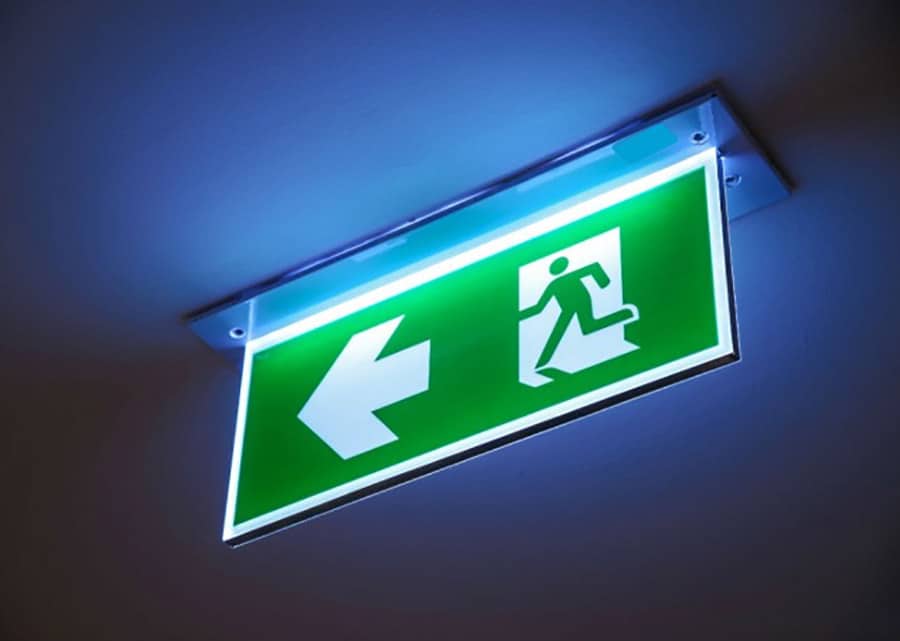
Emergency Lighting Testing in London
BS 5266-1:2016 and BS EN 50172 compliant testing across London. Annual 3-hour discharge, monthly function checks, lux-meter verification and a digital certificate within 24 hours. HMO, commercial and managed-block.
Out-of-hours scheduling at no premium — most discharge tests run after trading so the building is dark during the test.
24/7 landline 0207 046 1363 · Mobile/WhatsApp 07456 975436 · [email protected]
Emergency lighting testing in London is mandatory for every HMO and commercial premises under the Regulatory Reform (Fire Safety) Order 2005. BS 5266-1:2016 requires a monthly function test and an annual 3-hour full discharge test on every emergency luminaire. Our testing covers fittings from £69, with a BS 5266 + BS EN 50172 digital certificate issued within 24 hours.
What emergency lighting testing covers
Emergency lighting exists for one job: to keep the escape route lit when the mains fails. The British Standard that governs the design, installation and testing of those systems is BS 5266-1:2016, with BS EN 50172 setting the European requirements for the routine maintenance regime. Together they form the framework every responsible person needs to follow under the Regulatory Reform (Fire Safety) Order 2005.
A test visit covers every emergency luminaire, every exit sign and any central battery unit or inverter. Each fitting is identified against the system drawing, switched to battery, observed for the full discharge period, then measured with a calibrated lux-meter at floor level against the design value. The results are written into the on-site log book and onto the certificate, fitting-by-fitting, with a clear pass or fail against the standard.
Where the system fits is set by the fire risk assessment. Escape routes need 1 lux minimum on the centre line, anti-panic open areas need 0.5 lux minimum, and high-risk task areas need 10% of the normal task illuminance. Exit signs need to be visible and legible at the design viewing distance. Our engineers carry every fixture type — bulkheads, downlights, exit boxes and centrally-supplied luminaires — so common remedials are dealt with on the same visit.
Who needs emergency lighting testing in London
The duty rests on the responsible person under the Regulatory Reform (Fire Safety) Order 2005 — usually the landlord, the employer or the managing agent. The duty is to provide and maintain appropriate fire safety provisions, and the supporting government guidance reads that as BS 5266-compliant emergency lighting on every escape route.
- HMO landlords — every licensed House in Multiple Occupation in London needs emergency lighting on shared escape routes — staircases, landings, corridors and any internal route to the final exit. The annual BS 5266 certificate is one of the standard documents the council asks for at licence renewal.
- Commercial premises — offices, retail, hospitality, salons, gyms and light-industrial all sit under the RRO. The fire risk assessment will specify the system extent, and BS 5266 sets the test schedule. HSE prosecutions under the Health and Safety at Work Act 1974 are still being brought where emergency lighting has been allowed to fall out of service.
- Managed blocks of flats — common parts of purpose-built flats and converted houses fall under the RRO from 2023 changes to the Fire Safety Act 2021. Block managers and freeholders now need the annual emergency lighting certificate as part of the standard fire safety pack.
- Schools, places of worship, community buildings — any non-domestic premises with public access. Most are inspected periodically by the local fire authority and a missing or expired emergency lighting certificate is one of the most commonly cited deficiencies.
- Holiday lets and serviced apartments — buildings let on short-term contracts with shared escape routes are treated as the responsibility of the operator under the RRO and need a working, tested emergency lighting system.
Our testing service across London
Every visit is carried out by an electrician on the NICEIC register, 18th Edition qualified and trained on BS 5266 / BS EN 50172 testing. Calibrated lux-meters and battery analysers are carried on every van with annual certificates kept on file. Bookings are usually attended within 3–5 working days; same-week and out-of-hours commercial slots are routine.
The 3-hour discharge test runs in real time — there is no way to compress it because the point is to prove the battery actually lasts the rated duration. Most commercial discharge tests are scheduled for evenings or weekends so the building can be made dark and the test run without disrupting trading. There is no out-of-hours premium for emergency lighting testing on scheduled work.
Combined visits with the fire alarm BS 5839 test and the EICR get a portfolio discount — most landlords schedule all three on the same annual date to keep the compliance calendar tight.
Emergency lighting testing cost in London
Pricing is by fitting count. A fixed figure is confirmed on the call once the number of luminaires and exit signs is known. No VAT add-on, no out-of-hours premium on scheduled commercial work, no parking surcharges.
| System Size | What’s Covered | Price |
|---|---|---|
| Up to 3 emergency lighting fittings | Monthly function test or annual 3-hour discharge test, BS 5266 certificate. | £69 |
| Up to 6 emergency lighting fittings | Annual 3-hour discharge test, lux-meter check, BS 5266 + BS EN 50172 certificate. | £79 |
| Up to 10 emergency lighting fittings | Full system test, exit-sign verification, certificate within 24 hours. | £99 |
Prices include VAT. Systems over 10 fittings priced per fitting after a short site visit. See the full pricing page.
What’s included in every test
- Visual inspection of every luminaire, exit sign and central battery unit
- Monthly function test — short-duration switch-over check on every fitting
- Annual 3-hour full-discharge test in accordance with BS 5266-1:2016
- Lux-meter measurement against the 1-lux minimum on escape routes and 0.5-lux on open areas
- Verification of exit-sign legibility, mounting height and viewing-distance compliance
- Battery health check — terminal voltage, charge current and ageing assessment
- Confirmation that maintained, non-maintained and sustained fittings are wired to BS EN 50172
- Log-book entry with date, duration, fittings tested and pass/fail per fitting
- Digital BS 5266 certificate issued within 24 hours, hard copy on request
- Remedial quote on the day for any failed fitting, battery pack or driver
The BS 5266 testing schedule — what gets checked, and when
BS 5266-1:2016 sets out a layered regime — short checks frequently, deeper tests less often. Skipping the monthly function test is one of the most commonly cited reasons emergency lighting fails at the annual discharge: a battery that has not been cycled for 11 months often will not hold a charge when it is finally needed.
Function (short-duration) test
Every emergency luminaire is switched to its battery for a brief period — typically less than 30 seconds — to confirm the lamp strikes and the changeover relay operates. Results recorded in the on-site log book. Required by BS 5266 and BS EN 50172 every month without exception.
3-hour full discharge test
Every fitting is held on battery for the full 3-hour duration its rating claims. At the end of the test each fitting must still meet the minimum illuminance: 1 lux on the centre line of escape routes, 0.5 lux on open (anti-panic) areas. A failed fitting fails the certificate.
Lux-meter verification
Hand-held calibrated lux-meter readings taken at floor level on escape routes, at every change of direction, at exit doors and at fire-fighting equipment. Readings are logged against the design — typical office targets are 1 lux minimum, 5 lux at points of emphasis.
Battery and driver inspection
Battery terminal voltage on float, charge current, ambient temperature and age are recorded. Nickel-cadmium and lithium-iron-phosphate packs are typically replaced at 4 years, sealed lead-acid centralised systems at 5–7 years depending on ambient temperature and discharge cycles.
On top of the monthly and annual tests, a daily visual is expected — usually nothing more than a glance at the green LED on the central battery panel or, on self-contained systems, a walk-through to confirm every charge indicator is showing healthy. Daily checks are recorded in the on-site log book by the duty holder. We supply printed log books for clients without one as part of every annual visit.
Already due your annual test?
Most London HMOs and commercial premises run their emergency lighting on a calendar anniversary — if the certificate is older than 12 months, the building is technically non-compliant. Get a fixed price on the phone and a slot booked the same day.
What we’ve checked on a typical visit
Every certificate carries a fitting-by-fitting record, but the engineer also looks at the system as a whole. A small HMO escape route normally has a maintained bulkhead at the top of the stairs, a non-maintained bulkhead on each landing and an exit sign over the final door. A small office adds non-maintained downlights along the main circulation route and an additional fitting at every change of direction.
- Battery health — terminal voltage on float and after discharge, charge current and visible age of the pack. Most NiCd packs reach end-of-life at 4 years; we carry common replacement packs as van stock.
- Mounting and viewing distance — exit signs must be visible at the design distance (typically 24 m for the larger sign, 16 m for the smaller). Signs blocked by recent partitioning are a frequent finding at commercial sites.
- Lux readings on the centre line — measured at floor level on the escape route, at every change of direction and at the final exit. Below 1 lux on a route is a fail.
- High-risk task lighting — kitchens, plant rooms and any process area need 10% of normal task lighting. Frequently missing on older office conversions.
- Self-test luminaire status — modern self-test fittings carry their own LED indicator; a flashing red usually means a battery fault. Each one is logged and either replaced on the day or scheduled.
- Log-book and previous certificates — checked for continuity with the previous annual visit so a paper trail is maintained for the borough or insurer.
Need a quote, an urgent test, or a re-test after a failure?
Fixed prices confirmed on the call. Same-week slots across London. Out-of-hours commercial scheduling at no premium.
Areas covered
Emergency lighting tests are carried out across all 32 London boroughs and the City of London. Highest booking volumes from Camden, Westminster, Islington, Hackney, Tower Hamlets, Southwark, Lambeth, Wandsworth, Hammersmith & Fulham, Kensington & Chelsea, Haringey and Greenwich.
Frequently Asked Questions
How much does emergency lighting testing cost in London?
How often do emergency lights need to be tested?
Is emergency lighting a legal requirement?
What is the 3-hour discharge test?
Do you provide the BS 5266 certificate the same day?
What if a fitting fails the 3-hour test?
Do HMOs need emergency lighting?
What's the difference between maintained and non-maintained fittings?
Can you test emergency lighting alongside the fire alarm?
How long does the annual test take?
Still have questions?
Speak to an engineer for a fixed quote, certificate sample or a same-week slot. Combined visits with fire alarm testing, EICR and fire risk assessment get a portfolio discount.
£5m PL + £5m EL Hiscox insured · NICEIC approved · 24/7 across London · VAT registered