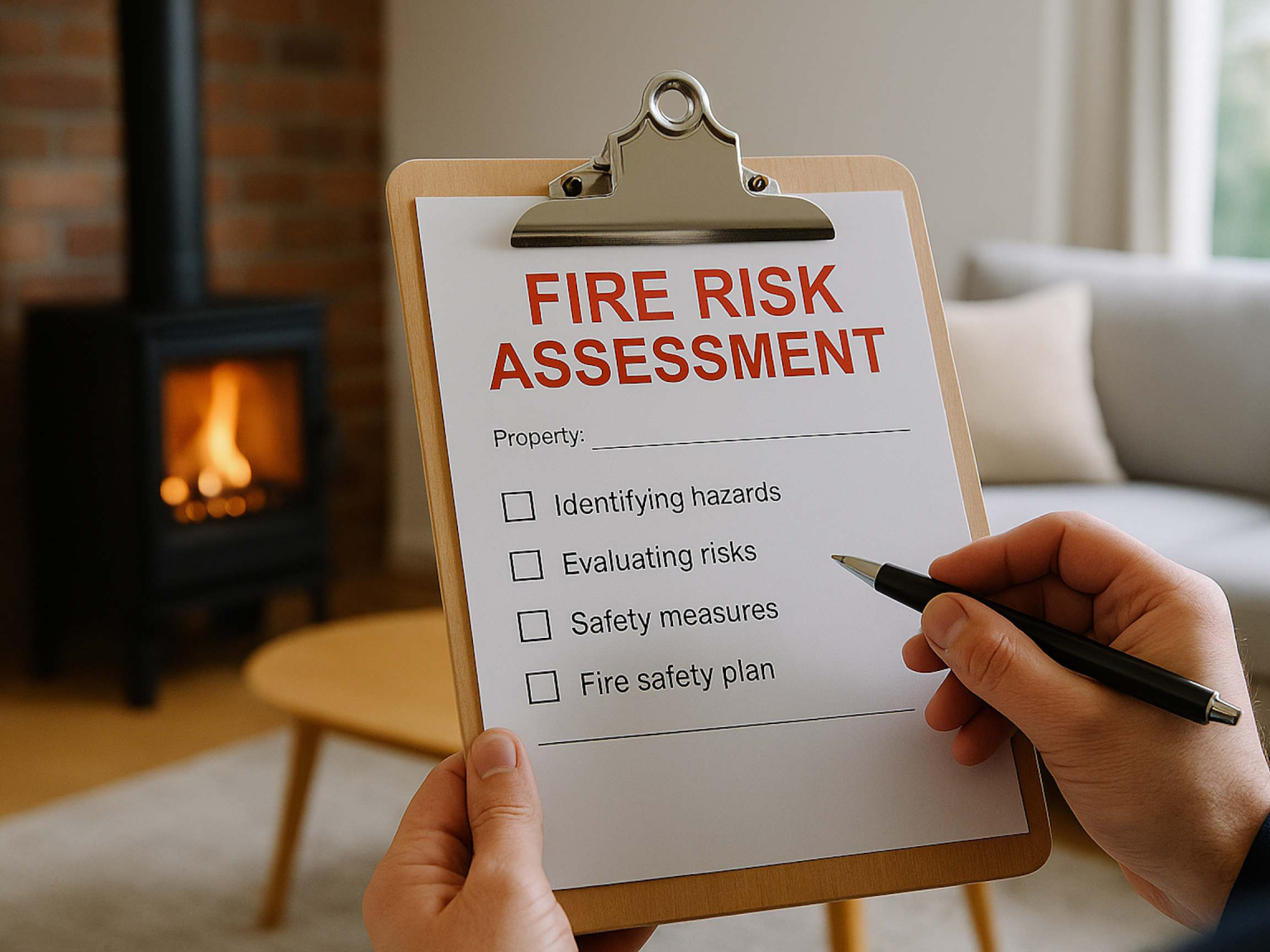
Fire Risk Assessment in London
PAS 79-1:2020 fire risk assessment from £169. Written report within 24 hours, photographic action plan, full compliance with the Regulatory Reform (Fire Safety) Order 2005. HMOs, blocks of flats, single-lets and small commercial premises across London.
Same-week site visits. Combined HMO licence pack (FRA + EICR + EPC + gas safety) available at portfolio discount.
Prefer a landline? Call 0207 046 1363 — 24/7.
A fire risk assessment in London costs £169-£249 depending on property type. It is a legal requirement under Article 9 of the Regulatory Reform (Fire Safety) Order 2005 for every non-domestic premises, every HMO and every block of flats with common parts. The PAS 79-1:2020 report is issued within 24 hours of the site visit with a photographic, priority-coded action plan.
What is a fire risk assessment?
A fire risk assessment is the formal, written exercise required by the Regulatory Reform (Fire Safety) Order 2005 to identify the fire hazards present in a building, identify the people at risk, evaluate the likelihood and severity of harm, remove or reduce that risk so far as is reasonably practicable, and record the findings in a document the responsible person can keep, review and act on. The duty falls on the responsible person — usually the landlord, freeholder, managing agent or employer — and cannot be delegated away.
The accepted methodology is set out in PAS 79-1:2020 (non-domestic) and PAS 79-2:2020 (housing), both published by BSI. The assessor works through a structured nine-step process — building description, occupancy profile, fire safety provisions, fire hazards, people at risk, evaluation of risk, recording of findings, planning the action plan and review schedule. Every London borough, every major insurer and every block managing agent accepts the PAS 79 format.
The Fire Safety Act 2021 clarified that the structure, external walls (including cladding, balconies and windows) and entrance doors of every block of flats are within scope of the assessment. The Fire Safety (England) Regulations 2022 added specific duties for blocks above 11 m — including quarterly fire door checks in common parts and annual checks of flat entrance doors — that the assessment now needs to reflect.
Who needs a fire risk assessment
- Landlords with HMOs — every HMO under the Housing Act 2004, whether mandatory-licensed (5+ persons, 2+ households), additionally-licensed by the borough, or unlicensed, must have a current written fire risk assessment. London boroughs request a copy at every licence application and renewal.
- Freeholders and block managing agents — every block of flats with common parts (corridors, stairs, lobbies, bin stores, plant rooms) needs a Type 1 PAS 79 assessment as a minimum. Higher-risk and post-incident reviews trigger Type 2, 3 or 4.
- Single-let private rentals — the assessment is not legally mandatory inside a single-household private rental, but the housing standards in the Housing Health and Safety Rating System (HHSRS) effectively require the landlord to assess fire safety. Boroughs increasingly request the written PAS 79-2 record as part of a Selective Licence.
- Employers and commercial occupiers — every employer with five or more employees on a single premises must record a fire risk assessment under Article 9(7) of the RRO. Smaller employers must still carry one out, just without the recording duty.
- Short-term lets — Airbnb, serviced apartments and short-let portfolios fall under the RRO when shared facilities or common parts are involved, and many platforms now require a current FRA as part of host onboarding. See our landlord compliance overview for the full certificate stack.
Our fire risk assessment service
Every assessment is carried out by an assessor competent under Article 18 of the RRO — registered on the IFE or IFSM third-party scheme, with current £2m PI insurance and a documented CPD programme. The methodology follows PAS 79-1:2020 for non-domestic premises and PAS 79-2:2020 for residential, mapped against the LACORS/LGA guidance for blocks of flats.
Site visits are scheduled within 3-5 working days across London. Priority bookings (borough deadline, insurance renewal, post-incident review) are available same-week or same-day. The site visit takes 60-90 minutes for a 1-3 bed property, 90-120 minutes for a 5-6 bed HMO and a half-day for a typical block common parts plus 4-flat sample.
The written PAS 79 report lands in your inbox within 24 hours of the visit as a digital PDF, with the action plan coded by priority — Intolerable / Substantial / Moderate / Tolerable / Trivial — against the BS 5306 risk matrix. Each finding is photographed, located against a floor plan sketch and given a target completion date. Remedials within our own scope (fire doors, intumescent stopping, BS 5839 alarms, BS 5266 emergency lighting, signage) are quoted alongside the report at no extra charge.
Fire risk assessment cost in London — transparent pricing
Pricing is by property type and occupancy band. The figure is confirmed on the call based on bedrooms, common parts, fire alarm grade and any communal plant or commercial element. No VAT add-ons, no parking charges, no out-of-hours premium on standard scheduled visits.
| Property Type | What’s Covered | Cost |
|---|---|---|
| 1-3 bedroom property | Single occupancy, full PAS 79 site visit, photographic report. | £169 |
| 4 bedroom HMO | Council-licensable HMO, BS 9991 considerations, action plan. | £179 |
| 5 bedroom HMO | Mandatory licensed HMO, full common-parts assessment. | £219 |
| 6 bedroom HMO | Larger HMO with individual room sampling, fire door survey. | £229 |
| Communal / commercial | Block common parts or small commercial PAS 79 + Type 1. | £249 |
Prices include VAT, site visit, PAS 79 written report, photographic action plan and digital PDF within 24 hours.
Get a fixed price in 60 seconds
Tell us property type, bedrooms and borough — confirmed quote on the call, site visit booked within 3-5 working days.
What’s included in every fire risk assessment
- Identification of the responsible person under Article 3 of the RRO 2005
- Identification of relevant persons at risk — tenants, visitors, contractors, neighbours
- Compartmentation survey — walls, ceilings, service penetrations, fire stopping
- Escape route inspection — travel distances, door widths, final exits, dead-end conditions
- Fire door survey — FD30/FD60 ratings, intumescent strips, smoke seals, self-closers
- Signage audit — running-man pictograms, fire action notices, extinguisher ID
- Detection and alarm review — Grade D LD2 / Grade A coverage, interlinking, sounder levels
- Electrical and ignition hazard sweep — consumer unit condition, overloaded sockets, portable heaters
- Emergency lighting check — 3-hour duration, illumination on escape routes, monthly log
- PAS 79-1:2020 written report with priority-coded action plan within 24 hours
What we check on site
Every assessment works through five core check areas. Each finding is photographed, measured against the relevant British Standard and coded for priority. The action plan that lands in your inbox lets you go straight from report to remedial without a second consultation.
Compartmentation and fire stopping
Every fire-resisting wall, ceiling and floor on the escape route is checked for breaches — unsealed pipe runs, holes around cables, missing intumescent collars at soil stacks, gaps over suspended ceilings. Compartmentation is what gives tenants the 30 or 60 minutes the building was designed around. A single 50 mm hole at a copper pipe penetration can void that protection entirely, and is the single most common finding in London HMOs.
Means of escape
Travel distances are measured against the values in BS 9991 (residential) and BS 9999 (other premises). Dead-end conditions over 9 metres, escape doors hung the wrong way, stair winders too tight, final exits locked with thumb-turns the wrong side — each is recorded with a photograph and a code. Stair pressurisation, smoke ventilation and AOVs are checked where fitted.
Fire doors
Every fire door on the escape route is surveyed individually — plug-tested for solid core, gap measured around the frame (3 ± 1 mm), intumescent and smoke seals checked for continuity, hinges counted (three required, CE-marked), closer tested for full latch from 30°, glazing checked for FD-rated wired or Pyran. Doors are coded against BS 8214 and the 2022 Fire Safety (England) Regulations door-check duty.
Detection, alarms and lighting
Alarm grade is determined against BS 5839-6 (domestic / HMO) or BS 5839-1 (commercial). Grade D LD2 minimum is the standard for shared houses; Grade A with addressable panel is normal for purpose-built blocks. Heat detectors in kitchens, smoke in escape routes, sounder dB levels measured at the pillow. Emergency lighting is checked for 3-hour duration to BS 5266-1 and the monthly flick-test log is requested.
Signage and management
Running-man pictogram signs to BS EN ISO 7010, fire action notices at every alarm call point, extinguisher signage and servicing labels (current annual service), assembly point identification. The management element of the assessment — fire log book, weekly call point test record, evacuation drill schedule — is reviewed and gaps are written into the action plan.
Findings are then collated into a single action plan with each item priority-coded, photographed and time-bound. For HMOs the action plan is mapped against the borough licence schedule so the landlord can show licensing officers exactly what has been actioned and when.
After the report — same-team remedials
A fire risk assessment that does not result in action is just paperwork. Most of the typical findings — a missing intumescent strip on a flat entrance door, an FD30 door without a self-closer, an emergency light without a current 3-hour test, a Grade D LD2 alarm that should have been upgraded to LD1 — fall well inside our remedial scope.
Where the assessor identifies remedials, a fixed-price quote is issued at the same time as the report. The same team can return to fit fire doors to BS 8214, top up intumescent stopping at service penetrations to BS 476, install or upgrade BS 5839-6 detection, install BS 5266-1 emergency lighting, fit BS EN ISO 7010 signage and complete the borough HMO licence pack alongside the EICR and CP12.
For ongoing compliance, the property is added to our 12-month review reminder so the next assessment is scheduled before the previous one expires — most borough licensing teams take a dim view of a lapsed FRA at renewal.
Penalties for non-compliance
Enforcement under the RRO 2005 sits with the local fire and rescue authority — in London that is London Fire Brigade. LFB audits routinely uncover missing or out-of-date assessments and the enforcement powers are wide.
- Unlimited fines under Article 32 of the RRO 2005 on summary conviction or indictment for failure to carry out a suitable and sufficient fire risk assessment.
- Up to 2 years’ imprisonment for the responsible person where the breach materially increases the risk of death or serious injury.
- Enforcement notices, alterations notices and prohibition notices served by London Fire Brigade — prohibition notices can shut a building immediately.
- HMO licence revocation by the local authority where the missing FRA forms part of a wider management failure under the Housing Act 2004.
- Insurance refusal — most landlord and block insurance policies require a current FRA as a policy condition. A fire claim on a property with an expired or missing assessment is commonly refused.
- Civil liability in tort where a tenant or visitor is injured and the assessment would have identified the hazard.
Areas covered
Fire risk assessments are carried out across all 32 London boroughs and the City of London. Heaviest booking volumes come from Camden, Westminster, Islington, Hackney, Tower Hamlets, Southwark, Lambeth, Wandsworth, Hammersmith & Fulham, Kensington & Chelsea, Haringey and Greenwich — boroughs with the largest HMO and block stock.
Frequently Asked Questions
How much does a fire risk assessment cost in London?
Is a fire risk assessment a legal requirement?
What is PAS 79?
How often does a fire risk assessment need to be reviewed?
What's the difference between a Type 1, 2, 3 and 4 fire risk assessment?
Do HMOs need a fire risk assessment?
How quickly can you do a fire risk assessment?
What happens if I don't have a fire risk assessment?
Will the report tell me what to fix?
Who carries out the assessment?
Still have questions?
Speak to a fire risk assessor today. Confirmed fixed price on the call, site visit within 3-5 working days across London, PAS 79 report within 24 hours of attendance. Bundle with your EICR and CP12 at portfolio rates.
Companies House No. 17120057 · £5m PL + £5m EL Hiscox cover · Assessor PI £2m