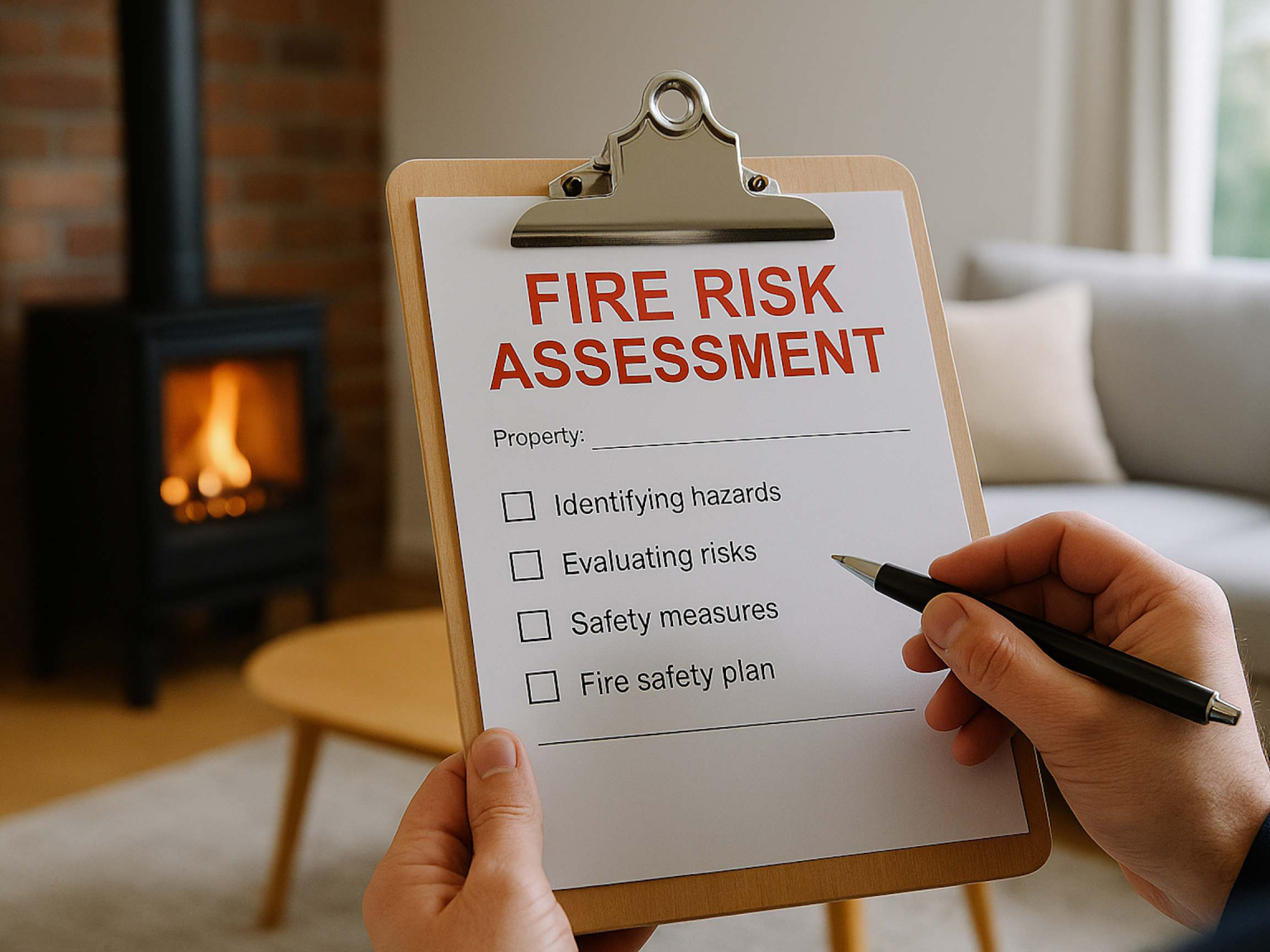
How Much Does a Fire Risk Assessment Cost in London? 2026 Prices
Real London 2026 pricing for fire risk assessments by property type — flats, HMOs, mixed-use, commercial — plus the cost factors that move the price and where landlords can save without cutting corners.
A standard PAS 79-compliant fire risk assessment (FRA) in London in 2026 costs £169 to £249 for a typical small residential block, single-let flat, or small HMO. Larger HMOs, mixed-use buildings and commercial premises sit higher — usually £275 to £495 depending on storey count, number of flats or sleeping rooms, communal-area complexity and whether a Type 1, Type 2, Type 3 or Type 4 inspection is required under PAS 79. Emergency Repairs London publishes fixed prices from £169 for compliant Responsible-Person FRAs across the 32 London boroughs, with a written report typically delivered inside 5 working days. Call 0207 046 1363, WhatsApp 07456 975436 or email [email protected].
If you have searched for the price of a fire risk assessment in London this year you will have seen a range so wide it is genuinely useless — £45 quotes sitting alongside £600 ones for the same flat. The headline number on a comparison site rarely reflects what the assessor actually does on the day, and that gap is where landlords get burned: a cheap report that does not satisfy the Responsible-Person duty under the Regulatory Reform (Fire Safety) Order 2005 is worse than no report at all, because it creates a documented record of an inadequate assessment.
This page is the real price list for London in 2026 — what a compliant PAS 79-method FRA actually costs by property type, what moves the price up or down, and where you can legitimately save money without ending up with a desktop questionnaire dressed up as a fire safety report.
Headline Prices — What You Actually Pay in London 2026
Emergency Repairs London publishes fixed prices across the 32 London boroughs. The starting point is £169 for a standard single-let or small block FRA and £249 for a typical small HMO. Larger and more complex properties are scoped before quote because a fixed list price would either overcharge straightforward buildings or undercharge genuinely complex ones — neither outcome is honest.
To set the rest of the market in context: independent assessors in London in 2026 generally price between £150 and £700 for residential work and £400 to £1,500 for commercial premises depending on size and complexity. Anything below £120 in London is almost certainly a desktop FRA — more on that further down.
Need a fixed price now? Call 0207 046 1363 or WhatsApp 07456 975436 with the property address, storey count and number of flats or sleeping rooms. You will get a fixed price back inside ten minutes during business hours and we can usually book the site visit inside the same week. See the full service detail at Fire Risk Assessment London.
Cost by Property Type
The biggest single driver of the price is what the building is and how it is occupied. Below is the typical 2026 range by property type for a London property assessed against PAS 79 with a written report.
- Single-let flat or maisonette — typically £169–£199. One protected escape route, one occupancy, a self-contained fire compartment. The shortest inspection of the lot.
- Small residential block (up to 6 flats, up to 3 storeys) — typically £199–£249. Communal escape route inspection, communal-area fire-door sample, communal alarm and emergency lighting review.
- Small HMO (up to 5 occupants, single household sharing) — typically £249–£295. Every bedroom inspected, kitchen high-risk review, BS 5839-6 Grade D LD2 alarm-system check, fire-door integrity sample.
- Large HMO (6–10 occupants, often licensed) — typically £295–£395. Adds escape-route inspection on every storey, BS 5839-6 Grade A inspection where applicable, BS 5266 emergency-lighting inspection in protected routes.
- Medium block (7–20 flats, 4–6 storeys) — typically £325–£495. Stair pressurisation review where present, dry-riser inspection log review, lift-lobby protection check, refuse-store fire separation.
- Mixed-use (commercial ground floor, flats above) — typically £325–£495. Adds commercial-tenant compartmentation review, separation between use classes, and a check on the means of escape from the upper floors that does not pass through the commercial demise.
- Small commercial premises (shop, office, salon, café) — typically £275–£450. Maximum occupancy calculation, escape capacity check, signage audit, emergency-lighting BS 5266 inspection, where applicable a separate PAS 79-2-style commercial assessment.
- FRA review of an existing report (no material change) — typically 40–60% of the new-assessment price for the same property — useful for the annual review cycle.
The Five Factors That Move the Price
If two London assessors quote different prices for the same property, the difference is almost always traceable to one of the following five factors. Knowing them lets you ask the right questions and stops you comparing a thorough quote with a stripped-back one.
- Storey count. A 6-storey block has more escape route to inspect than a 3-storey block, more fire-door samples, and more lobby-protection checks. PAS 79 expects the level of inspection to scale with the building, not be a fixed line item.
- Number of sleeping units. Sleeping risk is the highest-consequence fire scenario in residential property. Bedrooms add inspection time and report length on a near-linear basis — this is why HMOs cost more than non-HMO blocks of the same physical size.
- Communal-area complexity. A single straight corridor on each floor is fast. A stair core with secondary escape routes, lift lobby, refuse store, plant room, riser cupboards and basement service area is not. Refuse stores and basement plant rooms are disproportionate time-sinks because the fire-separation detail matters.
- PAS 79 inspection type required (1, 2, 3 or 4). See the next section. Type 1 (non-destructive, communal areas only) is the cheapest. Type 3 (intrusive into flats) is the most expensive because access to every dwelling has to be coordinated.
- New assessment vs. review of existing. If a competent PAS 79 report is already on file and the building has not materially changed, a review takes a fraction of the time and a competent assessor will charge accordingly. If no prior report exists or the prior one is non-PAS-79, it is a fresh assessment regardless of any paperwork the previous owner held.
PAS 79 Inspection Types — Why Type 3 Costs More
PAS 79:2020 (Parts 1 and 2) defines four inspection types for residential FRAs, and the type fundamentally drives the price.
- Type 1 — Non-destructive inspection of communal areas only. Most common for residential blocks. This is what almost every routine block FRA is. ERL's £199–£249 block price is a Type 1.
- Type 2 — As Type 1 but with destructive sampling (e.g. lifting a section of ceiling to verify compartmentation). Usually only commissioned after a Type 1 has flagged a concern. Significantly more expensive because of the making-good and the structural sign-off.
- Type 3 — Non-destructive inspection of communal areas and a sample of flats. Required where there is reason to suspect compartmentation issues inside flats — e.g. older blocks with known fire-stopping defects. Access coordination to each sampled flat is the main cost driver.
- Type 4 — As Type 3 but with destructive sampling inside flats as well as communal areas. The most thorough and the most expensive, usually only commissioned for high-rise post-incident or post-defect.
If an assessor quotes a single price without naming the inspection type, ask them. A competent quote will state the type and explain why it is appropriate for the property.
Why Under-£120 FRAs in London Are a Red Flag
The London labour market for a competent fire risk assessor sits between £55 and £85 per hour fully loaded. A compliant Type 1 FRA for even a small residential block — travel, site visit, fire-door sample, alarm and emergency-lighting check, photographic record, PAS 79 report write-up, significant findings register, prioritised action plan, QA review — is a minimum of 3 hours of qualified time. Below £120 the maths simply does not work for a real site visit in London.
What is actually being delivered at that price is one of three things: a desktop FRA based on a landlord questionnaire (no site visit, not compliant for any premises with communal areas); a template report with the address swapped in; or a loss-leader where the assessor expects to recoup the cost by selling remedial works at inflated prices. None of those help the Responsible Person discharge the duty under the Regulatory Reform (Fire Safety) Order 2005, and the first two will not stand up to London Fire Brigade scrutiny if there is an incident.
The cost of getting it wrong is not the difference between £79 and £199 — it is potential prosecution under Article 32 of the Order, with unlimited fines on indictment and, in serious cases, imprisonment. The price gap is not worth it.
What's Not in the FRA Price — Remedial Works
The FRA price covers the assessment, the report and the action plan. It does not cover the remedial works the report identifies. The remedial costs are quoted separately so the Responsible Person can prioritise and, importantly, can choose not to use the assessing firm for the remedials — that separation is good practice and we deliberately preserve it.
Typical remedial price ranges for London 2026:
- BS 5839-6 Grade D LD2 alarm upgrade (interlinked mains-wired smoke alarms with battery backup, suitable for most HMOs and rental flats) — typically £395–£795 for a 1–3 bed property depending on cable routes and access.
- BS 5839-6 Grade A panel-based system (required in some larger HMOs and most blocks) — typically £1,200–£3,500 depending on detector count and panel zoning.
- BS 5266 emergency lighting (escape routes, final exits, stair cores) — typically £75–£140 per luminaire installed including test cycle and commissioning certificate.
- FD30S fire-door upgrade (intumescent strips, cold smoke seals, replacement closer, threshold seal where required) — typically £195–£395 per door.
- FD30 or FD60 door replacement (where upgrade is not feasible) — typically £595–£1,200 per door installed with certification.
- Signage compliance (Health and Safety (Safety Signs and Signals) Regulations 1996, photoluminescent where required) — typically £250–£550 per typical property.
Compliance bundle for landlords. If you have multiple properties or a portfolio under management, our Landlord Compliance hub bundles FRA, EICR, gas safety and PAT under a single annual schedule with portfolio pricing. Email [email protected] with your address list.
How to Save Money Without Cutting Corners
There are legitimate ways to bring the cost down. None of them involve a desktop FRA or a £79 special.
- Book in clusters. If you own or manage multiple properties in the same postcode cluster, batching the inspections into one day removes travel time and we pass the saving on. Three properties in the same SW or E postcode booked together typically saves 10–15% on the per-property price.
- Review rather than replace. If you already have a PAS 79-compliant FRA from a competent assessor and the building has not materially changed, commission a formal review rather than a fresh assessment. ERL prices reviews at 40–60% of the new-assessment price.
- Get the access right. The single biggest avoidable cost is wasted site visits. If access to communal areas, plant rooms, refuse stores and riser cupboards needs concierge or managing-agent coordination, line it up before the assessor arrives. Two visits cost twice as much as one.
- Decouple the remedials. Get the FRA from one firm, quote the remedials from two or three. This is good practice and you will almost always save money on the works package — especially on alarm-system installations where pricing varies sharply.
- Time the licence cycle. If you are commissioning the FRA specifically for an HMO licence application or renewal, book it 6–8 weeks before the licence deadline, not 2 — rush jobs against a deadline have less room for price negotiation and you risk a late-licence penalty if the remedials run long. See HMO Fire Risk Assessment Requirements and How Often Is a Fire Risk Assessment Legally Required? for the licensing-cycle detail.
How to Book — Three Routes
- Phone: 0207 046 1363 — fastest. A real person takes the address, storey count and number of flats or sleeping rooms and quotes a fixed price.
- WhatsApp: 07456 975436 — best if you can send a photo of the front elevation and the communal-area entry. The dispatcher can usually quote inside ten minutes during business hours.
- Email: [email protected] — best for portfolios. Send an address list and any existing FRA reports on file and we will come back with a portfolio quote.
Standard turnaround is the site visit inside one week of booking and the written report inside five working days of the inspection. Faster turnaround is available on request where a sale completion, mortgage condition, insurance renewal or HMO licensing deadline is driving the timeline.
FAQs
The FAQ section at the foot of this page (rendered from the schema above) covers: the headline 2026 price range in London, whether a £79 FRA is legal, why HMO assessments cost more, how long the inspection and report take, whether ERL also covers the remedial works, and how often a new FRA is required under the Regulatory Reform (Fire Safety) Order 2005.
Book the assessment now — 0207 046 1363, WhatsApp 07456 975436, or [email protected]. Fixed prices from £169, full PAS 79 methodology, written report inside five working days.
— John Alexander N. — Emergency Repairs London
Key Takeaways
- ERL fixed prices start at £169 for a standard single-let or small block FRA and rise to £249 for typical small HMOs — larger or more complex properties are scoped before quote
- The Regulatory Reform (Fire Safety) Order 2005 makes the Responsible Person legally accountable for arranging a 'suitable and sufficient' FRA — there is no statutory rate card, but PAS 79 sets the methodology
- Five factors move the price: storey count, number of sleeping units, communal-area complexity, PAS 79 inspection type (1–4), and whether an existing report needs reviewing versus a fresh assessment
- A cheap FRA is almost always a desktop FRA — pricing under £120 in London usually signals no site visit, no communal-area inspection, and a report that will not survive Fire Brigade scrutiny
- The FRA itself is only half the cost story — remedial actions (BS 5839-6 alarm upgrades, BS 5266 emergency lighting, fire-door upgrades) are quoted separately after the report
- Reviewing an existing FRA after a material alteration costs less than commissioning a fresh one — typically 40–60% of the new-assessment price if the original is on file and still broadly valid
