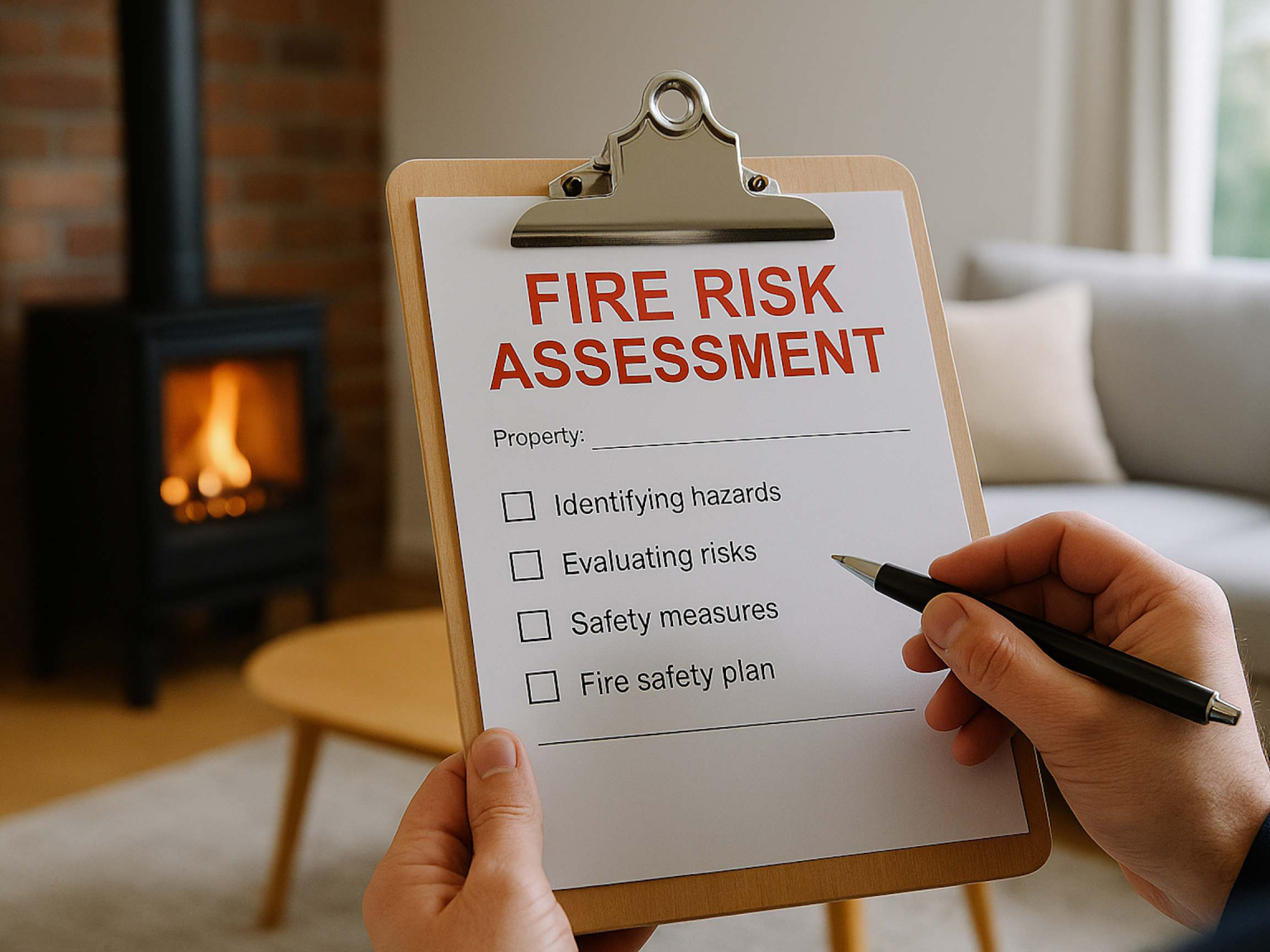
How Often Do London Landlords Need a Fire Risk Assessment? Statutory Frequency, Borough Variations & Review Triggers
Statutory frequency requirements under the Regulatory Reform (Fire Safety) Order 2005, borough variations across London, and the review triggers that force an earlier reassessment. Practical guidance for landlords, HMO operators, freeholders and managing agents.
There is no fixed statutory interval. The Regulatory Reform (Fire Safety) Order 2005 (RRO) requires the Responsible Person to keep the Fire Risk Assessment (FRA) under review and revise it whenever it is no longer valid or there has been a significant change. In practice, industry guidance (PAS 79 and the LGA HMO guidance) treats annual review and full reassessment every 1–3 years as the working standard for residential blocks and HMOs in London, with low-risk single-let dwellings reviewed annually and reassessed at most every 3 years. Higher-risk premises — sleeping accommodation, HMOs, blocks over 11m, premises with vulnerable occupants — sit at the shorter end. Call Emergency Repairs London on 0207 046 1363 or WhatsApp 07456 975436 to book.
Short answer. The Regulatory Reform (Fire Safety) Order 2005 (RRO) is the controlling legislation, and it deliberately does not specify a calendar frequency. Article 9(3) requires the Responsible Person to keep the Fire Risk Assessment under review "regularly" and to revise it where it is no longer valid or where there has been a significant change. The working standard the industry has settled on — codified through PAS 79-1:2020, PAS 79-2:2020 and the LGA HMO guidance — is an annual desk-and-walk review, with a full on-site reassessment every one to three years depending on the risk profile of the premises.
That short answer hides a lot of detail. London adds borough licensing layers on top of the RRO, post-Grenfell legislation has tightened the regime for taller buildings, and a set of operational triggers force an early reassessment regardless of where the calendar sits. This article walks through what the law actually requires, what the working standard looks like in practice, where the boroughs diverge, and the eleven trigger events that should put a new FRA into the diary even if the existing one is only a few months old.
If you would rather book a survey now and read this later, call 0207 046 1363 or WhatsApp 07456 975436. We hold PAS 79-qualified assessors on the team and run FRA surveys across the 32 London boroughs with a written report inside five working days.
The Statutory Position — What the Law Actually Says
The Regulatory Reform (Fire Safety) Order 2005 came into force on 1 October 2006 and is the controlling statute for fire safety in non-domestic premises, the common parts of residential blocks, HMOs and any workplace in England and Wales. The duty falls on the Responsible Person — usually the employer, the building owner, the freeholder, the managing agent or the person who has control of the premises in connection with a trade, business or undertaking.
Article 9 is the operative provision. Article 9(1) requires a "suitable and sufficient" risk assessment. Article 9(3) is the frequency clause and reads, in substance, that any such assessment must be reviewed regularly so as to keep it up to date, and revised where it is no longer valid or where significant changes have occurred. Article 9(6) caveats that a review is required in particular where there is reason to suspect the assessment is no longer valid, or where there has been a significant change in the matters to which the assessment relates.
That is the whole frequency framework in primary law. No interval. No calendar. The legislator left the cadence to industry guidance and to the judgement of the Responsible Person, because the appropriate interval for a single-let house in Bromley is not the same as the appropriate interval for a 40-unit purpose-built block in Tower Hamlets with vulnerable occupants and a Stay-Put policy.
Two pieces of secondary legislation refine the picture. The Fire Safety Act 2021 clarified that the RRO applies to the structure, external walls and individual flat entrance doors of any building containing two or more dwellings — which closed the loophole identified after Grenfell. The Fire Safety (England) Regulations 2022, in force from 23 January 2023, added prescribed duties for residential blocks over 11m and over 18m, including quarterly checks of fire doors in common parts (over 11m) and monthly checks of lifts and key fire-safety equipment (over 18m). Those prescriptive checks do not replace the FRA; they sit alongside it.
The Industry Working Standard — Annual Review, 1–3 Year Reassessment
PAS 79 is the publicly available specification published by BSI that sets out the methodology for FRAs. PAS 79-1:2020 covers general non-domestic premises; PAS 79-2:2020 covers housing — purpose-built flats, converted flats and HMOs. Both documents recommend a review at least annually and a full reassessment at an interval determined by the risk profile, with three years as the upper bound for most premises.
Translated into a working cadence:
- Annual review — every year, the Responsible Person (or a competent person engaged by them) walks the premises, checks that the existing FRA is still valid, signs the review section of the report, and either confirms the assessment as still suitable and sufficient or flags it for a full revisit. The review is documented but does not require a fresh full report.
- Full reassessment — every one to three years depending on risk. A fresh on-site survey, a new written report under PAS 79 format, a new significant-findings list, a new action plan. The reassessment supersedes the previous report.
The exact interval inside the 1–3 year range is set by the risk profile. The LGA's Guide to Fire Safety in Purpose-Built Blocks of Flats and the National Fire Chiefs Council guidance both recommend 12 months for high-risk premises, 24 months for medium risk and 36 months for low risk. "Risk" is a composite of building height, construction type, occupancy vulnerability, presence of sleeping accommodation, history of fire incidents and the condition of fire-protection measures.
Frequency by Property Type
The table below is what we apply on our London Fire Risk Assessment bookings unless a licence condition or insurer's clause demands tighter. It is consistent with PAS 79 and the LGA guidance and is the cadence most competent assessors recommend to landlords and managing agents.
- Single-let house or flat, no HMO licence, low occupancy turnover — annual review, full reassessment every 3 years.
- Single-let house or flat with a selective licence in force — annual review, full reassessment every 2 years (the licence condition typically caps it at 2).
- HMO under additional or mandatory HMO licence (3+ unrelated tenants in most London boroughs, 5+ for the national mandatory scheme) — annual review, full reassessment every 1–2 years. See our HMO Fire Risk Assessment London page.
- Purpose-built block of flats, under 11m — annual review of common parts, full reassessment every 2–3 years.
- Purpose-built block over 11m (Fire Safety Regulations 2022 building) — annual review, full reassessment every 2 years, plus quarterly fire-door checks in common parts as a separate prescriptive duty.
- Purpose-built block over 18m or 7 storeys (Higher Risk Building under Building Safety Act 2022) — annual review, full reassessment every 1–2 years, with the FRA forming part of the Safety Case Report submitted to the Building Safety Regulator.
- Mixed-use premises with commercial ground floor and residential above — annual review, full reassessment every 1–2 years; the commercial use typically pulls the interval to 12 months.
- Sleeping accommodation outside the HMO definition — small care settings, supported housing — annual full reassessment as standard, given occupancy vulnerability.
Need a survey on a portfolio? We run scheduled FRA programmes for managing agents, freeholders and landlord groups across London. Call 0207 046 1363, WhatsApp 07456 975436, or email [email protected] for a portfolio quote.
Borough Variations Across London
The RRO is national legislation but London borough licensing schemes layer additional conditions on top. The conditions are imposed under the Housing Act 2004 (selective and additional licensing under Parts 2 and 3) and are enforceable as licence terms — breach can void the licence and trigger civil penalties up to £30,000 per offence.
The boroughs operate to different settings. The pattern in 2026:
- Newham — borough-wide selective and additional licensing. FRA review required annually as an express licence condition; full reassessment every 12 months for HMOs.
- Waltham Forest — borough-wide selective licensing. Annual FRA reassessment is standard licence wording for HMOs and most selective-licensed single-lets.
- Tower Hamlets — additional licensing across the borough plus selective licensing in designated wards. Annual FRA reassessment expected for HMOs; 2-yearly for single-lets.
- Croydon — additional licensing across the borough since 2020. Annual FRA reassessment for HMOs, annual review for selective-licensed properties.
- Hackney, Haringey, Lewisham, Southwark, Lambeth, Brent, Ealing, Enfield — additional HMO licensing in designated wards; standard licence condition is annual review with full reassessment every 1–2 years.
- Westminster, Kensington & Chelsea, Camden, Hammersmith & Fulham, City of London — mandatory HMO licensing only (5+ tenants); local conditions tend to follow the national pattern of annual review and 1–2 year reassessment.
- Outer boroughs (Bromley, Bexley, Havering, Hillingdon, Sutton, Kingston, Richmond) — mandatory HMO licensing only in most cases; FRA frequency follows PAS 79 default of annual review and 2–3 year reassessment.
The borough licensing schedule changes periodically. Newham renewed in 2023, Waltham Forest in 2024, Croydon in 2025. Before any FRA cycle is locked in, check the current licence terms attached to the specific property — they sit on the council's licensing register and on the licence document itself.
The Eleven Review Triggers — Forced Reassessment
The calendar interval is the default. The triggers below override it. Where any of these occur, Article 9(3) RRO requires a review and, in almost every case, a revised FRA — regardless of whether the existing report is six months old or two years old.
- Change of use — the premises moves from one Use Class to another, or sleeping accommodation is introduced where none was provided before.
- Layout alteration — structural changes, new partitions, removed walls, new staircases, alterations to escape routes, conversions of common cupboards to occupied space.
- Change of tenant cohort or occupancy numbers — the demographic or vulnerability profile changes (e.g. premises becomes housing for adults with mobility issues), or the number of sleeping persons changes materially.
- Fire incident on site — any fire, regardless of size, requires a review. A small kitchen fire that was self-extinguished still triggers it.
- Near-miss — smoke incident, AFD activation that revealed a missing detector zone, fire-door failure under test.
- Complaint about fire safety — from a tenant, leaseholder, neighbouring occupier, employee or contractor. Documented complaints must be reviewed; an undocumented one should still trigger a check.
- Enforcement or alterations notice from the LFB — service of any formal notice under Articles 29–31 RRO triggers a full reassessment.
- New fire-safety information about the building — cladding survey results, EWS1 outcomes, intrusive compartmentation surveys, asbestos surveys that reveal previously unknown sprayed coatings on structural members.
- Deterioration of fire-protection measures — fire doors out of compliance with BS 8214, AOVs failing the BS EN 12101 smoke-control test, dry risers failing the annual BS 9990 pressure test, emergency lighting failing the monthly or annual BS 5266 test.
- Change of Responsible Person — sale of the freehold, change of managing agent, change of director at the freehold company. The incoming Responsible Person should commission a fresh FRA rather than inherit the outgoing person's report unread.
- Publication of new standards or guidance — a substantive update to BS 5839-6 (residential smoke and heat alarms), BS 5266 (emergency lighting), PAS 79, or the publication of a new official guidance document by the Home Office or the Building Safety Regulator.
Items 1–4 are absolute — there is no judgement to exercise. Items 5–11 are discretionary in the sense that the Responsible Person must consider whether the trigger is material to the existing assessment; in most cases it is.
Higher Risk Buildings (HRBs) Over 18m
The Building Safety Act 2022 created a separate regime for Higher Risk Buildings — residential buildings of at least 18 metres in height or at least 7 storeys, containing at least two residential units. Roughly 1,200 buildings in London fall inside the HRB definition.
For HRBs the FRA is still required under the RRO, but it additionally forms a component part of the Safety Case Report that the Accountable Person submits to the Building Safety Regulator. The Safety Case Report must be kept current — the BSR can require it to be resubmitted at any time and routinely audits the underlying FRAs as part of the building's registration cycle. In practice this pushes the reassessment cadence for HRBs to the 12–24 month end of the range, and the LFB and BSR will both expect to see a current report on any inspection.
The HRB regime is administered alongside our standard FRA work and we cover the additional Safety Case requirements through the Landlord Compliance Hub for portfolio clients.
What Goes Wrong When Landlords Stretch the Interval
The temptation to stretch the FRA cycle — "the building hasn't changed, so the assessment is still valid" — is real, particularly on stable single-let portfolios. The cases we see most often when an LFB inspection or insurance claim brings it to a head:
- Significant findings unactioned — the previous FRA flagged a missing self-closer on a flat entrance door, or a dead-battery emergency luminaire on a stair, and the action list was never closed out. Even if the FRA itself is in date, the failure to close significant findings is a separate Article 9 breach.
- BS 5839-6 alarm grade out of date — the previous FRA was conducted before the 2019 revision to BS 5839-6, which tightened the grade requirements for HMOs and rental dwellings. A pre-2019 FRA will frequently specify a Grade D or LD3 system where the current standard requires Grade D2 or LD2.
- BS 5266 emergency lighting drift — luminaires installed under earlier revisions of BS 5266 are no longer compliant with the 2016 standard, particularly in common parts of converted flats. The drift only becomes visible on a fresh PAS 79 assessment.
- Cladding and compartmentation — premises that passed an FRA in 2018 may since have been the subject of an EWS1 survey, an intrusive compartmentation survey, or a Building Safety Regulator direction. The old FRA does not reflect that information.
- Insurance void — building-insurance policies routinely include a warranty that the FRA is current and that significant findings have been actioned. A stale FRA is a routine ground for an insurer to decline a claim after a fire.
How We Schedule the Review Cycle for Portfolios
For managing agents and landlords with multiple properties we run the FRA cycle as a scheduled compliance programme rather than as a series of one-off bookings. The pattern is straightforward: every property gets a date in the calendar set against its individual risk profile, with the annual review and the full reassessment booked together at year zero so the cycle does not slip. The review month and the reassessment month are not always the same; for an HMO on a 12-month reassessment cycle the review IS the reassessment, while for a 3-year low-risk property there are two intermediate annual reviews between full reassessments.
Reports are issued in PAS 79 format with the significant-findings list separated from the action plan, action items date-tagged with a target completion, and a sign-off section for the Responsible Person to confirm the actions have been closed. The next review date and the next reassessment date are both written into the cover page so the diary cannot be lost.
If you manage a London portfolio and have not yet committed the FRA cycle to a fixed schedule, the Landlord Compliance Hub sets out the full annual cycle alongside EICR, gas safety, EPC, legionella and PAT. The fire-safety side links back to the dedicated FRA service page; the HMO-specific cycle lives at HMO Fire Risk Assessment London.
For related reading on the same topic, our breakdown of what FRAs actually cost in London this year is at Fire Risk Assessment Cost London 2026, and the borough-by-borough HMO-specific requirements are at HMO Fire Risk Assessment Requirements.
FAQs
The FAQ block below (rendered from the schema above) covers the legal frequency under the RRO 2005, how often HMO assessments need to be redone in London, the distinction between review and full reassessment, the trigger events that force an early reassessment, when the assessment must be in writing, and the consequences of letting it lapse.
Book a Fire Risk Assessment with us. PAS 79-qualified assessors, written report inside five working days, cover across the 32 London boroughs. Call 0207 046 1363, WhatsApp 07456 975436, or email [email protected].
John Alexander N. — Emergency Repairs London
Key Takeaways
- The RRO 2005 does not set a fixed interval — it sets a duty to keep the FRA under review and revise it on any significant change
- Industry working standard: annual review, full reassessment every 1–3 years depending on risk profile; HMOs and sleeping-accommodation premises typically reassessed every 1–2 years
- Higher Risk Buildings (HRBs) over 18m or 7 storeys fall additionally under the Building Safety Act 2022 — the FRA forms part of the Safety Case Report submitted to the Building Safety Regulator
- London borough licensing schemes (selective, additional, mandatory HMO) frequently impose tighter review intervals than the RRO baseline — Newham, Waltham Forest, Tower Hamlets and Croydon are the most prescriptive
- Eleven review triggers force an earlier reassessment regardless of date: change of use, layout alteration, new tenant cohort, fire incident, near-miss, complaint, regulator notice, new fire-safety information, deterioration of fire-protection measures, change of Responsible Person, new BS-5839-6 or BS-5266 guidance
- A 'suitable and sufficient' FRA under Article 9 RRO must be written down where five or more persons are employed, where a licence is in force (most London HMOs), or where an alterations notice has been served — which in practice means almost every London landlord premises
- Post-Grenfell enforcement under the Fire Safety Act 2021 and the Fire Safety (England) Regulations 2022 has increased the inspection rate by the LFB — out-of-date FRAs are now a routine prohibition-notice ground
