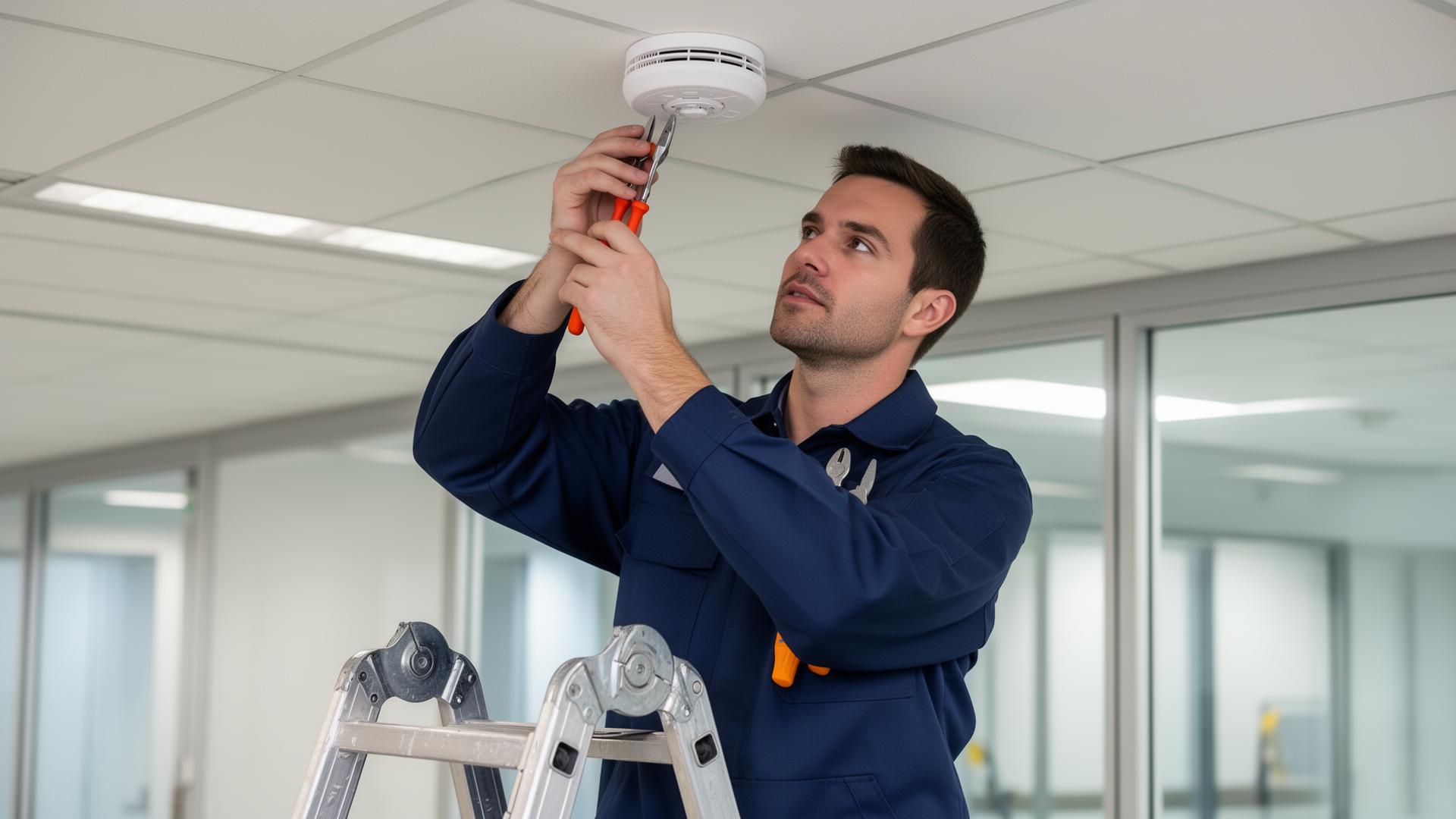
Fire Alarm Testing Schedule: Weekly, Monthly, Annual — The Landlord Reference
The full statutory test schedule for landlords under BS 5839-6 and the RRO 2005, plus how to keep the test logbook so it stands up to an LFB or council audit.
Under BS 5839-6 (domestic) and BS 5839-1 (HMO common areas / commercial), a London landlord's fire-alarm test schedule has four tiers: a WEEKLY user test of one manual call point or one detector per zone (rotating), a MONTHLY function test of every interlinked unit, a SIX-MONTHLY service inspection of the system on Grade A and Grade D systems, and an ANNUAL service by a competent engineer with a certificate. Battery-only smoke alarms in single-dwelling lets need a monthly push-button test by the tenant and a battery change at the LL's annual visit. Every test gets a logbook entry: date, time, device tested, result, tester signature. The logbook is what the London Fire Brigade and the council ask for under the Regulatory Reform (Fire Safety) Order 2005 and the Smoke and Carbon Monoxide Alarm (England) Regulations 2022. Call Emergency Repairs London on 0207 046 1363, WhatsApp 07456 975436, or email [email protected] to book a compliant annual service.
If you let property in London, the fire-alarm test schedule is not a single date in the calendar — it is a four-tier cadence that runs every week of the year. Get it right and the logbook does the talking for you at any council or London Fire Brigade audit. Get it wrong and the absence of a logbook becomes the audit finding, regardless of how new and how well-specified the actual system is.
This article is the working reference: what to test weekly, monthly, six-monthly and annually; who does what; what goes in the logbook; and where the most common audit failures come from. It draws on BS 5839-6 (domestic premises), BS 5839-1 (non-domestic and HMO common parts), PAS 79 (fire risk assessment methodology), and the duties set out in the Regulatory Reform (Fire Safety) Order 2005 and the Smoke and Carbon Monoxide Alarm (England) Regulations 2022 as amended.
The Legal Framework: RRO 2005 + 2022 Regs
Two pieces of law sit on top of the British Standards and turn them into enforceable duty.
The Regulatory Reform (Fire Safety) Order 2005 applies to the common parts of any premises that is not a single private dwelling — so all HMOs, all blocks of flats (common parts only), all mixed-use buildings, and all commercial premises. Article 9 requires a written fire-risk assessment. Article 17 requires the Responsible Person to keep all fire-safety equipment in efficient working order and in good repair. The British Standards are how you demonstrate compliance with Article 17 in practice; the logbook is how you prove it.
The Smoke and Carbon Monoxide Alarm (England) Regulations 2015 (as amended 2022) apply to the dwelling itself in any rental — including single-family lets where the RRO 2005 does not bite. The 2022 amendment extended the duty to social housing and added the requirement that the landlord (or agent) repair or replace a faulty alarm reported by a tenant "as soon as reasonably practicable." There is no fixed timescale in the regulations themselves, but enforcement practice across London councils has settled on 28 days as the outer bound, and same-day or next-day for any alarm that is the only smoke alarm on a storey.
Both regimes assume you have a written test schedule and a logbook to back it up. The schedule below is the one we issue with every annual service we carry out across the 32 London boroughs.
The Weekly Test (HMO and Commercial)
For any property with a BS 5839-1 Grade A system — typical in licensed HMOs, larger blocks of flats with a central panel, and any commercial premises — the weekly test is the foundation of the schedule.
The procedure, drawn directly from BS 5839-1 section 44:
- Operate one manual call point using the test key. Rotate the call point each week so that every call point in the building has been tested at least once per quarter.
- Confirm the panel registers a fire signal at the correct zone.
- Confirm the sounders operate at the audible level required by the design.
- Silence and reset the panel cleanly with no residual fault indication.
- Log: date, time, call-point reference, sounder result, panel result, tester initials.
The weekly test takes a competent person under five minutes in a typical small HMO. In larger systems with voice-alarm zones or multi-loop panels it can take fifteen. We carry it out as part of our PPM rota for managing agents who do not have a competent on-site person, but in most lets the schedule is handed to a named house manager, caretaker or letting-agent representative.
For a Grade D1/D2 domestic system in a single-family let, the BS 5839-6 equivalent is a periodic user test — typically monthly, not weekly — carried out by the tenant under written instructions left at the property at the start of the tenancy.
Need an annual service or a compliant logbook reset? Call Emergency Repairs London on 0207 046 1363 or WhatsApp 07456 975436 — we cover the 32 London boroughs and turn standard fire-alarm services round inside five working days.
The Monthly Test (All Properties)
The monthly test catches anything that the weekly call-point rotation has not yet reached, and it picks up any drift in detector sensitivity, battery condition (on systems with standby batteries), or panel status that has accumulated since the last engineer visit.
In a Grade A system (HMO or commercial): visually inspect the panel, log the standby-battery voltage where the panel displays it, and confirm there are no active fault indicators. If the panel has logged any false alarms since the last entry, investigate and record the cause.
In a Grade D domestic system: the tenant pushes the test button on at least one interlinked detector, confirms all linked detectors sound together, and logs the result. The landlord retains the master log and reviews it at each property visit and at the annual service.
In a Grade F battery-only system (single-occupancy let with no mains alarms — increasingly rare and being phased out across London on tenancy changeover): the tenant pushes the test button on every alarm monthly. The landlord verifies operation at every visit and replaces the sealed unit at end-of-life (typically 10 years from manufacture, marked on the back of the unit).
The Six-Monthly Service Inspection
BS 5839-1 section 45.3 specifies a six-monthly service inspection for Grade A systems with more than thirteen detectors. BS 5839-6 carries a parallel six-monthly inspection for Grade A and Grade D1/D2 domestic systems in larger HMOs.
The six-monthly is a half-annual service — the engineer attends, tests a sample of detectors (typically 25% of devices, rotating so every device is tested within four visits), checks the panel and battery, reviews the logbook for any incidents since the last visit, and issues an interim certificate. It does not replace the annual full service; it sits between annual services to catch drift early.
For smaller properties — single-family lets, two-bed HMOs with a basic Grade D system — the six-monthly is usually folded into the tenant's monthly routine and a single annual engineer visit. The British Standard allows this proportionality; the risk assessment in the property file should record the decision and the reasoning.
The Annual Service & Certificate
The annual service is the only test in the schedule that legally requires a competent fire-alarm engineer — usually a BAFE SP203-1 registered firm. Every detector is tested using the appropriate stimulus (smoke aerosol for optical detectors, heat source for heat detectors, magnet for manual call points). Every sounder is verified. The standby battery is load-tested or replaced if it has reached its service life. The control panel is checked end-to-end.
On completion the engineer issues:
- A service certificate naming the standard worked to (BS 5839-1 or BS 5839-6), the devices tested, defects found, defects rectified, defects outstanding, and the next service date.
- A logbook entry summarising the visit.
- If the property is part of a managed portfolio, a single-page compliance summary suitable for handing to a leasehold management company or to the building's responsible person.
The certificate is the document the council, the LFB, the buildings insurer and any future buyer or mortgage valuer will ask for. Keep the last three years' worth on file.
The Logbook — What to Record
The logbook is the single most important piece of evidence in any audit. A well-kept logbook turns a thirty-minute inspection into a five-minute one.
Each routine test entry needs: date, time, tester name (or initials with a name register at the front of the book), device tested or test type, result, any fault and any action taken. Each service entry needs: engineer name and qualification, firm name, certificate reference, next service date.
The logbook should also store:
- The original commissioning certificate from when the system was installed
- The most recent fire risk assessment (PAS 79 format is the working standard)
- All service and interim certificates
- Any false-alarm investigation notes — false alarms above two per year per detector head are a flag in BS 5839-1 and should be investigated
- The system design document (zone plan, device schedule)
Paper logbooks are still common and remain compliant. Digital logbooks — typically QR-code scan-in systems linked to a portfolio dashboard — are increasingly the standard for managing agents with multi-property portfolios. Either is acceptable; what is not acceptable is a logbook with a six-month gap, an entry that simply says "tested OK" with no device reference, or a logbook produced retrospectively the day before an inspection. Inspectors recognise both immediately.
Schedule by System Grade
BS 5839-6 sets out six grades for domestic premises (F, E, D2, D1, C, B, A in ascending order of robustness). The test schedule scales with the grade.
- Grade F (battery-only, single-family lets — being phased out): tenant monthly push-button test, landlord verification at tenancy change, sealed-unit replacement at 10 years. No engineer service required, but a basic record should still be kept.
- Grade D1 / D2 (mains-powered with sealed-in or replaceable battery backup — the modern standard for most rentals): tenant monthly test, landlord verification at tenancy change and during periodic inspections, annual engineer service.
- Grade C (mains-powered with central control unit): tenant monthly, six-monthly engineer interim, annual engineer service.
- Grade B / A (full-system installations with panel, used in larger HMOs and blocks): weekly user test (rotating call points), monthly panel check, six-monthly engineer interim, annual engineer service.
If your property currently has a Grade F system and the tenancy is changing, it is almost always worth upgrading to Grade D1 at turnover — the wiring goes in cleanly while the property is empty, the lifetime cost is lower than rolling replacement of Grade F sealed units, and the compliance position is materially stronger. We do these upgrades alongside smoke alarm installations across London routinely.
For the full grade-by-grade specification — what each grade actually contains, which property type it suits, and the cost implications — see the companion article BS 5839-6 Grades Explained.
Common Audit Failures
From the audits we attend on landlord and managing-agent behalf, the same handful of failures account for the majority of enforcement notices.
- No logbook, or a logbook with gaps — by a long way the most common finding. Even where the hardware is brand new and the engineer's service certificate is on file, the absence of routine weekly/monthly entries is a finding under Article 17 of the RRO 2005.
- Annual service overdue — typically by two to six months. Often happens when a property changes managing agent and the schedule is not handed over cleanly.
- Battery-only Grade F system not declared in the fire risk assessment — the FRA should note the grade and justify it against the property's risk profile. A bare "smoke alarms fitted" is not enough.
- Manual call points obstructed or unreachable — common in HMOs where a piece of furniture has been moved in front of the call point. Picked up immediately on a walk-through.
- Sounder coverage below the BS 5839 audibility threshold in a back bedroom — usually a design failure rather than a testing failure, but flagged by the engineer during the annual service and recorded in the certificate as an outstanding defect. If the defect sits open for more than one service cycle, the inspector treats it as wilful non-compliance.
- Emergency lighting tests missing from the same logbook — fire-alarm and emergency-lighting (BS 5266) test schedules are often kept together. If the emergency-lighting 3-hour discharge test is missing, the inspector will look harder at everything else.
Book a compliant annual service with a clean logbook handover. Email [email protected], call 0207 046 1363, or WhatsApp 07456 975436. We provide the certificate, the logbook template, and — for portfolio clients — a single-page compliance summary suitable for handing to your block manager or insurer. Full landlord-side compliance covered on the landlord compliance hub.
FAQs
The FAQ section at the foot of this page (rendered from the schema above) covers: how often a London landlord legally has to test fire alarms, what the weekly test involves, who is allowed to do the annual service, what goes in the logbook, whether battery-only alarms need the schedule, and what happens if no logbook is available during an inspection.
If you have a property with an overdue service, an alarm that has started chirping, or a managing-agent handover where the previous logbook has been lost, do not wait for the next inspection to surface the problem. Call 0207 046 1363 or message 07456 975436 on WhatsApp and we will book a visit, reset the logbook, and bring the schedule up to standard. Booking the annual fire alarm test at the same time as your EICR or gas safety renewal often saves a separate visit.
John Alexander N. - Emergency Repairs London
Key Takeaways
- Weekly: test one manual call point or one detector per zone on a rotating basis — BS 5839-1 section 44 for HMO/commercial; the BS 5839-6 equivalent for domestic is a periodic user test
- Monthly: function-test every interlinked detector in the dwelling using the push-button or magnet test — log per device
- Six-monthly: service inspection on Grade A and Grade D1/D2 systems with mains-powered detectors
- Annual: full service by a competent engineer covering every device, the control panel (if any), standby battery condition, and a fresh certificate
- The logbook (paper or digital) is the single most important compliance document — no logbook = enforcement risk regardless of how well the system performs
- Battery-only alarms in single-occupancy lets still need a monthly tenant test, and the landlord must check the alarm is in working order at the start of each new tenancy under the 2022 Regs
- Emergency lighting tests (BS 5266) run on a parallel monthly + annual schedule — see our 3-hour discharge test guide linked below
