Leak Detection Cost London 2026: What You'll Actually Pay and Why
Leak detection in London costs £180–£550 depending on property type and method. Here's a full 2026 price breakdown — acoustic, thermal imaging, hydrogen tracer gas, supply pipe and internal surveys — with advice on when insurance covers it.
Acoustic leak detection in London costs £180–£320 for a standard internal survey and £280–£480 for a supply pipe survey including a driveway run. Emergency same-day detection in Zones 1–3 costs £380–£550. Thermal imaging is typically combined with acoustic at £340–£500 total. Hydrogen tracer gas (for hard-to-find leaks) costs £380–£550 as an escalation step. Most buildings insurance policies include trace and access cover (typically £5,000–£10,000 limit) that pays the survey fee — ERL provides the ABI-format report required for insurance claims. No find no fee applies: if we can't locate the leak, you pay nothing.
Leak detection pricing in London is one of the more confusing areas of the plumbing trades market. Headline prices vary from £150 to £600 for what is marketed as "the same service," and the difference is almost never explained to the customer upfront. This article lays out exactly what the main methods cost, what drives the variation, and — critically — whether your buildings insurance will pay the bill before you spend anything at all.
2026 Leak Detection Prices in London
The table below sets out ERL's current survey prices across all detection methods. All surveys carry no find no fee — if we cannot locate the leak, you pay nothing.
| Survey type | What's included | Price range | No Find No Fee? |
|---|---|---|---|
| Standard internal acoustic survey | Acoustic microphone scan of internal pipework, floor and wall voids; verbal report with likely leak zone | £180–£320 | Yes |
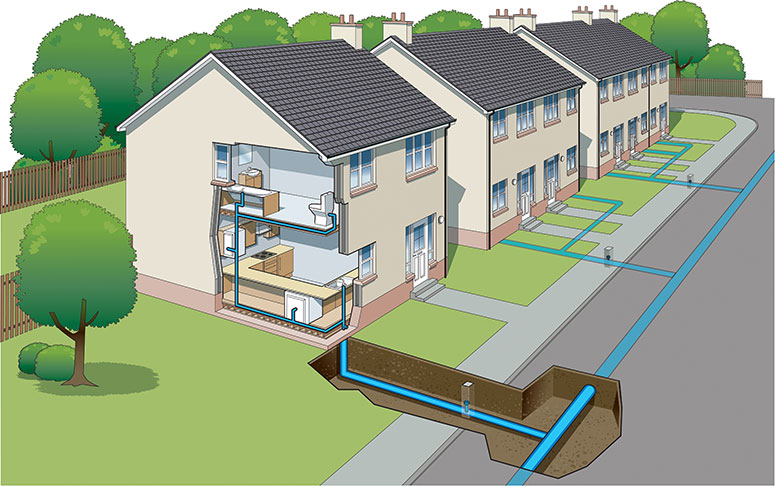
| Supply pipe acoustic survey | Acoustic correlator survey of supply pipe from boundary stop tap to internal stop tap, including driveway and path runs up to 25 m | £280–£480 | Yes |
| Emergency same-day (Zones 1–3) | Supply pipe acoustic with 60–120 min response; includes out-of-hours callout premium; covers all London Zone 1–3 postcodes | £380–£550 | Yes |
| Acoustic + thermal imaging combined | Acoustic correlator plus FLIR thermal camera scan of floors, walls and ceiling voids; identifies moisture plumes and wet spots not detectable acoustically | £340–£500 | Yes |
| Hydrogen tracer gas escalation | 5% H2 / 95% N2 tracer gas introduced to pipe; surface sensor locates exit point to ±0.3 m; applied when acoustic is inconclusive (e.g. lead pipe, deep run, concrete over void) | £380–£550 total (differential over acoustic) | Yes |
| Full insurance package (acoustic + thermal + ABI report) | Combined acoustic and thermal survey; ABI-format written report required for trace and access insurance claim; signed by a qualified engineer; submitted to insurer on customer's behalf if required | £440–£620 | Yes |
Prices include VAT. Emergency out-of-hours (after 18:00 weekdays, weekends) carries a £75–£100 premium on the standard rates above. Zone 4–6 properties outside Central London are priced at the lower end of each range — the higher end applies to Zone 1–2 properties where access, parking and permit complications add time on site.
What Affects the Cost?
The price variation within each survey type is not arbitrary. Four factors determine where on the range a specific job lands:
Property size and pipe network complexity. A one-bedroom flat in a purpose-built block has 5–8 metres of internal cold supply pipework and can typically be surveyed acoustically in 45 minutes. A four-storey Victorian terraced house in Islington has 30–50 metres of pipework across four floors, with branch circuits to kitchen, two or three bathrooms, and possibly an additional branch to a cellar or loft conversion. Complexity drives time, and time drives cost. Large properties with multiple suspected leak zones (for example, where the meter test shows flow but the leak cannot be narrowed to a single branch) take longer and land nearer the top of the range.
Access difficulty. The main limitation on acoustic detection accuracy is surface attenuation — the acoustic signal from a leak point has to travel through soil, sand, hardcore, concrete and tarmac before the engineer's microphone picks it up. A supply pipe at 600mm depth under garden topsoil is the ideal case. The same pipe at 1.2m depth under reinforced concrete — a converted garage floor or a later driveway pour — attenuates the signal significantly and may require the hydrogen tracer gas escalation. Escalation adds cost but remains under the no find no fee guarantee.
Pipe material. Modern blue MDPE transmits acoustic signals at a predictable frequency. Lead pipe (common in pre-1970 London properties) transmits differently — lower frequency range, higher attenuation, shorter effective correlator baseline. Steel and cast iron are harder still. On a property with a lead or steel supply pipe, the engineer typically has to work at shorter baseline intervals, taking more readings to achieve the same confidence level. This adds 30–60 minutes to the survey time and pushes the price toward the top of the supply pipe range. The tracer gas escalation bypasses the acoustic material limitation entirely — it works the same regardless of pipe material — but it does add cost.
Emergency vs. scheduled. A scheduled survey booked 24–48 hours ahead allows the engineer to plan travel efficiently across a day's caseload. An emergency same-day response in Zone 1–2 requires an engineer to divert from their existing route or be dispatched specifically. The emergency premium (£75–£100) reflects the logistics cost, not a different quality of service. If your situation is not urgent — you have confirmed a leak but there is no active water damage, no Thames Water deadline, and no structural risk — booking 24–48 hours ahead saves money with no meaningful downside.
A note on comparing quotes. When comparing leak detection quotes from different companies, the headline survey price is less important than the escalation policy. A company quoting £180 for an acoustic survey with no no find no fee guarantee and no escalation chain can cost you more in total than an ERL survey at £340 with full no find no fee and tracer gas escalation included — because if their acoustic is inconclusive, they charge again for a second method. Ask every company you contact: (1) Is no find no fee guaranteed and does it cover all methods or just the initial scan? (2) What methods do you escalate to if acoustic is inconclusive? (3) Do you charge separately for each escalation step?
Can Insurance or Thames Water Pay?
Trace and access cover — what it is. Approximately 97% of UK buildings insurance policies written in the last 15 years include a section called "trace and access" (sometimes "finding a hidden leak" or "detection costs"). This section pays for the cost of locating a hidden water leak and for the damage caused by accessing the fabric of the building to reach it — breaking up floor tiles, cutting into plasterboard, opening up a concrete slab. It does not pay for the pipe repair itself, but it does pay the survey fee.
Typical policy limits range from £5,000 to £10,000 for trace and access, which is more than sufficient to cover any leak detection survey in London. The excess on a trace and access claim is usually the same as the main buildings policy excess — typically £100–£250.
How to find out if your policy includes it: Retrieve your buildings insurance policy schedule (the document that lists the coverage sections and limits) and search for "trace and access," "tracing and access," or "finding a hidden leak." If you cannot find the policy document, call your insurer or broker and ask directly: "Do I have trace and access cover and what is the limit?" This call takes two minutes and can save you several hundred pounds.
What the insurer requires from ERL: To submit a trace and access claim, your insurer will ask for a written report from the detection engineer in ABI format. The ABI format (Association of British Insurers standard) is a structured report that includes: engineer's name and qualifications, survey date and address, detection methods used, location of the leak found (or confirmation that no leak was located), estimated leak rate, and a recommendation for repair. ERL provides this report as part of the full insurance package survey (£440–£620) or as a standalone add-on to any survey for +£100. We can submit the report directly to your insurer's claims department if you provide the claim reference.
The trace and access cover pays the survey, not the repair. The pipe repair itself — excavating the supply pipe, replacing the damaged section, reinstating the surface — is not covered by trace and access. It may be covered under a separate section of your buildings policy (usually "accidental damage to underground services") but this varies by insurer and the excess on this section is sometimes higher. Check your policy schedule for both sections before deciding how to proceed.
Thames Water leak allowance. Separately from insurance, if the leak is on your supply pipe (not an internal fitting), Thames Water offers a leak allowance — a bill credit for the estimated water volume lost through the leak period. To qualify: the leak must have been on the customer's private supply pipe, the repair must have been completed, and the application must be submitted within 3 months of the repair date. ERL provides the repair completion documentation Thames Water requires for the allowance application. For a 1 litre/minute leak running for 60 days before detection, the allowance credit can reach £250–£400 depending on your water and wastewater tariff.
Combining insurance and the allowance: Both can apply to the same leak. Insurance covers the survey cost (trace and access claim). Thames Water covers the water volume lost (leak allowance claim). The repair cost itself may be covered by a separate accidental damage section of your buildings policy, or it falls to you directly. Getting the survey covered by insurance and the water loss covered by Thames Water means the only out-of-pocket cost for many customers is the repair, which in a standard supply pipe case runs £800–£1,500 for excavation and pipe replacement.
Ready to book? Call Emergency Repairs London on 0207 046 1363. Before you call, check your policy schedule for trace and access cover and have the insurer's claims number available if you have one. We will confirm whether the ABI insurance package applies, provide a fixed survey price, and arrange same-day detection across all 32 London boroughs. No find no fee on every survey. If we don't find the leak, you pay nothing.
FAQs
The four questions below address the most important practical queries on leak detection pricing in London in 2026 — what you'll actually pay, whether insurance covers it, what no find no fee really means, and why cheaper quotes can end up costing more.
If you are working against a Thames Water Section 75 deadline (4 weeks from the notification date to complete a repair), detection speed matters more than a small price difference. A same-day survey that finds the leak and gets a repair scheduled is worth more than a cheaper quote that takes 5 days to arrive on site. Call 0207 046 1363 — same-day response, no find no fee, across Greater London.
Valentin N. — Operations Director, Emergency Repairs London
Key Takeaways
- Standard acoustic supply pipe detection in London: £280–£480 (no find no fee)
- Emergency same-day detection Zones 1–3: £380–£550 with 60–120 min response
- Hydrogen tracer gas is an escalation method, not a separate full survey — added at differential cost when acoustic is inconclusive
- Most buildings insurance policies include trace and access cover (£5,000–£10,000 limit) which pays the survey fee — you need an ABI-format report from a qualified engineer
- Getting three quotes is sensible on repair work, but on leak detection the no find no fee guarantee matters more than the cheapest quote number
- Thames Water leak allowance (water rebate) can offset hundreds of pounds in water cost if claimed within 3 months of repair
