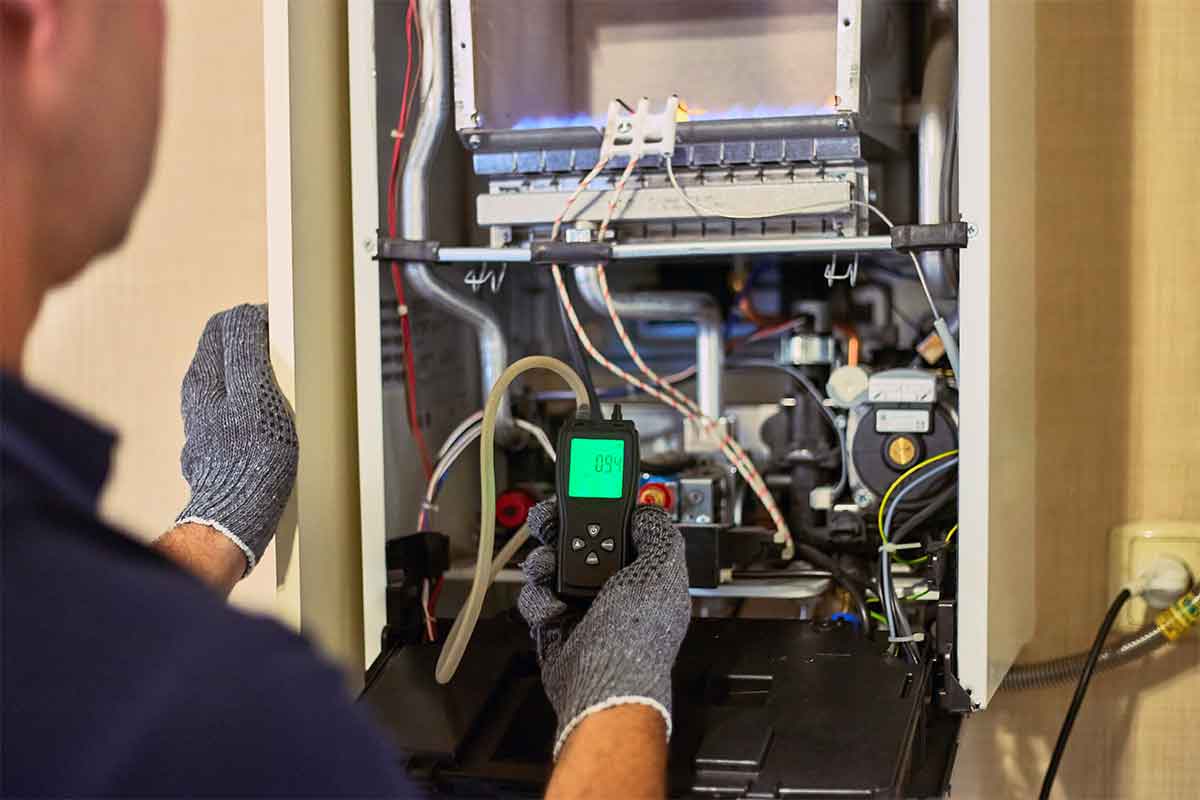
Boiler Leaking Water: Where It's Coming From and How Serious It Is (London 2026)
Found water under your boiler? Work out where it is actually coming from, whether it is dangerous or just a nuisance, what you can safely do yourself, and what a Gas Safe repair costs in London.
Turn the boiler off at its switched fused spur, put a container under the drip, and photograph where the water is coming from. Then work out the source, because that is what decides the urgency. Water running from the brass pipe on the outside wall is the pressure relief valve discharging, which normally means the expansion vessel has failed: urgent but not dangerous. Drips from a compression joint on the copper pipes below the boiler are the mildest case and often a same-visit fix. A wet patch on the underside of the casing with clean water and no obvious joint above it usually means the pump gasket or the heat exchanger, and a leaking heat exchanger on a boiler over about twelve years old is normally the point where replacement beats repair. Clear water dripping from the white plastic condensate pipe is not a fault at all. Treat it as an emergency if water is running onto electrics, if the leak is fast enough to need the mains turned off, or if there is any burning smell. If you can smell gas, stop and ring the National Gas Emergency Service on 0800 111 999 first. Never take the boiler casing off: under the Gas Safety (Installation and Use) Regulations 1998 that is Gas Safe engineer work only.
Finding water under the boiler is one of those moments where the honest answer to "how bad is this?" is: it depends entirely on where the water is coming from. The same puddle on a kitchen floor can be a £90 compression joint, a £200 expansion vessel, or the end of the boiler's working life. Nothing about the size of the puddle tells you which.
So this guide is organised the way you actually experience the problem. You have seen water. The first job is to work out its source, because the source decides the urgency, the cost and whether you should be switching anything off tonight. Everything below is done from outside the boiler casing, because that is the only side of it you are legally allowed to touch.
⚠️ Before anything else: if you can smell gas, this stops being a leak question. Turn the gas off at the meter's emergency control valve, open windows and doors, do not touch electrical switches, do not use naked flames, and ring the National Gas Emergency Service on 0800 111 999. It is free and staffed 24 hours. The water can wait until the supply has been made safe.
The First Five Minutes: Four Things That Are Safe and Useful
Do these in order. All four are outside the casing, all four are legal, and all four shorten the engineer's visit.
Switch the boiler off at the fused spur
Not just at the thermostat. Find the switched fused spur, usually a small switch on the wall near the boiler, and turn it off. This takes the electrical side out of the equation and stops the leak being heated, which is what turns a weep into a run.
Put something under it and protect the floor
A washing-up bowl, a roasting tin, an old towel. If the water is running along a pipe before it drips, tie a length of string or a strip of cloth around the pipe and lead it into the container so the drip follows the string rather than spreading across the casing.
Photograph exactly where the first drip forms
Not the puddle, the origin. Get close, use the phone torch, and take two or three angles. This is the single most useful thing you can hand an engineer, because it often identifies the component before anyone arrives and decides which parts go on the van.
Read the pressure gauge and write the number down
A leak on the heating side pulls the pressure down. A gauge that has fallen below 1 bar, or that keeps falling over the next few hours, confirms the water is leaving the sealed circuit rather than being condensate. A gauge sitting normally at 1.0 to 1.5 bar points you toward condensate or a leak that is not on the heating circuit at all.
💡 Three quick observations worth making while you are there. Is the water clean or rusty? Rusty means it has been leaking long enough to corrode something. Is it warm or cold? Warm points to the heating circuit or the hot side of a combi; cold points to the mains inlet or condensate. Does it drip only when the boiler runs, or continuously? Intermittent, running-only drips are very often condensate.
Dangerous Leak or Nuisance Drip?
Most boiler leaks are a nuisance rather than a danger. A small number are not. The line between them is not the amount of water, it is where the water is going and what else is happening at the same time.
| Signal | What it means | What to do |
|---|---|---|
| Water reaching the electrical side of the boiler, a socket, or the fused spur below it | Genuine hazard | Isolate at the fused spur or consumer unit before touching anything wet, then call |
| Water running rather than dripping, filling a bowl in minutes | Urgent | Boiler off, stopcock off, call for a same-day or out-of-hours visit |
| Water coming through the ceiling into the room below | Urgent | Boiler off, water off, move what you can, photograph for insurance |
| A burning, acrid or scorching smell alongside the leak | Emergency | Isolate electrically and call immediately; do not reset or restart |
| Any smell of gas | Gas emergency, handled separately | Gas off at the meter, ventilate, ring 0800 111 999 first |
| A slow drip you can catch in a container, boiler otherwise behaving | Nuisance | Boiler off, container under it, book a daytime visit at the lower call-out rate |
| Clear water from the white plastic pipe only, while the boiler is running | Usually not a fault | Read the condensate section below before booking anything |
The call-out itself is £60 whatever the hour, so there is no night premium on getting an engineer to the door. The difference between the last two rows and the first four is the labour rate once the first 45 minutes are used up — £110 an hour on a weekday against £140 an hour out-of-hours. If you can safely contain the water overnight, waiting for morning saves you on the labour, not the call-out. If you cannot, do not try.
Water From the Outside Discharge Pipe (Pressure Relief Valve)
What it looks like: the water is not really inside at all. Step outside and look for a brass or copper pipe terminating low on the external wall near the boiler, usually 200 to 400mm above ground with a downturned elbow. If it is actively dripping, wet, streaked with white limescale, or the brickwork below it has gone green with moss, that pipe has been discharging. Inside, the tell is a pressure gauge that reads high when the boiler is hot and low the following morning.
What it means: the pressure relief valve is a spring-loaded safety device that opens at around 3 bar and dumps water out through that pipe rather than let pressure build in the sealed circuit. It is doing its job. The question is why it needs to. In most cases the answer sits one component upstream: the expansion vessel has lost its air charge, so when system water heats and expands there is nowhere for the extra volume to go, pressure spikes, and the valve opens. Less often the valve seat itself has scaled or pitted and no longer seals at rest, which is more common in London than nationally because of how hard the water is here.
How urgent: urgent but not dangerous. Nothing is going to fail catastrophically tonight. What will happen is that the system keeps losing water, the boiler eventually locks out on low pressure, and every top-up you do introduces fresh oxygenated water that accelerates corrosion inside the radiators and the heat exchanger.
What you can safely do: photograph the wet discharge pipe, read the gauge when the system is cold and again when the boiler has been running for fifteen minutes, and write both numbers down. A cold reading around 1.2 bar rising past 2.5 bar within a few minutes of firing is close to a confirmed expansion vessel diagnosis before the engineer has left the depot.
⚠️ Stop point. Both the pressure relief valve and the expansion vessel sit inside the boiler casing on every mainstream UK boiler. Under the Gas Safety (Installation and Use) Regulations 1998, opening that casing is restricted to Gas Safe registered engineers. There is no homeowner fix here, and re-pressurising a vessel through its Schrader valve is not a job to attempt with the case off.
If it turns out the water outside is not hot and not from the boiler at all, the culprit may be a cistern or a loft tank overflow instead. Our guide to an overflow pipe dripping outside a London home walks through telling those apart.
Leaking Pipework Joints Below the Boiler
What it looks like: a bead of water forming at a specific point on the copper pipework under the boiler, usually at a compression fitting, an isolation valve, or the filling loop connection. Run a dry tissue around each joint and the wet one gives itself away immediately. Often there is a faint chalky white deposit built up around the nut, which is what a joint that has been weeping slowly for months leaves behind.
What it means: compression joints work by squeezing a soft olive between the nut and the pipe. Thermal cycling over years slowly relaxes that seal, and vibration from the pump does not help. It is the ordinary wear-out failure of a heating system rather than a sign of anything worse.
How urgent: the mildest of all the cases here. A weeping joint is measured in drips per minute and can usually wait for a weekday appointment, provided it is not dripping onto anything electrical.
What you can safely do: identify which joint, contain the drip, and note whether it gets noticeably worse when the heating comes on. That last detail matters, because a joint that only weeps hot is behaving differently from one that weeps constantly, and it tells the engineer whether they are looking at the flow, the return or the cold feed.
✓ The one bright spot. Pipework below the boiler is outside the appliance, so it is ordinary plumbing rather than restricted gas work. That usually makes it the quickest and cheapest of the leaks on this page, frequently resolved inside the call-out window with no parts beyond a new olive. Do not be tempted to put a spanner on it yourself, though: over-tightening a tired compression joint on a pressurised circuit is a reliable way to turn a drip into a jet.
Leaking Pump Head or Pump Gasket
What it looks like: clean system water appearing part way down the casing rather than at the very bottom, often on one side, and typically with a dried mineral trail or a rust-coloured stain marking the path it has been taking for weeks before you noticed. On boilers where the pump sits low, the water simply arrives at the bottom edge and you cannot see the origin at all, which is why the photograph in step three matters.
What it means: the circulating pump has a gasket between the pump head and its body, and a mechanical seal on the shaft. Both are consumables. They typically start weeping somewhere between eight and twelve years of service, and London's hard water shortens that by scoring the seal faces. A pump that is weeping is often a pump that is also getting noisy or working harder than it should.
How urgent: in between. It rarely becomes a flood, but it is inside the casing next to the electrical side of the boiler, so it is not one to run for weeks while you think about it. Same-day if the leak is more than an occasional drip, otherwise a weekday booking.
What you can safely do: switch the boiler off, contain the water, and listen back over the last few months. A pump that has become noticeably louder, or a system where one part of the house went lukewarm, is corroborating evidence. Beyond that, the pump is inside the casing and that is where you stop.
Worth knowing: on some boilers the small brass auto air vent sits on the pump head and can be the actual source, weeping water along with air when its float valve fails. It presents almost identically to a pump gasket leak from outside, and it is a considerably cheaper part. Only someone with the case off can tell you which one you have.
Leaking Heat Exchanger: The Expensive One
What it looks like: this is the leak with the fewest external clues, which is part of what makes it the one people dread. Typically it is water arriving at the bottom of the casing with no wet joint anywhere you can see, often warm, sometimes rusty or discoloured, and usually accompanied by pressure that will not hold no matter how many times it is topped up. On an older boiler it frequently arrives alongside kettling, that percolating or banging sound from inside the unit, and a boiler that has been overheating and locking out.
What it means: the primary heat exchanger is where the burner's heat is transferred into the system water. It is under constant thermal stress, and in London it is under constant chemical attack too, because hard water scales the internal waterways and scale creates hot spots. Enough cycles of that and the metal cracks or corrodes through. Once it is leaking, it cannot be patched or sealed; it is a replacement part.
How urgent: the boiler needs to come out of service. A heat exchanger leak is not a slow degradation you manage, because water is escaping inside the appliance next to electrics and combustion components, and continued firing makes it worse quickly.
What you can safely do: switch it off at the fused spur, leave it off, and describe the full history on the phone. Age of boiler, whether it kettles, whether it has ever been power flushed, how long the pressure has been dropping. Those four facts are what an engineer needs to give you an honest repair-versus-replace answer rather than a guess.
⚠️ Do not keep topping up and running it. A system leaking through the heat exchanger will happily swallow a top-up every day, and each one puts fresh oxygenated water into a circuit designed to run without it. That accelerates corrosion everywhere else at the same time as you are deciding what to do about the boiler.
Condensate: The Water That Is Usually Not a Leak
Every condensing boiler in the UK produces waste water as a normal part of operating. It is called condensate, it is mildly acidic, and it drains away through a white plastic pipe, usually 22mm or 32mm, that runs from the boiler to an internal drain, a gully or an external wall. A modern combi can produce a couple of litres of it on a cold day. It is the single most common thing homeowners mistake for a boiler leak.
Three checks separate condensate from a genuine leak:
- The pipe. Condensate is only ever in white plastic. Copper and brass never carry it. If the water is coming from a metal pipe or from the casing itself, it is not condensate.
- The timing. Condensate is produced while the boiler is firing and stops shortly after. A drip that appears during a heating cycle and dries up between cycles is very likely a loose push-fit joint or a hairline crack in the condensate pipe. A system leak carries on regardless, because the circuit stays pressurised whether the boiler is running or not.
- The water. Condensate is clear and quickly goes cold. Because it is slightly acidic it tends to leave a pale mark on a light surface rather than the rusty or dirty staining that heating system water leaves.
A dripping condensate joint is still worth fixing, because acidic water sitting on a floor or inside a cupboard does no good, but it is a plumbing repair rather than an emergency and it usually costs very little. The related failure is the opposite one: in cold weather the external section of that pipe can freeze solid, at which point the boiler shuts down rather than leaks. That is a London winter classic, and our frozen pipes guide covers thawing it with warm, never boiling, water.
Water Near the Boiler, But Not From the Boiler
Roughly one call in six that comes in as "my boiler is leaking" turns out not to be the boiler. Water travels along pipes, joists and the tops of cupboards before it drops, so the point where it appears is often nowhere near the point where it escaped. Before accepting the boiler as the culprit, rule these out:
- A hot water cylinder above or beside it. In flats and airing-cupboard installs the cylinder sits close to the boiler, and an unvented cylinder's own relief discharge or a weeping immersion boss will drip straight into the same space. If you have a Megaflo or similar unvented cylinder, check it before blaming the boiler.
- A pipe running through the same cupboard. Heating and mains pipework very often shares the boiler cupboard. A joint 600mm to the left, hidden behind the casing, will present as water under the boiler.
- A leak from the flat above. Common in London blocks and converted terraces. The tell is water arriving from above the boiler rather than below it, and staining on the ceiling or the top of the casing rather than underneath.
- A radiator or towel rail on the other side of the same wall. Water tracks along the floor void and emerges at the lowest point, which is often the boiler cupboard.
- Condensation, not condensate. A cold mains pipe in a warm humid kitchen will sweat visibly and drip. It is not a leak and there is nothing to repair beyond lagging the pipe.
If you genuinely cannot tell where the water is originating, that is what leak detection exists for. Acoustic and thermal equipment finds a leak without opening a floor, which is almost always cheaper than the exploratory alternative. Our leak detection cost guide sets out the London pricing.
Water, Electrics and the Risk People Underestimate
A boiler is a live 230V appliance with a printed circuit board, a fan, a pump, sensors and wiring, all inside a casing that a leak fills from the top down. This is the part of a boiler leak that is genuinely dangerous, and it is the part people worry about least because water on a floor looks harmless.
Three practical rules:
- Isolate before you mop. Turn the boiler off at the switched fused spur before you put your hands or a cloth anywhere near it. If the spur itself is wet, or if there is a socket beneath the boiler that has water on or near it, go to the consumer unit and turn off the circuit instead. Do not reach past water to reach a switch.
- If the RCD has tripped, leave it tripped. A residual current device that has cut the power because water has reached a live component has done exactly what it exists for. Repeatedly resetting it to get heating back is asking the fault to happen again with you standing there.
- Do not dry it out and restart it. Water that has been into a boiler's electrical section leaves corrosion behind on connectors and the PCB, sometimes days after the visible water has gone. The boiler needs an engineer's eyes on it before it is put back into service, not a hairdryer.
💡 Where the fused spur usually is. Most London installations put a switched fused spur within a metre or so of the boiler: on the wall beside it, inside the same cupboard, or just outside an airing cupboard door. If yours is not obvious, find it now and note where it is. Looking for it for the first time while water is running is the wrong moment.
What the Leak Is Doing to Your Pressure
Every leak on the heating side is also a pressure problem, and the two symptoms usually arrive together. Water leaves the sealed circuit, the gauge falls, and below roughly 0.5 bar most boilers lock out and stop firing. Plenty of people meet this problem from the other direction: they notice the pressure keeps dropping long before they ever see water, and go looking for a leak.
If that is closer to your situation, the diagnostic runs the other way round and we have covered it in detail in why your boiler keeps losing pressure, with the four causes ranked by frequency. That article starts from the gauge; this one starts from the puddle. They meet in the middle.
What matters for a visible leak is the temptation to keep topping up. Between spotting the leak and the engineer arriving, one top-up to get heating back on a cold night is reasonable, and our step-by-step repressurising guide shows how to do it safely to 1.2 bar. Repeated top-ups are not, for two reasons: you are pumping fresh oxygenated water into a system built to run without it, and you are washing away the evidence of how fast the leak actually is, which is one of the more useful things you can tell an engineer.
What a Leaking Boiler Costs to Fix in London (2026)
Indicative 2026 London pricing. The call-out covers travel and the first 45 minutes on site including diagnosis, and parts are quoted before fitting rather than after.
| Job | Typical London cost (2026) | Notes |
|---|---|---|
| Call-out + diagnosis (any hour, including out-of-hours and weekends) | £60 | Includes first 45 minutes on site |
| Engineer labour after the first 45 minutes | £110/hr weekday, £140/hr out-of-hours | Charged in 15-minute increments, plus parts |
| Repressurise / restart / minor fix (no parts) | £60–£120 | Often within the call-out window |
| Expansion vessel / PRV | £120–£280 | Cause of most outside discharge pipe drips |
| Pump replacement | £180–£380 | Part + labour |
| Diverter valve replacement | £150–£320 | Common combi hot-water fault |
| Fan replacement | £200–£420 | Part-price varies by model |
| PCB (circuit board) replacement | £350–£650 | Often the repair-vs-replace tipping point |
| Primary heat exchanger | £450–£750+ | Scale-related; may favour replacement |
Two things follow from that table. The cheapest outcomes are the ones at the top, and a weeping compression joint below the boiler frequently finishes inside the call-out window with no parts at all. The expensive outcomes are at the bottom, and they are also the ones where a PCB has been ruined by water that was allowed to keep running, which is the strongest practical argument for switching the boiler off the moment you see a leak.
Repair or Replace: The Old Heat Exchanger Question
Most leaks do not raise this question at all. A pump, an expansion vessel, a pressure relief valve or a compression joint are discrete component repairs and you simply have them fixed. The judgement only really arises with a leaking heat exchanger, and occasionally with a boiler that has had water through its electrics.
The rule of thumb engineers work to is the same one that applies to any big boiler part: repair if the boiler is under about ten years old and the fault is a single component; start pricing a replacement once it is 12 to 15 years old, or the repair would cost more than roughly half a new install. A new combi fitted in London runs about £2,000 to £3,500 depending on the boiler and the complexity of the job, so a £600 heat exchanger on a fourteen-year-old unit that is also scaling up is money better put toward a replacement.
There is a London-specific wrinkle worth adding. Heat exchangers here fail disproportionately because of hard water, and a heat exchanger that has scaled badly enough to leak is almost always sitting on a system that has been running with sludge and depleted inhibitor for years. Fit a new heat exchanger into that system without addressing it and you have bought the same failure again on a slightly longer timescale. If you do repair rather than replace, insist on a flush and a fresh inhibitor dose in the same visit, and treat that as part of the repair cost rather than an upsell. Our emergency boiler repair guide sets out the wider repair-versus-replace maths, including what Boiler Plus requires of a replacement in England.
Landlords: A Leaking Boiler Starts Two Clocks
If you let the property, a leaking boiler is a legal matter alongside a practical one. Under Section 11 of the Landlord and Tenant Act 1985 you must keep the installations for space heating and hot water in repair and proper working order, and you must keep the structure and exterior in repair, which brings water damage from the leak into scope as well. Under the Homes (Fitness for Human Habitation) Act 2018, a property left without heating or hot water, or with damp and water damage spreading from an unrepaired leak, can be judged unfit for human habitation.
Three practical points. Ask the tenant to photograph the leak and the pressure gauge, which gives you a dated record and speeds up the dispatch. Never coach a tenant into opening the boiler or tightening anything, because that puts an untrained person next to live electrics and a gas appliance and puts you on the wrong side of the regulations. And remember that the annual Gas Safety Record (CP12) from a Gas Safe engineer is a separate obligation that runs regardless of whether anything has broken. Our Section 11 repair obligations guide covers the timescales in more detail.
Where You Must Stop: The Gas Safe Line
Under the Gas Safety (Installation and Use) Regulations 1998, work on a gas appliance in the UK may only be carried out by an engineer on the Gas Safe Register. Removing the casing of a sealed-system gas boiler counts as work on the appliance. It is a criminal offence for anyone else to do it, it invalidates the boiler warranty and often the home insurance, and with a leak in progress it puts you next to live mains electrics, a pressurised water circuit and a gas carrying component at the same time. It also breaks the room-sealed integrity of the appliance, which is what keeps combustion products in the flue rather than in your home.
The boundary is physical and it is simple: outside the casing is yours, inside the casing is not.
💡 Outside the casing, and yours to do: switching the boiler off at the fused spur, isolating the water at the stopcock, putting a container under the drip, reading and recording the pressure gauge, photographing the source, checking whether the water is coming from the white condensate pipe, checking the outside discharge pipe for drips, and ruling out a cylinder or a neighbouring pipe.
⚠️ Inside the casing, and never yours to do: the pump, the pump gasket, the auto air vent, the expansion vessel, the pressure relief valve, the heat exchanger, the internal pipework, the gas valve, the PCB and the flue. That includes "just having a quick look" with the case off, and it includes putting a spanner on any joint you can only reach by removing it.
When an engineer attends, ask to see their Gas Safe ID card and check the registration number at gassaferegister.co.uk. The card shows which appliance types they are qualified to work on, and the number should match the one on your invoice.
Frequently Asked Questions
Is a leaking boiler an emergency?
Why is my boiler leaking water from the bottom?
Can I still use my boiler if it is leaking?
Why is water coming out of the pipe on my outside wall?
How do I tell condensate from a real leak?
Should I turn the water off if my boiler is leaking?
Is a leaking heat exchanger worth repairing?
My boiler leaks only when the heating is on. What does that mean?
The Bottom Line
Switch the boiler off at the fused spur, catch the water, photograph where the drip starts, and read the pressure gauge. Those four minutes of work will tell you and your engineer more than an hour of speculation. Then match what you are seeing to the sections above: outside discharge pipe means expansion vessel or relief valve; a wet joint below the boiler is the cheap end; clean water from the casing with no visible joint is the pump or the heat exchanger; clear water from a white plastic pipe is probably not a fault at all.
Whatever the source, the casing stays on. Everything genuinely diagnostic that a homeowner can do sits outside it, and everything inside it is restricted by law to a Gas Safe registered engineer. If you smell gas at any point, that comes first and it goes to 0800 111 999.
Emergency Repairs London provides same-day and 24/7 emergency boiler repair with Gas Safe registered engineers across all 32 London boroughs, including leak diagnosis, expansion vessel, pressure relief valve, pump and heat exchanger work. Fixed £60 daytime call-out, quoted before work starts. Lines are open 24/7 on 0207 046 1363.
Key Takeaways
- The source of the water decides the urgency. Before anything else, look at where the drip starts and whether the water is clean, rusty, hot or cold.
- Turn the boiler off at its switched fused spur, catch the water in a container, photograph the drip, and check the pressure gauge. Those four things are safe, useful and all outside the casing.
- Water running from the brass discharge pipe on the outside wall is the pressure relief valve doing its job, usually because the expansion vessel has lost its air charge. Urgent, fixable, £120 to £280.
- Weeping compression joints on the copper pipes below the boiler are the mildest and cheapest case, and are often outside the casing where a plumber can reach them without Gas Safe restrictions applying.
- A leak from the pump head or its gasket shows as clean water tracking down the casing from a specific point, often with a stain or limescale trail built up over weeks.
- A leaking heat exchanger is the expensive one. On a boiler over 12 to 15 years old, a £450 to £750 heat exchanger against a £2,000 to £3,500 replacement is usually the point to price a new boiler.
- Clear water from the white plastic condensate pipe is normal. Condensing boilers produce it constantly, and it is the single most common thing mistaken for a leak.
- Water and a live appliance are a genuine hazard. If water is reaching the electrical side of the boiler or dripping onto a socket or spur below it, isolate the boiler at the fused spur before you mop anything.
- Never remove the boiler casing. Under the Gas Safety (Installation and Use) Regulations 1998 that is restricted to Gas Safe registered engineers, and doing it yourself is a criminal offence.
- Any smell of gas comes first: turn the gas off at the meter, ventilate, and ring the National Gas Emergency Service on 0800 111 999.
