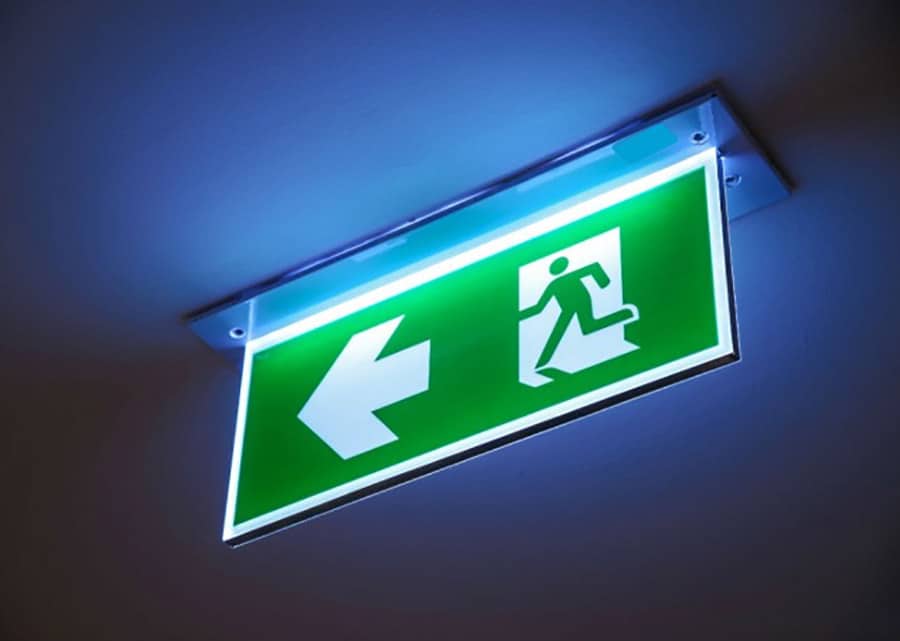
Emergency Lighting Tests: Monthly, Annual Schedule 2026
Monthly flick test and annual 3-hour discharge test for BS 5266-1 emergency lighting. Full landlord schedule for HMOs and blocks of flats in 2026.
BS 5266-1 emergency lighting in HMOs, blocks of flats and commercial premises must be tested on two schedules. A short monthly flick test — simulate a mains failure, confirm every luminaire and exit sign illuminates, restore mains, verify the battery recharges — recorded in the BS 5266-1 logbook by a competent landlord or manager. And a full annual 3-hour discharge test — every luminaire must stay lit for the full three hours under battery alone, signed off by a BS 5266-trained engineer with a certificate. Skip either schedule and you fail the next HMO licence inspection, the next fire-risk assessment review, and any post-incident insurance claim. ERL covers both schedules across London — logbook flick visits from £35 and annual 3-hour discharge tests from £69 by fitting count. Call 0207 046 1363 or WhatsApp 07456 975436 to book the property in.
Emergency lighting is the system of luminaires and exit signs that keep an escape route legible when the mains supply fails. In an HMO, a block of flats or any commercial premises, the moment the lights go out is the moment people most need to see where the stairs are — and the only way that happens reliably is a properly designed, properly installed and properly tested BS 5266-1 installation. The standard is unforgiving about testing: a system that has not been functionally tested in the last month and discharge-tested in the last twelve months is, in legal and insurance terms, no system at all.
This page sets out the test schedule that a London landlord, managing agent or HMO operator should be running in 2026. There are two intervals — a short monthly flick test that a competent landlord can perform themselves, and a full annual 3-hour discharge test that a BS 5266-trained engineer signs off. We cover where emergency lighting is required, who can carry out each test, what to record in the logbook, the failure modes we see most often on first attendance, and what the work typically costs across the 32 London boroughs.
Why Emergency Lighting Matters
Mains failure during an evacuation is rare but not negligible. The combination of a fire that compromises the supply cable, a fault that trips the consumer unit, and a panicked occupant trying to find an unfamiliar staircase in the dark is exactly the scenario BS 5266-1 exists to prevent. Emergency luminaires switch over to internal battery the moment they lose mains, and an exit sign over a fire door does the same — the door remains visible from anywhere on the escape route for the rated duration of the system, almost always three hours.
The duty to install and maintain emergency lighting sits on the Responsible Person under the Regulatory Reform (Fire Safety) Order 2005, which in a rented or HMO property is normally the landlord, freeholder or managing agent. Compliance with BS 5266-1 is the engineering benchmark a fire-risk assessor and a council enforcement officer measure against, and it is the standard cited in HMO licence schedules across every London borough we work in.
Where Emergency Lighting Is Required
The fire-risk assessment is the authoritative document for any specific property, but the common cases are:
- 3-storey-and-above HMOs — Almost always required across the protected escape route, on every landing, at every change in direction, above every final exit and at every fire door. Most London-borough HMO licence schedules state this explicitly.
- Common parts of blocks of flats — Lobbies, corridors, stairs and the area outside the final exit. Required under the Fire Safety (England) Regulations 2022 for buildings above 11m and strongly recommended below that height.
- Commercial premises escape routes — Offices, shops, salons, restaurants and any other workplace covered by the RRO. Every defined escape route, every final exit and any open area larger than 60 m² where occupants would be present after dark.
- Any escape route with no borrowed light — Internal stairwells, basement corridors, windowless rear lobbies. If the route would be in darkness with the mains off and the external streetlight not visible, emergency illumination is required regardless of property type.
A small two-storey single-family rented house with a front-door escape onto a streetlight-lit pavement usually does not need a dedicated emergency lighting installation — borrowed light covers it. The moment the property converts to a three-storey HMO or the escape goes through a windowless internal route, BS 5266-1 applies. Our HMO compliance checks service identifies exactly which schedule applies to your building before the licence inspection does.
The Monthly Flick Test
The monthly test — formally a "short-duration functional test" under BS 5266-8:2025 — is a quick check that every luminaire still switches over to battery and every exit sign still illuminates. The procedure on a typical London HMO installation:
- Simulate a mains failure on the local emergency-lighting circuit. On most modern installations this is done by turning a dedicated key-switch on the consumer unit; on older installs, by tripping the local breaker. Never isolate the whole consumer unit unless the design requires it.
- Walk the building. Confirm every emergency luminaire is lit and every illuminated exit sign is visible from the approach side. Note any fitting that fails to illuminate, fitted location and circuit reference.
- Restore the mains. Confirm every fitting returns to its normal state — the green charging LED present on most modern fittings should be lit, indicating the battery is recharging.
- Record the test in the BS 5266-1 logbook — date, tester name, fittings tested, any faults observed, action taken.
The whole exercise takes 10 to 20 minutes for a typical four-storey HMO and longer for a larger block. It needs no specialist equipment beyond eyesight and the building keys, and a competent landlord, building manager or caretaker can perform it without electrical qualifications. The discipline matters: a failure noticed and fixed within a month is a paperwork entry; a failure first identified at the annual test could be eleven months old.
The Annual 3-Hour Discharge Test
Once every twelve months the entire installation is run to its rated duration on battery alone — three hours for the standard London specification. The annual test is a real-world stress test of every component: the battery pack, the inverter, the lamp or LED module, the changeover relay. The procedure:
- The test is booked at end-of-day, with the agreement of any occupants, so that if a fitting fails partway through the test the building is unoccupied and the affected area can be temporarily made safe.
- The engineer isolates the supply at the local emergency-lighting switching point and starts a stopwatch. Every luminaire and exit sign must illuminate at the rated emergency-lighting illuminance — typically 1 lux on the centre line of an escape route under BS EN 1838.
- The building is walked at the start of the test, at the midway point and at three hours. Any fitting that fails to maintain illuminance for the full duration is recorded with its location and circuit reference.
- At the end of the test, mains is restored and the engineer confirms every fitting begins recharging. The certificate is issued, the logbook is updated, and any failed fittings are quoted for remediation.
The single most common annual-test finding we record across London is an ageing nickel-cadmium battery pack dropping out at the two-to-two-and-a-half-hour mark — visibly lit at the start of the test, dim by an hour in, completely off before three hours. NiCd packs have a useful service life of around four to five years; on a building approaching that age every fitting should be assumed suspect until proven otherwise.
Who Can Carry Out Each Test
The two schedules have different competence requirements:
- Monthly flick test — A competent landlord, property manager or caretaker can perform this. No formal qualification is required beyond an understanding of the system's switching arrangement, the BS 5266-1 logbook format and a basic safety awareness for working near a live consumer unit. Most managing agents we work with cover this internally.
- Annual 3-hour discharge test — Requires a BS 5266-trained engineer. The test involves running the system to battery exhaustion, measuring illuminance with a calibrated lux meter, replacing failed packs in line with BS 7671 wiring regulations and issuing a BS 5266-1 annual certificate. Third-party verification under a recognised scheme is strongly recommended — both for the technical quality and for the paperwork an insurer or council inspector will accept.
ERL covers both schedules under a single combined contract for most of our HMO and block clients — the engineer who runs the annual discharge test also reviews the year's monthly logbook entries and signs off the continuity.
The BS 5266-1 Logbook
The logbook is the document everyone asks for. Council enforcement on a routine HMO inspection, a buyer's solicitor during a block conveyance, the insurer after a claim — all of them want to see the bound paper book that lives next to the consumer unit and records every test, every fault and every remediation. The format BS 5266-1 expects:
- Date of test (monthly and annual entries in the same book, identified by type)
- Name and signature of the person carrying out the test
- Result — pass, or specific fitting reference and fault description
- Action taken — repair date, replacement fitting installed, re-test result
- For annual tests, the engineer's BS 5266-1 certificate number and the next test due date
Retention is 6 years minimum — the same horizon as the limitation period for most personal-injury and insurance claims arising from a fire incident. We keep our copies indefinitely and supply a duplicate to the landlord on request. For landlords running multi-property portfolios our landlord compliance hub coordinates the BS 5266 schedule alongside EICRs, gas safety, EPC and fire-risk assessment renewals so nothing slips out of date.
Common Fail Points on the Annual Test
The pattern of annual-test failures we see across London property is consistent year on year:
- Aged nickel-cadmium battery packs — By far the most common finding. NiCd cells lose capacity gradually and a four-to-five-year-old pack that holds 2.5 hours of illumination will read perfectly on a monthly flick test and then fail the annual discharge. Replace packs on a planned four-to-five-year cycle rather than reactively.
- LED conversions without specification check — Replacing a halogen or T5 lamp in an emergency luminaire with a generic LED bought from a wholesaler. Many domestic-grade LEDs are not certified for emergency-lighting duty and will not run from the internal inverter at the rated illuminance. Only LEDs marked as EL-rated and compatible with the specific fitting are acceptable.
- Sun-degraded exit signs — Photoluminescent and printed acrylic exit signs facing a south-facing window for years become illegible, with the green chevron faded to a barely visible outline. An exit sign that is not clearly readable from the approach side is non-compliant regardless of whether the lamp inside still works. Replace if illegible.
- Wireless test panels with dead coin cells — Modern self-test luminaires that report back to a wireless test panel are excellent in principle, but the panel itself has a battery that needs replacement every two to three years. A panel reporting no fault because it has been off for six months is the worst possible outcome.
- Final-exit signage missing — The fitting above the final exit door, which should be illuminated on both sides for external visibility, frequently missing or installed only on the inside. A common finding in older HMO conversions where the external face was never specified.
Items 1, 2 and 3 alone account for the majority of the annual-test remediation works we attend. Catching them in advance — through a properly run monthly logbook and a planned battery replacement cycle — reduces the annual-test invoice and keeps the certificate clean. For HMO operators our HMO fire risk assessment service aligns the BS 5266 schedule with the FRA review interval so both renew on the same visit where possible.
Cost Guide — London 2026
ERL pricing for emergency lighting work across the 32 London boroughs, accurate as of 2026:
- Monthly flick test with logbook entry — from £35 per visit for properties on a recurring schedule. For a typical four-storey HMO with 8 to 12 fittings the visit takes 15 to 20 minutes. Discounted block rates apply to portfolios of three or more properties.
- Annual 3-hour discharge test and BS 5266-1 certificate — typically £69 to £149 depending on fitting count, building access and time of day. A small HMO with 6 fittings is at the bottom of that band; a larger block of flats with 30+ fittings and external signage at the top.
- Battery pack replacement — from £45 per fitting parts-and-labour for a standard NiCd pack, more for sealed-unit luminaires that need full replacement.
- New emergency luminaire installed — from £95 per fitting including supply, fitting and circuit test, more for fire-rated downlights or external IP65 bulkheads.
- Whole-property BS 5266-1 design and install — quoted on site survey, typically £450 to £1,800 for a small HMO and £2,000 to £6,500 for a block common-part installation.
To book a flick visit or an annual discharge test, call ERL on 0207 046 1363 or WhatsApp 07456 975436 with the property address and fitting count. Combined contracts covering monthly flicks, annual discharge, fire alarm testing under BS 5839-6 and the EICR cycle are available for portfolio landlords — see our fire alarm testing service and fire risk assessment service for the adjacent schedules.
FAQs
The FAQ schema at the foot of this page covers the testing frequency, who can carry out the monthly test, the scope of BS 5266 as a standard family, how long the annual discharge test takes on a typical London HMO, and the procedure when a fitting fails the 3-hour test.
For the wider landlord-compliance picture — EICRs, gas safety, EPCs and HMO licence renewals — our landlord compliance hub for London ties every regime together. HMO operators specifically should also read our HMO compliance checks and HMO fire risk assessment pages.
Save the number now — 0207 046 1363 or WhatsApp 07456 975436. The monthly flick takes a quarter of an hour. The annual test takes half a day. Skipping either is the kind of decision that gets revisited in a courtroom.
John Alexander N. — Director, Emergency Repairs London
Key Takeaways
- BS 5266-1 is the British Standard for emergency lighting; BS 5266-8:2025 covers the testing routine. Two schedules apply: monthly short-duration flick test and annual full 3-hour discharge test
- Emergency lighting is required in almost every 3-storey+ HMO, the common parts of every block of flats, and every commercial premises with an escape route that loses borrowed light when the mains fails
- The monthly flick test simulates a mains failure (key-switch or breaker), confirms every luminaire and exit sign illuminates, then restores mains and verifies recharge. A competent landlord can perform it; record in the BS 5266-1 logbook
- The annual discharge test runs every luminaire on battery alone for the full 3 hours. Done end-of-day so the building is unoccupied if a fitting fails. A BS 5266-trained engineer issues the certificate
- Nickel-cadmium battery packs more than 4-5 years old commonly drop out at 2-2.5 hours into the discharge test — they are the single most common annual-test failure and must be replaced
- Logbook retention is 6 years minimum. The book is the document the council enforcement officer, the fire-risk assessor and the insurer all ask for first
- Standard LED lamps swapped into emergency luminaires without checking the EL rating are a hidden failure mode — many domestic-grade LEDs are not certified for emergency-lighting duty
- ERL pricing: logbook flick visits from £35, annual 3-hour discharge tests typically £69 to £149 depending on fitting count and access
