How to Check Your Water Meter for a Leak Overnight (Thames Water Guide)
The overnight meter test takes 2 minutes and tells you definitively whether you have a water leak on your supply pipe. Here's exactly how to do it, what the numbers mean, and what to do if you find one.
To check your water meter for a leak: (1) switch off all taps and appliances that use water, (2) find your water meter (usually in a box in the pavement at the front of your property), (3) write down the reading — the black digits and the red digits, (4) do not use any water for 60 minutes (overnight is better), (5) read the meter again. If the reading has increased with no water used, you have a leak. Even a small movement on the last red digit indicates a slow drip. Call Emergency Repairs London on 0207 046 1363 for a no find no fee supply pipe survey.
The overnight meter test is the fastest definitive answer to "do I have a leak?" that any London homeowner can run themselves — no tools, no professional required, and no charge. If your meter moves with every tap and appliance off, you have a leak. If it doesn't, you don't. This article walks through the full process for a Thames Water supply area property: how to find the meter, how to read it correctly, and exactly what the numbers tell you when you compare before and after readings.
A slow supply pipe leak is one of the most financially damaging things that can happen to a London property quietly. A 1 litre/minute leak — typical for a pinhole crack in a 50-year-old lead or iron supply pipe — runs £142 per month straight through your water bill. Thames Water's smart meter network is getting better at catching these before customers notice, but the meter test you can do tonight still gives you the most direct answer, and doing it yourself puts you ahead of the 4-week Section 75 deadline before it starts.
Step 1 — Find Your Thames Water Meter
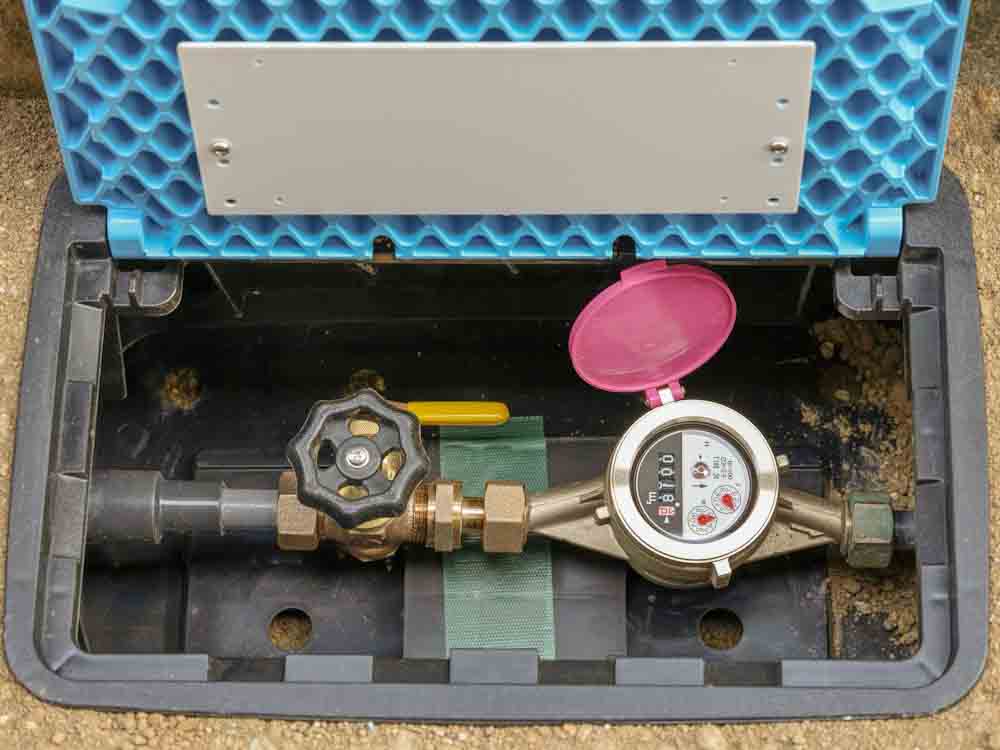
Thames Water meters in London are almost always outside the property, installed in a small chamber set flush into the pavement, path or front-boundary verge. The chamber cover is typically rectangular or square, approximately 20cm × 15cm, made of black plastic or cast iron, and stamped with a "W" or the word "water." It sits at or very near the boundary between your property and the public footway — often directly in line with the internal stop tap inside your home.
To open it: insert a flat-head screwdriver into the notch or slot on the edge of the cover and lever it up. The cover is not locked but can be stiff if it hasn't been lifted in years. Inside you will find the meter body (usually a white or grey cylindrical register unit), the meter dial, and the stop tap spindle if it is a combined stop-tap-and-meter chamber. There may be standing water in the chamber — this is normal groundwater and does not indicate a leak inside the chamber itself.
Older properties — particularly pre-1950 terraced houses in inner London boroughs — sometimes have their meter inside the property, typically under the kitchen sink or in a utility cupboard near the internal stop tap. If you cannot find an external chamber, check inside first.
Smart meters, which Thames Water has been rolling out across London since 2021, look identical externally to older meters. The difference is internal: a smart meter has a radio transmitter that sends hourly consumption data back to Thames Water's network without anyone needing to visit. You cannot tell from looking at the chamber whether you have a smart meter or a mechanical one, but both are read by the same method.
If you genuinely cannot locate your meter, call Thames Water on 0800 980 8800. They hold a record of every meter location in their supply area and will tell you exactly where to look. This call is free and takes about two minutes.
Step 2 — How to Read a Thames Water Meter
A standard Thames Water meter has two sets of digits on the register face:
- Black digits (the main read) — these count cubic metres (m3) of water used. A typical London household uses 100–150 m3 per year, so the black digits advance slowly in day-to-day use. Write down all black digits left to right.
- Red digits (the decimal fraction) — these count tenths, hundredths and thousandths of a cubic metre. One cubic metre is 1,000 litres, so the rightmost red digit represents a single litre. These digits move fast on a leaking pipe and slowly on normal overnight use. Write all red digits down too.
Some Thames Water meters also have a leak indicator — a small red or black triangle, star, or flow symbol on the face of the register. When any water is flowing through the meter, this symbol rotates or spins. With all taps off, a spinning leak indicator is an immediate confirmation of a leak, even before you take a before-and-after reading. Look for it first — it saves you the wait.
Write the full reading in a note on your phone with the time and date: for example, "07:15 — 00487.512" (black: 00487, red: 512). This is your baseline.
Step 3 — Do the Overnight Leak Test
Six steps, in order:
- Switch off all taps — kitchen, bathroom, utility room, outside taps. Every tap in the property.
- Check all toilet cisterns are not running. Listen at each toilet for the hiss of a slow-fill valve. Toilets are the single most common cause of a false positive on a meter test — a running cistern flows at 0.05–0.3 litres/minute and will move your meter red digits without you knowing. To confirm a cistern is sealed, put a few drops of food colouring into the cistern and check after 10 minutes — if colour appears in the pan without flushing, the flapper is leaking. Fix the toilet first before running the meter test.
- Switch off appliances that use water. This includes: dishwasher, washing machine, water softener (which back-washes on a timer), ice maker in an American-style fridge, pond pump if fed from the mains, garden irrigation timer, humidifier. If in doubt, switch it off at the wall.
- Read the meter and photograph the display. Note the exact time.
- Wait. 60 minutes minimum for a confident result. Overnight — 8 hours — is better and will catch a very slow drip (below 0.05 litres/minute) that might not register clearly in an hour. Do not use any water during the test period.
- Read the meter again and photograph it. Note the exact time.
A 1 litre/minute leak increases the reading by 0.001 m3 every 16.7 seconds. Over 60 minutes it adds 0.060 m3 — the last two red digits will advance by 60 units in an hour, clearly visible. A very slow 0.1 litre/minute drip adds 0.006 m3 in an hour — the last red digit advances by 6 units. Even this is readable if you photograph both readings at a good angle.
What the Results Mean
Compare your before and after readings and apply the following:
No movement at all — you do not have a detectable leak on your supply pipe or internal plumbing. Either no leak exists, or the flow rate is below the meter's minimum registration threshold (typically 0.01–0.03 litres/minute on a standard mechanical meter). At that rate the financial loss is under £10/year — negligible. No action needed unless you have other reasons to suspect a leak (damp patches, unexplained bill increase).
Small movement in the red digits only — a slow leak, likely a dripping compression joint, a weeping pipe crack, or a slow-fill valve you missed. 0.05 L/min is still 26 m3/year — approximately £86/year at Thames Water's current combined water and wastewater rate (£3.31/m3). Worth fixing but not urgent enough to be a Thames Water-notifiable event. Book a survey at your convenience.
Clear movement in the red digits within 30 minutes — a meaningful leak, typically 0.2–1 L/min. This category covers most supply pipe pinhole leaks and cracked joints. At 0.5 L/min you are losing 720 litres/day — 263 m3/year — approximately £871/year. Call ERL on 0207 046 1363 for a same-day acoustic survey.
Movement in the black digits within the test period — a significant leak at above 1 L/min. You are losing over 1,440 litres per day. At Thames Water's combined rate this is £4.77/day or £1,738/year. A leak at this rate will almost certainly trigger Thames Water's overnight flow detection on a smart meter, meaning their Section 75 notification letter may already be in the post. Do not delay — call ERL immediately.
Whatever the reading, the meter test only confirms that a leak exists and gives you a flow-rate estimate. It cannot tell you where the leak is — whether it is on the underground supply pipe from your boundary stop tap to the house, on an internal branch pipe, or at a fitting inside the property. Locating the leak requires an acoustic survey: an engineer uses a ground microphone and electronic correlator to listen for the pressure differential at the leak point through the ground surface. ERL's no find no fee leak detection service covers the full acoustic, thermal and hydrogen tracer gas chain — if we cannot find the leak, you pay nothing.
Once the leak is found and repaired, submit a Thames Water leak allowance application within 3 months of the repair date. The allowance is a bill credit for the estimated volume of water you lost through the leak period. For a 1 L/min leak running for 3 months before detection, that credit can reach £400–£600. Full details on the allowance process are on our Thames Water leak detection London page.
Run your meter test tonight. If the digits move, call Emergency Repairs London on 0207 046 1363 — same-day acoustic survey, no find no fee, across all 32 London boroughs.
FAQs
The four questions below cover the most common points of confusion around the Thames Water meter test — meter movement interpretation, meter location, smart meter detection, and what to do once you confirm a leak.
If you have received a Thames Water notification letter about overnight flow and are working against the 4-week Section 75 repair deadline, call rather than email — the deadline is fixed from the notification date and same-day detection is available. Our Thames Water deadline response service handles the survey, repair, Building Regulations notification and leak allowance paperwork as a single package. Call 0207 046 1363 now.
Valentin N. — Operations Director, Emergency Repairs London
Key Takeaways
- The overnight meter test is definitive — if your meter moves with all taps off, you have a leak on your supply pipe or internal plumbing
- Your Thames Water meter is usually in a small plastic box in the pavement or path at the front of your property boundary — lift the cover with a screwdriver
- Smart meters (Thames Water's roll-out since 2021) send hourly readings to Thames Water automatically — they can detect leaks before you see them on a bill
- A 1 litre/minute leak uses 1,440 litres per day — at Thames Water's rate of ~£3.31/m3 (water + wastewater), that's approximately £4.77/day or £142/month you're paying for nothing
- If Thames Water detects overnight flow on your meter before you do, they will notify you by letter — and the 4-week Section 75 deadline starts from their notification date, not yours
- The meter test only confirms a leak exists — not where it is. Supply pipe detection requires an acoustic survey (ERL, no find no fee, same day)
- Fix within 4 weeks and claim the Thames Water leak allowance within 3 months — a rebate for the water you lost
