Thames Water Leak Allowance: Who Pays and How to Claim
Thames Water only covers leaks up to your boundary. Find out which side your leak is on, meet the 4-week repair deadline, and claim the leak allowance rebate.
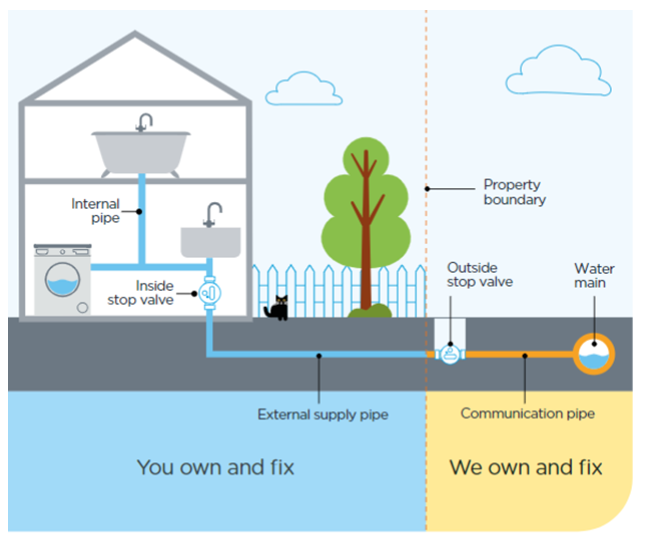
Thames Water's legal responsibility ends at the boundary stop tap — the small metal or plastic box set into the pavement or path at the edge of your property. The pipe from the water main to that stop tap is Thames Water's; the pipe from that stop tap into your home (called the supply pipe) is yours. If you have a leak anywhere from the boundary stop tap through your garden, under your driveway, and into your internal plumbing, you are responsible for fixing it — Thames Water will not send a plumber. If Thames Water has detected the leak on their meter, they will notify you and you have 4 weeks to fix it before Section 75 of the Water Industry Act 1991 applies. Call Emergency Repairs London on 0207 046 1363 for same-day detection.
The most common source of confusion we see when a homeowner discovers they have a water leak in London is a straightforward one: they assume Thames Water will come and fix it. In most cases, they will not. The division of responsibility between Thames Water and the homeowner is defined in legislation and follows a physical line — the boundary stop tap at the edge of your property. Understanding exactly where that line sits, and which side of it your leak is on, is the first thing you need to know before you call anyone.
This article walks through the legal framework, the practical test you can do yourself in under ten minutes, what happens if you miss the repair window, and how to recover the cost of the water loss through the Thames Water leak allowance scheme. If you have already received a notification from Thames Water, the 4-week clock is running — call Emergency Repairs London on 0207 046 1363 for same-day acoustic detection across the 32 London boroughs.
Where Thames Water's Responsibility Ends
Thames Water's legal obligation under the Water Industry Act 1991 covers two assets: the water main running under the public highway, and the communication pipe that branches off that main and runs to the edge of your property. At the edge of your property — typically at the pavement line for a London terraced house — there is a small valve called the boundary stop tap. That valve is the exact legal boundary between Thames Water's network and your private supply.
Thames Water confirms this on their own leak reporting resources: they are responsible for the pipe up to and including the boundary stop tap. From the boundary stop tap onward, into your garden, under your driveway, through the external wall of your property and into your internal plumbing — every metre of that pipe is yours. If it leaks, it is your cost to detect and repair. Thames Water will not dispatch a plumber to private supply pipes under any circumstances.
On a typical London Victorian terraced house, the boundary stop tap sits under a small square metal or plastic lid set into the pavement at the front of the property, directly in line with where the communication pipe crosses from the public footway onto your land. On newer detached properties or houses with side access, it may be in the path or verge at the side boundary. The lid is usually stamped with a "W" or the word "water." If you have never located yours, doing so now — before you have a leak emergency — is worth five minutes of your time.
Thames Water owns and maintains all assets up to that tap. If the communication pipe between the main and your boundary stop tap is leaking, call Thames Water's leaks line on 0800 316 9800 — that repair is their cost and their responsibility. They have a statutory duty to repair leaking infrastructure within their network.
Communication Pipe vs Supply Pipe — The Key Distinction
The two pipes that matter in any Thames Water leak dispute are the communication pipe and the supply pipe, and the terms are often confused in conversations between homeowners and call centres.
The communication pipe is Thames Water's pipe. It runs from the water main under the road to your boundary stop tap. It is typically a 25mm MDPE blue pipe on post-1970 installations, or old lead on Victorian infrastructure that has not been replaced. Thames Water installs it, maintains it, and repairs it at their cost. You have no legal obligation in relation to this pipe — if it leaks, it is not your problem.
The supply pipe is your pipe. It runs from the boundary stop tap, under your garden or driveway, through the external wall of your property, and to your internal stop tap — usually located under the kitchen sink. Everything downstream of the internal stop tap is internal plumbing, also your responsibility. The supply pipe on a London terraced house is typically 3 to 8 metres long for a front-garden property, and can be 15 to 20 metres on detached houses with long side approaches. On post-1970 properties the supply pipe is almost always 25mm blue MDPE plastic. On pre-1970 properties — a very significant proportion of the London housing stock — it is frequently the original lead pipe, which is softer, more prone to ground-movement cracking, and a health consideration in its own right.
Thames Water will repair a leaking communication pipe at no cost to you. They will not repair a supply pipe under any circumstances. When Thames Water contacts you to say their meter has detected a leak at your property, the leak is almost always on the supply pipe — their metering detects flow beyond the boundary stop tap, which by definition places the loss on your side.
How to Tell Which Side of the Boundary Your Leak Is On
There is a simple field test you can carry out yourself, in under ten minutes, to establish whether a suspected leak is on Thames Water's communication pipe or your supply pipe. You will need to locate your boundary stop tap first.
The boundary stop tap test:
- Close the boundary stop tap completely (turn clockwise with a flat-bladed screwdriver or a boundary-tap key, available from any plumber's merchant for about £5).
- Go to your Thames Water meter, which is usually in the pavement close to the boundary stop tap, under a separate small circular lid. Watch the meter dial or digital display for two to three minutes with all taps indoors turned off.
- If the meter stops completely — no movement at all — the leak is downstream of the boundary stop tap, meaning it is on your supply pipe and is your responsibility.
- If the meter continues to register flow with the boundary stop tap fully closed, the loss is occurring between the main and the boundary stop tap — on the communication pipe. That is Thames Water's responsibility. Call their leaks line on 0800 316 9800 and report it.
A secondary check, which requires no physical access to the stop tap, is the overnight meter test that Thames Water themselves describe in their leak-detection guidance. Take a meter reading last thing at night after ensuring no water is used (no dishwasher running, no cistern filling). Take another reading first thing in the morning before any water is used. If the figures differ, water has been moving through the meter overnight — indicating a loss somewhere on your supply pipe or internal plumbing. This is the test Thames Water's own smart meters run automatically, which is how the majority of leak notifications are generated.
If you cannot locate the boundary stop tap, or it is seized and will not turn, do not force it — a seized stop tap on a Victorian property will shear. Call Emergency Repairs London on 0207 046 1363. Our engineers carry boundary tap keys and can free a seized tap as part of the detection visit.
The 4-Week Deadline and Section 75 Enforcement
If Thames Water's meter detects a leak at your property — whether through a smart meter alert, a routine meter read comparison, or a neighbour's report of water appearing at the surface — they will contact you. The notification typically arrives by letter to the registered address, by phone call to the number on your account, or in some cases as a smart meter alert in your online Thames Water account. The notification will state the date on which the leak was detected and will advise you to arrange a repair.
That date of notification starts a statutory 4-week clock under Section 75 of the Water Industry Act 1991. Section 75 grants Thames Water the power to enforce repair of private supply pipe leaks that are wasting water. The mechanism works as follows:
- Within 4 weeks of notification: you arrange and complete the repair. You notify Thames Water with the plumber's invoice reference and the repair date. The matter is closed, and you can proceed to claim the leak allowance rebate (covered in the next section).
- After 4 weeks without repair: Thames Water serves a formal Section 75 notice. This notice authorises Thames Water to appoint a contractor to carry out the repair themselves and to recover the cost from you as a debt. Thames Water's contractor rates are set to recover their cost base — in practice, homeowners who allow Section 75 enforcement typically pay £180 to £300 per hour for labour, materially above the market rate of a private contractor appointed directly. The total cost of enforcement routinely exceeds the cost of the private repair by 40 to 80%.
- In persistent non-repair cases: Thames Water can disconnect the water supply at the boundary stop tap and leave the property without water until the repair is confirmed. This is rare, but it happens.
The practical implication is straightforward: if you have received a Thames Water leak notification, the cheapest outcome by a significant margin is to arrange a repair within the 4-week window. ERL's Thames Water deadline service is designed specifically for this scenario — same-day acoustic detection across Zones 1–3, next-day across all 32 boroughs, with the repair documentation needed for both the Thames Water notification response and the leak allowance claim issued on the same day as the repair.
Thames Water Leak Allowance — Getting Your Rebate
Thames Water operates a leak allowance scheme that provides a rebate on your water bill for the volume of water lost to a supply pipe leak, on the basis that you were not aware of the leak and could not reasonably have prevented the loss. The allowance does not pay for repair costs — it covers the water cost only. For a metered property with a supply pipe leak running at 1 to 3 litres per minute (a typical undetected underground leak in London), the allowance can represent a rebate of £150 to £600 on a six-month billing period.
Eligibility conditions:
- You must be on a water meter. Unmetered properties do not pay for water by volume and cannot claim an allowance.
- The leak must have been on a pipe you own — the supply pipe or internal plumbing. You cannot claim an allowance for a leak on Thames Water's communication pipe (that was their loss, not your bill).
- The repair must be completed within 4 weeks of Thames Water's notification date.
- The claim must be submitted within 3 months of the repair completion date. Thames Water will not backdate an allowance claim under any circumstances. Once the 3-month window closes, it is closed.
How to claim:
- Complete the Thames Water Leak Allowance form, available on their website under "Help with your bill" or by calling 0800 316 9800.
- Attach a copy of the plumber's invoice showing: the address, the work carried out (supply pipe leak repair), the date of repair, and the contractor's contact details. ERL provides a full invoice with all required fields on the day of repair.
- Provide your account number and an approximate start date for the leak if known (Thames Water will estimate this from their meter data if you cannot provide it).
- Submit by post or via your online Thames Water account. Thames Water typically processes allowance claims within 4 to 6 weeks and applies the credit to your account or issues a cheque.
ERL provides complete repair documentation — invoice, description of the fault, repair method, pipe material, and the estimated flow rate of the leak — formatted to match Thames Water's allowance claim requirements. If you have appointed us for the detection and repair, we will hand you everything you need to make the claim before we leave site.
What Your Buildings Insurance Covers
Approximately 97% of standard UK buildings insurance policies include trace and access cover. This is a specific coverage section that pays for two things: the cost of finding a hidden leak (the detection survey), and the cost of gaining physical access to it (lifting floor tiles, core-drilling through a concrete driveway, breaking out a section of path). It does not pay for the pipe repair itself, and it does not pay for the water that was lost — that is the Thames Water leak allowance.
Understanding what trace and access covers, and what it does not, avoids the most common mistake: homeowners who are told by an insurer that "the claim is covered" and then receive an unexpected bill for the actual pipe repair. The split is consistent across ABI-member insurers:
- Covered under trace and access: acoustic detection survey, ground microphone scan, correlator testing, the physical access works (lifted tiles, excavated path, core drill), and reinstatement of the access area to a structurally sound condition. Typical T&A limit per claim: £5,000 to £10,000.
- Not covered: the cost of repairing or replacing the supply pipe, the water loss (claim via Thames Water allowance), or redecoration beyond the access damage footprint.
To make a trace and access claim, your insurer will require a written detection report in ABI format, setting out: the property address, the suspected leak location before investigation, the detection method used, the confirmed leak location and depth, the access method proposed, and the estimated access cost. ERL provides an ABI-format written detection report as a standard add-on to every supply pipe detection survey, included at +£100 above the detection fee. This report is accepted by all major London-area insurers including Aviva, AXA, LV, Direct Line, Hiscox, and Zurich.
If you intend to make a trace and access claim, notify your insurer before any access work begins — most policies require pre-authorisation of access costs above £500. ERL can provide a scoped estimate for the access works that your insurer can authorise in advance. Do not wait until after excavation to contact the insurer; retrospective authorisation is routinely declined.
Received a Thames Water leak notification or suspect you have a supply pipe leak? Call Emergency Repairs London on 0207 046 1363 for same-day acoustic detection and repair. We cover all 32 London boroughs, provide the documentation for your Thames Water leak allowance claim, and produce the ABI-format insurer report for your trace and access claim. Don't let the 4-week Section 75 window close on you.
FAQs
The FAQ schema at the foot of this page covers the six questions we hear most on Thames Water leak responsibility callouts: who is responsible for which pipe, how to find the boundary stop tap, what happens if you ignore the notification, whether Thames Water contributes to repair costs, whether a high bill could be Thames Water's fault, and how quickly ERL can respond to a Thames Water deadline situation.
If you are dealing with a shared supply pipe — one pipe that serves two or more properties — the responsibility question becomes more complicated. The position at law is that all properties served by a shared supply pipe are jointly and severally responsible for its repair. If a neighbour refuses to contribute or is uncontactable, you are not protected from Thames Water enforcement. We cover this in detail in our article on shared supply pipe leaks and neighbour responsibility in London.
For a full guide to claiming your water loss back through the Thames Water scheme after the repair has been completed, see our dedicated article on how to claim the Thames Water leak allowance. For insurers requiring detailed trace and access documentation, the trace and access insurance cover guide explains exactly what insurers expect and what ERL's ABI report provides.
Save the number — 0207 046 1363. Same-day response across London for Thames Water deadline repairs. The 4-week window moves fast when you are waiting for a surveyor's slot.
Valentin N. — Operations Director, Emergency Repairs London
Key Takeaways
- Thames Water's responsibility ends at the boundary stop tap — they own the communication pipe, you own the supply pipe from boundary inward
- The boundary stop tap is set into the pavement or path at the edge of your property boundary — often under a small square metal or plastic cover
- If Thames Water has detected your leak on their meter, you will receive a letter or phone call — this starts the 4-week Section 75 clock
- Under Section 75 of the Water Industry Act 1991, if you don't fix within 4 weeks, Thames Water can repair it themselves and charge you their rates
- On a metered property, if you fix the leak within 4 weeks, you can claim a Thames Water leak allowance — a rebate for water lost, claimed within 3 months of the repair
- Thames Water does NOT pay for private supply pipe repairs, leak detection costs, or reinstatement of damaged surfaces
- Your buildings insurance trace and access cover — present on ~97% of UK policies — typically pays for locating the leak and reinstating the access damage
- ERL provides complete repair documentation for your Thames Water leak allowance claim after the repair
