Shared Supply Pipe Leak in London: Who Pays When Neighbours Share a Pipe?
Many older London terraced houses share a single supply pipe between two or more properties. When it leaks, responsibility is joint — and so is the cost. Here's how to identify a shared pipe, who pays what, and how ERL's survey can determine exactly whose section has failed.
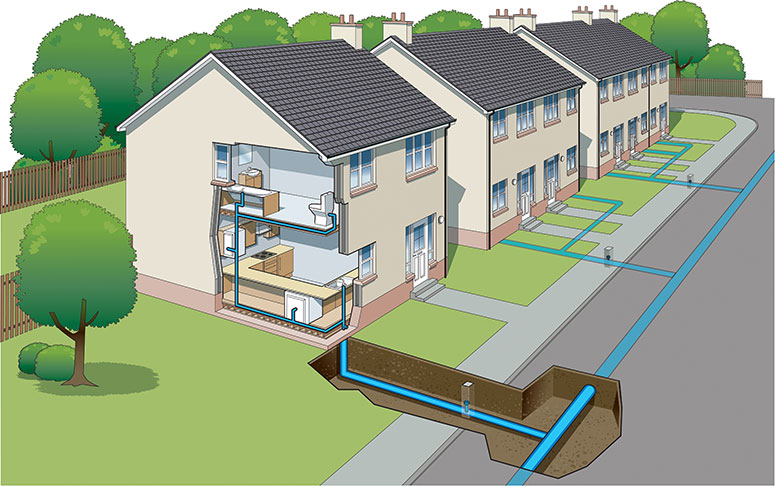
A shared supply pipe is a single water supply pipe that serves two or more properties from the Thames Water boundary stop tap, before splitting into individual private pipes inside or beneath each property. They are very common in pre-1980 London terraced housing, where a single pipe was laid to serve a pair or row of houses and was never upgraded. When a shared supply pipe leaks, responsibility for the repair is joint between all the properties that share it — in proportion to their use, or in equal shares if no other agreement exists. A surveying engineer can identify which section of the shared pipe has failed and apportion responsibility accordingly. Call ERL on 0207 046 1363 for a shared pipe assessment.
A shared supply pipe leak is one of the most complicated domestic plumbing situations in London, not because the repair is technically difficult, but because it involves two or more property owners who may have never spoken about plumbing in their lives. Thames Water sets a hard deadline, neighbours may disagree on who pays, and the pipe is often buried under a shared path or under someone's floor. This page explains exactly how these situations work — legally, technically and practically — and what ERL does to cut through the confusion.
If you have already received a Thames Water notice about a shared supply pipe, the 4-week Section 75 repair deadline is running. Call Emergency Repairs London on 0207 046 1363 to book a shared pipe survey and get a confirmed scope and cost before that clock expires.
What Is a Shared Supply Pipe?
A shared supply pipe is a single water supply pipe that serves two or more properties from one Thames Water boundary stop tap. In London's older terraced housing stock — particularly Victorian and Edwardian terraces and 1950s–70s post-war builds — it was standard practice to run one pipe from the water main connection to serve a pair of houses or a short row. The pipe runs from the boundary stop tap, under the shared path or front garden, and then splits either outside under the path or inside the first property it reaches, into separate branches for each house. The shared section is physically one pipe. Each property then has its own branch and its own internal stop tap controlling supply to that property alone.
The split point between the shared section and the individual branches is not always marked, known to the owners, or easy to locate. It is frequently buried under a path, beneath a floor screed or under a front garden. Thames Water records sometimes show the shared connection arrangement, but the physical split point location is rarely on record anywhere.
Signs you may have a shared supply pipe
- You are in a pre-1980 terraced or semi-detached house in London
- Your internal stop tap location does not correspond to a direct run from the street — the pipe appears to enter from an unexpected angle or from beneath a shared path
- Your water pressure drops noticeably when a neighbour is running taps or using appliances simultaneously
- Thames Water records or your property deeds reference a shared connection or a "communication pipe" serving adjacent properties
- You have an old lead supply pipe — lead pipework is almost always original Victorian infrastructure, and Victorian terraces were routinely plumbed on shared runs
Blue MDPE (medium-density polyethylene) is the standard supply pipe material in use since the 1980s, replacing the original lead. Many shared supply pipes have been partially upgraded — MDPE from the main to the split point, with older pipework continuing to each property — which creates mixed-material runs that are harder to pressure-test and trace.
How Responsibility Is Shared Between Neighbours
The legal framework is straightforward, though the application of it in practice can be contested. Under the Water Supply (Water Fittings) Regulations 1999, each property owner is responsible for maintaining the water fittings on their side of the Thames Water stop tap — which includes the shared supply pipe section that feeds their property. For pipes shared between multiple properties, responsibility for the shared section is joint and several among all properties it serves.
In practice this means three things:
- Costs are split equally between all properties served by the shared section, unless an existing recorded agreement (a deed of easement, a property deed clause or a Land Registry restriction) specifies a different apportionment. Equal-share is the default position in the absence of any such agreement.
- You cannot unilaterally refuse to repair a shared supply pipe that is actively leaking. Thames Water issues formal repair notices under Section 75 of the Water Industry Act 1991 to all connected properties, and the 4-week deadline applies to the shared pipe collectively. Failure to repair within the deadline allows Thames Water to carry out the repair themselves and bill each property for their share — with an added premium for the administrative overhead.
- You cannot withhold consent to repair work on the grounds that you dispute your share of the cost. The appropriate response to a cost dispute is to proceed with the repair, document all expenditure, then recover your neighbour's share through civil channels if necessary.
One common point of confusion: Thames Water's Section 75 notice applies to the shared pipe as a whole, not to individual properties separately. This means all named properties are jointly bound by the single deadline. If one property acts and the others do not, the acting property can proceed with the repair and invoice the non-contributing properties afterwards. The legal position supporting this recovery in the small claims court is well-established.
A further point worth knowing: if your property is a leasehold flat or is managed by a freeholder or managing agent, the freeholder may be the responsible party rather than the leaseholder. Check your lease terms. Managing agents dealing with shared pipe notices should contact ERL directly — we work regularly with estate management firms across London.
Identifying Which Section Has Failed
The single most important step in any shared supply pipe leak situation is determining which section of the run has failed — the shared section (the responsibility of all connected properties) or one property's private branch (the responsibility of that property alone). This distinction can be the difference between a cost split across three properties and a full repair bill falling on one owner.
ERL's shared pipe survey process works through five stages:
- Simultaneous pressure test of all connected properties — an engineer at each internal stop tap isolates each branch in turn while pressure is held on the incoming supply. This confirms whether the shared section or a specific branch loses pressure, narrowing the fault to the correct section of pipe before any excavation is opened.
- Acoustic scan of the shared run — a ground microphone is passed along the full route of the shared pipe, from the boundary stop tap to the split point. The acoustic signature of a leak (a characteristic hiss or pulse depending on pressure) localises the fault to within approximately 0.3 metres on a confirmed pipe route.
- Individual branch scans if the shared section holds pressure — if the pressure test confirms the shared section is sound, each property's private branch is scanned in sequence from that property's internal stop tap outward. This identifies which branch has failed and confirms single-property responsibility.
- Cross-correlation — on longer shared runs or runs under hard surfaces, cross-correlation uses two ground sensors simultaneously to triangulate the exact leak position between them, independently of pipe route assumptions. Accurate to within 150mm in most conditions on London clay soils.
- Survey report — ERL produces a written report identifying the failed section, the responsible parties, the proposed excavation approach, and a quoted repair method. For shared section failures, the report identifies all connected properties and their equal-share cost allocation. For branch failures, it identifies the sole responsible property and confirms the others have no liability for this repair.
Why the survey report matters beyond the immediate repair: a written determination from a qualified engineer that the leak is on a neighbour's private branch — not the shared section — is the document you need if a neighbour later claims you should have contributed to a repair that was not your liability. We have seen disputed shared pipe situations where one property contributed to a repair that turned out to be entirely on another property's branch, simply because no survey was done first. A £350 survey is cheap insurance against a £2,800 unnecessary contribution.
For Thames Water-notified leaks, ERL's survey report can also be submitted directly to Thames Water as evidence of the repair scope and the identified responsible parties, which supports any subsequent extension requests or liability challenges. See our Thames Water leak detection London page for the full process on Section 75 repairs.
When Neighbours Dispute Responsibility
Most shared pipe situations resolve quickly once a clear survey report is in hand. The report takes the question of where the leak is and who is responsible out of the realm of opinion and into documented evidence. Neighbours who were reluctant to engage often accept the survey findings and agree to a cost split without further dispute.
For situations that remain contested after the survey, the practical guidance is:
Proceed with the repair regardless of the dispute. The Thames Water 4-week Section 75 deadline does not pause for neighbour negotiations. A dispute that causes you to miss the deadline exposes all connected properties — including yours — to Thames Water's enforcement repair at inflated cost. Protect yourself by proceeding, documenting all costs, and recovering the disputed share afterwards. Do not allow a neighbour's non-cooperation to create a worse outcome for you.
Document everything. Keep copies of the Thames Water notice, the ERL survey report, all repair invoices, and any written or email communication with neighbours about cost-sharing. This documentation is the foundation of any small claims court action if recovery becomes necessary.
Invoice the non-contributing property formally. A written invoice specifying the repair date, total cost, equal share calculation, and payment deadline creates a formal paper trail. Many neighbours who declined verbal cost-sharing requests will pay on receipt of a formal invoice — it changes the nature of the request from informal to actionable.
Small claims court for amounts up to £10,000. Joint pipe liability is a well-established area of civil law. Court fees are low (typically £35 to £205 depending on claim amount), the process is designed for unrepresented parties, and the legal position on equal-share responsibility for shared supply pipes is clear. A neighbour who refuses to pay their documented share after the repair is done is in a weak position in court.
Consider decommissioning the shared pipe at the same time. If excavation is already being made to repair the shared section, the marginal cost of replacing the shared run with individual pipes — one dedicated pipe per property — is often much smaller than the full cost of a separate individual pipe project later. Individual pipes eliminate all future shared liability, allow each property to isolate its supply independently, and avoid this situation repeating. ERL quotes both options (repair the shared pipe vs lay new individual runs) on every shared pipe survey. For a row of three properties where excavation is already open, individual pipe runs have been quoted at £600 to £900 per additional property beyond the first. The decision to decommission the shared pipe is the single most effective long-term resolution to shared pipe liability.
Thames Water's role ends at enforcement. Thames Water will notify connected properties and will enforce the repair deadline. They do not determine liability shares between neighbours, they do not mediate cost disputes, and they do not carry out partial-section repairs based on a liability determination. Their involvement is regulatory, not adjudicatory. Any cost recovery between properties happens through civil channels after the repair is complete.
If your situation involves a managing agent, a housing association, or a freeholder rather than a private neighbour, the process is the same but the counterparty for the invoice and any subsequent court action is the managing entity rather than an individual. ERL works regularly with managing agents and can address survey reports and correspondence directly to the entity responsible for the adjacent property.
Have a shared supply pipe leak or a Thames Water notice? Call Emergency Repairs London on 0207 046 1363 for a same-day shared pipe survey across Greater London, or use our no find no fee leak detection service if the leak location is not yet confirmed. We cover all 32 London boroughs and can coordinate multi-property survey visits where all affected neighbours need to be present simultaneously.
FAQs
The five questions below cover the situations we encounter most often on shared supply pipe callouts: what a shared pipe is, how responsibility is divided when a neighbour's leak affects you, how cost agreements work between neighbours, what Thames Water's actual role is, and whether replacing the shared pipe with individual runs makes more sense than repair.
If your situation involves a shared supply pipe in a leasehold block, an HMO or a property with a deed of easement that specifies non-standard liability arrangements, call us directly — these situations benefit from a short consultation before a survey visit is booked, to ensure the survey report addresses the specific liability framework that applies to your property.
Valentin N. — Operations Director, Emergency Repairs London
Key Takeaways
- Shared supply pipes are common in pre-1980 London terraced housing — a single blue MDPE (or old lead) pipe serving 2–4 properties from one Thames Water boundary stop tap
- When a shared pipe leaks, repair responsibility is joint between all properties served by that pipe — typically in equal shares unless a recorded agreement says otherwise
- You cannot withhold repair consent — a neighbour who refuses to contribute can be pursued in the small claims court for their share
- Thames Water treats a shared supply pipe leak the same as an individual supply pipe leak — they notify all connected properties and the 4-week Section 75 deadline applies
- ERL's shared pipe survey identifies exactly which section of the shared run has failed — and whether the failure is in the joint section or one property's private branch
- If the leak is on one property's private branch (after the split), only that property is responsible — even if the pipe is physically under a neighbour's land
- Replacing a shared supply pipe with individual pipes (decommissioning the shared run) is strongly recommended during any major repair — ERL quotes both repair and individual-pipe options
