Lead Supply Pipe Replacement London: Costs, Process and Thames Water Grants
Pre-1970 London properties often still have lead supply pipes running from the boundary stop tap into the home. Lead affects water quality and leaks are common. Here's what replacement costs, how Thames Water's help scheme works, and what ERL's process involves.
Lead supply pipes were standard in London homes built before 1970 and are still present in hundreds of thousands of pre-war terraced houses across inner London boroughs. Thames Water offers partial grant funding toward lead supply pipe replacement on private supply pipes through their Lead Replacement Programme — currently covering up to 50% of costs in some cases. A full lead pipe replacement (boundary stop tap to internal stop tap) in London costs £1,200–£2,800 depending on run length and surface type. ERL detects lead pipe leaks, provides inspection reports for Thames Water's grant scheme, and carries out full MDPE replacements. Call 0207 046 1363.
An estimated 200,000 London properties still have their original lead supply pipe running from the boundary stop tap into the house. For most of those properties, the pipe has been underground for 60–100 years and the owners have no idea it is there — until it leaks, or until a water quality test reveals elevated lead levels in the kitchen tap. This article covers how to identify a lead supply pipe, what Thames Water's replacement grant scheme covers, what full replacement costs in London in 2026, and what ERL's end-to-end process involves from first call to final flush test.
Is My Supply Pipe Lead?
The first question is whether your supply pipe is lead at all. The answer correlates strongly with build date and location.
Build date as a proxy: Lead was the standard supply pipe material in the UK from the Victorian era through to approximately 1970, when copper became dominant and lead was phased out under building regulations. If your home was built before 1970 — which covers the vast majority of inner London terraced housing — and the supply pipe has never been replaced, it is almost certainly lead. Post-1970 properties will have copper (older) or blue MDPE (newer) supply pipes.
Inner London boroughs with highest lead pipe prevalence: Islington, Hackney, Southwark, Lambeth, Lewisham, Tower Hamlets, Haringey and Newham have the highest concentrations of pre-war terraced housing in Greater London and therefore the highest proportion of surviving lead supply pipes. Outer boroughs have lower prevalence but it is far from zero — any pre-1970 property anywhere in the Thames Water supply area can have lead pipework.
How to confirm pipe material yourself: Locate the point where the supply pipe enters your property — usually through the floor or wall near the internal stop tap, often under the kitchen sink, in the cupboard under the stairs, or in a ground-floor utility area. Look at the pipe. Blue plastic (MDPE) is unmistakably modern. Copper is clearly copper-coloured. Lead is dull grey and noticeably heavier than copper of the same diameter. The definitive scratch test: use a key to scratch the surface of the pipe. Lead scratches immediately to a bright silver-white colour underneath the grey oxide layer. Steel scratches to a duller grey and is harder to scratch. Copper scratches to a bright orange-gold. If it scratches silver, it is lead.
Water quality confirmation: The Water Supply (Water Quality) Regulations 2016 (SI 2016/614) set a parametric value of 10 micrograms of lead per litre (10 µg/L) at the tap. In areas served by corrosive soft water — parts of west and south-west London fed from reservoir catchments rather than the Thames — lead pipe can leach at levels considerably above this limit, especially in the first draw of water after the pipe has been standing overnight. Thames Water offers a free lead-in-water test to customers who believe they may have lead pipework — call 0800 980 8800 to request a sample kit.
Thames Water records: Thames Water holds pipe material records for the public main up to the boundary. They can sometimes confirm the private supply pipe material from historical records, though this is less reliable than a physical inspection. A call to 0800 980 8800 is worth making — if their records show lead at your address, it confirms the need for a survey regardless of what you can see inside the property.
Thames Water's Lead Pipe Replacement Scheme
Thames Water operates a Lead Pipe Replacement Programme as part of their statutory obligations under the Water Supply (Water Quality) Regulations 2016 and their Drinking Water Inspectorate licence conditions. The scheme provides partial financial contribution toward the replacement of lead supply pipes on the private side of the boundary (the section the homeowner owns and is responsible for maintaining).
What the scheme covers: Thames Water's contribution applies to the private supply pipe — from the boundary stop tap to the internal stop tap inside the property. The contribution rate and eligibility vary by area and by programme year, and Thames Water's funding for the scheme is allocated in tranches. In recent programme cycles, Thames Water has offered contributions covering 50% of replacement costs in the highest-priority areas (areas with highest measured lead exceedance), with lower contribution rates in other areas.
How eligibility is assessed: Thames Water assess eligibility based on (1) whether the property is in a designated priority area, (2) whether the lead level at the tap has been measured and found to exceed or approach 10 µg/L, and (3) whether the public main serving the property has already been replaced with non-lead material (if the public main is still lead, Thames Water will typically replace that at their own cost before or alongside the private pipe replacement). ERL provides the inspection report and pipe material confirmation that Thames Water's Developer Services team requires to assess a grant application.
How to apply: Contact Thames Water Developer Services directly on 0800 009 3921 or via the Thames Water website. Ask specifically about the Lead Pipe Replacement Programme. Request a home visit to assess eligibility — this is free. Before calling Thames Water, it is worth having ERL inspect and confirm your pipe material in writing, as this speeds up the application significantly.
Important timing note: Thames Water's scheme funding is not unlimited. Priority areas are assessed on a rolling basis and contribution rates can change between programme years. Do not assume the current contribution rate will still apply in six months — if you have confirmed lead pipework, apply promptly.
Lead Supply Pipe Replacement Costs in London
The cost of replacing a lead supply pipe in London depends on four factors: the run length (boundary to internal stop tap), the surface type over the pipe run (topsoil garden, path, driveway, public footway), whether mole boring is feasible, and the reinstatement specification required (like-for-like or upgrade).
| Run length | Surface type | Method | Price range (2026) |
|---|---|---|---|
| Short (3–7 m) | Topsoil / lawn | Open cut | £1,200–£1,600 |
| Short (3–7 m) | Block paving / path | Open cut + reinstate | £1,400–£1,800 |
| Medium (7–15 m) | Topsoil / lawn | Open cut | £1,600–£2,200 |
| Medium (7–15 m) | Concrete driveway | Mole bore (where feasible) | £1,800–£2,400 |
| Long (15 m+) | Mixed surfaces | Combined open cut + bore | £2,200–£2,800 |
All prices include: excavation or mole boring, removal of the old lead pipe, supply and installation of new blue MDPE pipe (WRAS-approved, BS EN 12201), new boundary stop tap where required, internal stop tap where required, reinstatement of excavated surfaces to original condition, and Building Regulations notification under the Water Supply (Water Fittings) Regulations 1999. Prices include VAT.
Prices do not include: Thames Water permit costs for work affecting the public footway (where applicable — ERL handles the permit application), specialist block-paving or natural-stone reinstatement above standard (add £200–£600 depending on specification), or lead water test kits (£45 per test if Thames Water's free test is not applicable).
With a Thames Water grant contribution of 50%, a medium run under garden (£1,800 gross) becomes £900 net to the homeowner. Even without a grant, the long-term benefit of eliminating lead from the water supply and removing a corroding pipe that will only get worse makes replacement the clear economic choice in most cases.
ERL's Replacement Process
ERL handles lead supply pipe replacement end-to-end — from the initial leak detection or water quality concern through to Building Regulations sign-off and post-replacement flush testing. The typical process for a London terraced house:
Step 1 — Detection and inspection. If the referral is a known or suspected leak rather than a planned replacement, ERL first runs an acoustic and hydrogen tracer gas survey to confirm the leak location and pipe condition. Lead pipe acoustic profiles differ from MDPE — the lower density and smaller bore mean acoustic signals attenuate faster. Hydrogen tracer gas (a 5% hydrogen / 95% nitrogen mixture pumped into the pipe at low pressure) bypasses the acoustic limitation and pinpoints the leak within ±0.3 m even under concrete driveways. The inspection report we produce includes pipe material confirmation, measured leak location, estimated pipe run length, and a grade assessment (A–D) of overall pipe condition. This report is the document Thames Water Developer Services requires to assess grant eligibility.
Step 2 — Grant check. We submit the inspection report to Thames Water on the customer's behalf (with written authorisation) and obtain a written confirmation of the applicable contribution before any work is priced or committed. This takes 5–10 working days for Thames Water to respond. We do not start replacement work before the grant position is confirmed in writing.
Step 3 — Quote and scheduling. On confirmation of the grant figure, we provide a fixed-price quotation for the replacement. For most London terraced houses the replacement is scheduled as a one-day job. We apply for any required Thames Water highway permit (for works within 1 metre of the public footway) as part of our preparation — permits typically take 5 working days and ERL absorbs the administration cost.
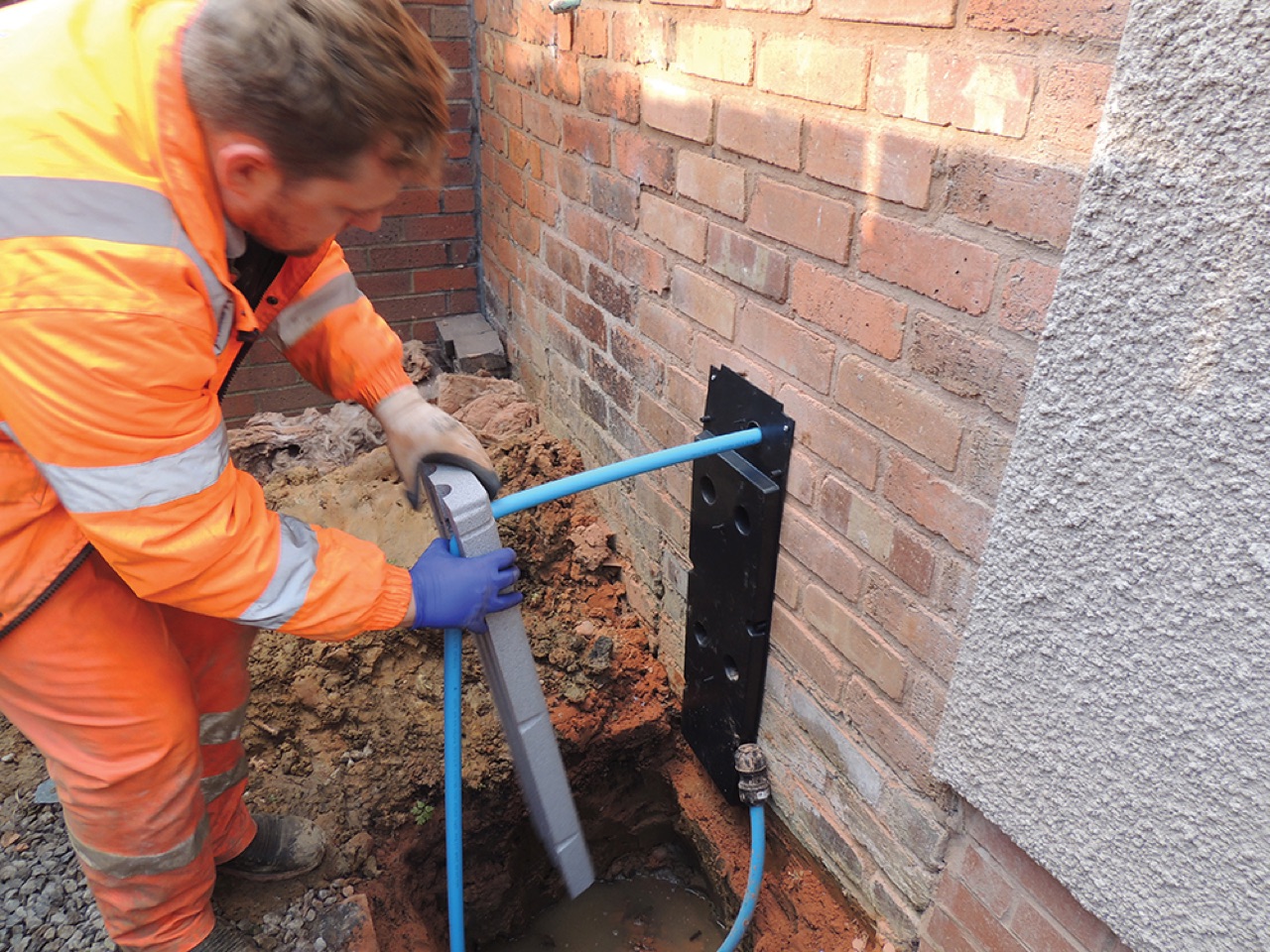
Step 4 — Replacement. On the day: isolate at the boundary stop tap, confirm isolation at the internal stop tap, excavate or bore the pipe run, remove the lead pipe (which is disposed of as controlled waste under the Environmental Protection Act 1990 — lead is a hazardous material), lay new blue MDPE to BS EN 12201, connect to the boundary stop tap and internal stop tap, pressure test at 1.5 times normal working pressure for 30 minutes, backfill and reinstate.
Step 5 — Building Regulations notification. Supply pipe replacement is notifiable work under the Water Supply (Water Fittings) Regulations 1999. ERL notifies Thames Water's Water Fittings team within 5 working days of completion. We provide the customer with a written completion certificate referencing the regulation notification.
Step 6 — Flush and test. New MDPE pipe does not contribute lead, but any residual lead in older internal fittings (solder joints, brass stopcocks with high lead content, old compression fittings) may still affect first-draw tap water for several weeks. We advise flushing the cold kitchen tap for 2 minutes before drawing water for drinking or cooking for the first 4 weeks after replacement. If a post-replacement lead-in-water test is desired, ERL can arrange this through an accredited laboratory — typically £85 per sample, results within 5 working days.
To start the process, call Emergency Repairs London on 0207 046 1363. We will arrange an initial inspection, produce the report for Thames Water's grant team, and handle the full replacement within your required timeline. Same-day acoustic surveys are available for urgent leak cases. All work guaranteed for 12 months on labour and 10 years on pipe materials.
FAQs
The four questions below cover the most common queries on lead supply pipe replacement in London — how to identify lead pipe, whether Thames Water contributes financially, whether a short-section repair is ever viable, and how long the job takes.
If you are dealing with a Thames Water Section 75 leak notification on a property that turns out to have a lead supply pipe, the same 4-week repair deadline applies regardless of pipe material. Call ERL on 0207 046 1363 — we carry out lead supply pipe replacements under Thames Water's deadline scheme and can complete a standard terraced-house run within the 4-week window including the grant application where applicable.
Valentin N. — Operations Director, Emergency Repairs London
Key Takeaways
- Lead supply pipes remain in an estimated 200,000 London properties — concentrated in pre-war terraced housing across inner boroughs (Islington, Hackney, Southwark, Lambeth, Lewisham)
- Lead pipes corrode and develop pinhole leaks as they age — acoustic detection is harder than on MDPE, but hydrogen tracer gas locates them precisely
- Thames Water runs a Lead Pipe Replacement Scheme offering partial grant funding — contact Thames Water's Developer Services to check eligibility before paying full price
- The Water Supply (Water Quality) Regulations 2016 set a lead limit of 10 micrograms/litre — old lead pipes often exceed this, especially in soft-water areas of outer London
- Full replacement from boundary stop tap to internal stop tap: £1,200–£2,800 in London, including excavation, new MDPE pipe, reinstatement, and Building Regulations notification under Water Regulations 1999
- After replacing a lead pipe, flush the cold tap for 2 minutes before drinking for the first few weeks — new MDPE will not contribute any lead, but any residual lead in fittings needs time to flush through
