Interlinked Smoke Alarms for HMOs: BS 5839-6 Rules 2026
Why HMOs need Grade D1 LD2 interlinked smoke alarms in 2026: mains-wired with battery backup, what LD1, LD2 and LD3 mean, and where each alarm has to go.
Houses in multiple occupation (HMOs) in London require interlinked smoke alarms under BS 5839-6. The default specification is Grade D1 LD2 — mains-powered alarms with sealed 10-year tamper-proof battery back-up, all interlinked so that detection in one location sounds every alarm in the property, covering escape routes plus high-risk rooms such as kitchens and lounges. Larger licensed HMOs of three or more storeys, or with five or more occupants, often need Grade A LD1 instead. Battery-only and non-interlinked alarms have not been adequate for an HMO since the Smoke Alarms (England) Regulations 2022 came into force in October 2022. A typical three-bedroom HMO upgrade to Grade D1 LD2 costs £900–£1,500 fully installed and certified. Call Emergency Repairs London on 0207 046 1363 or WhatsApp 07456 975436 for a borough-specific quote.
Why Interlinked Alarms Became Mandatory
The single biggest change to domestic fire-detection law in England in the last decade landed quietly on 1 October 2022, when the Smoke and Carbon Monoxide Alarm (Amendment) Regulations 2022 — usually called the Smoke Alarms (England) Regulations 2022 — extended the existing private-rented-sector duty to the social-rented sector and tightened the requirements that already applied to all rented homes. The headline rule has not changed since 2015: at least one smoke alarm on every storey of every rented home. What the 2022 amendment did was reinforce that, in any house in multiple occupation (HMO), the alarms have to do something the legal floor does not strictly mandate — they have to be interlinked.
The reason is straightforward. An HMO is, by definition, a property where unrelated households share circulation space — landings, stairs, kitchens, bathrooms. A smoke alarm sounding in a third-floor bedroom is no use to the household asleep in the basement studio if only that one alarm can be heard. The British Standard for domestic fire detection, BS 5839-6, has recommended interlinking in HMOs for more than a decade; the borough HMO licensing schemes that operate across all 32 London local authorities turn that recommendation into a binding licence condition. The combined effect, by 2026, is that an HMO without interlinked alarms is no longer a licensable HMO.
This article walks through the practical specification a London landlord or HMO operator actually needs to install: the grades, the categories, the difference between D1 and D2, where heat alarms go versus smoke alarms, the carbon-monoxide rule that runs alongside the smoke-alarm rule, what an electrician has to issue at the end of the job, and what the whole thing should cost in 2026. For a wider read on the full set of BS 5839-6 grades and where each one fits, our companion article BS 5839-6 grades explained is the place to start.
What "Interlinked" Actually Means
Interlinking is the principle that one alarm detects, all alarms sound. Smoke or heat in any one location triggers every alarm in the chain simultaneously, so every occupant of the property hears the alarm wherever they are.
There are two physical methods of interlinking permitted under BS 5839-6:
- Hard-wired interlink — A third "signal" core run alongside the permanent live and neutral feeding each alarm. When any alarm activates, it pulls the signal core and every other alarm on the loop sounds. Most reliable, most disruptive to retrofit because cables have to be run.
- Radio-frequency (wireless) interlink — Each alarm has a paired RF module. When one alarm activates, it broadcasts to every other alarm in the same RF group. Easier to retrofit because no signal cabling is needed, but the alarms must be commissioned as a group and an RF link diagnostic test must form part of the annual service.
Both methods are equally compliant when correctly specified and commissioned. In a new-build or rewire we default to hard-wired interlink; in a retrofit upgrade on an existing HMO we usually specify RF-interlinked Grade D1 heads because the disruption is a fraction of running new signal cables through finished plaster.
Grade D vs the Other BS 5839-6 Grades
BS 5839-6 defines six grades — A, B, C, D, E and F — running from most sophisticated and most reliable down to least. Two of those grades are the ones that matter for almost every HMO in London:
- Grade D — A system of one or more interlinked mains-powered smoke alarms (and heat alarms in kitchens) with an integral battery back-up inside each alarm head. No central control panel. This is the single most common grade in London HMOs and the default specification for small HMOs of one or two storeys.
- Grade A — A full BS 5839-1-style system designed for domestic use. Separately certified detectors, manual call points, sounders, and a central control and indicating panel with a 72-hour standby battery. This is the grade required in larger licensed HMOs — typically three or more storeys, or five or more occupants forming more than one household.
Grades B and C are effectively obsolete for new install. Grade E is mains-powered without battery back-up and almost never specified because a power cut leaves the property unprotected. Grade F is battery-only and is acceptable only where running a mains supply is genuinely impractical, which in a normal London terrace or conversion HMO is essentially never. For HMO work, the conversation is Grade D versus Grade A — nothing else.
D1 vs D2 — Which One Do Landlords Need?
The 2019 amendment to BS 5839-6 split Grade D into D1 and D2. The difference is the back-up battery inside each alarm head:
- Grade D1 — Mains-powered with a sealed, tamper-proof, 10-year lithium battery back-up. The occupant cannot open the unit and remove the battery. When the battery reaches end-of-life — typically around the 10-year mark — the entire alarm head is replaced.
- Grade D2 — Mains-powered with a user-replaceable battery back-up, traditionally a 9V PP3 cell or a pair of AAs. The occupant is supposed to replace the battery when the alarm chirps.
D1 exists because D2 had one well-documented failure mode: the tenant removes the battery to silence a chirping alarm, never replaces it, and the mains alarm runs on mains only — perfectly fine until the next power cut, at which point the property is unprotected. Sealed tamper-proof batteries eliminate the failure mode permanently.
For any new HMO install in London since the 2019 amendment, the default specification is Grade D1. Most borough licensing schemes have written D1 into their HMO licence conditions explicitly, and a D2 install fitted from 2020 onwards is usually treated as a non-conformance on inspection. If your HMO was last refitted before 2019 and the alarm heads have removable batteries, plan a D1 upgrade at the next replacement cycle — the unit cost differential per head is around £15–£25 and the compliance gain is significant.
The LD Categories — LD1, LD2, LD3, LD4
Grade describes the type of system. Category describes how much of the property the system covers. The four LD categories defined by BS 5839-6 are:
- LD1 — Whole-property protection. Detection in every circulation space (hallways, landings, stairs) and every habitable room and every room where a fire is likely to start. This is the most comprehensive category and is specified for larger licensed HMOs, bedsit-style HMOs and sheltered housing.
- LD2 — Escape routes plus high-risk rooms. Detection in every circulation space on the escape route plus every room presenting a high fire risk, which in practice means kitchens, living rooms and any room with a combustion appliance. This is the default specification for small HMOs in London.
- LD3 — Escape routes only. Detection in every circulation space on the escape route but not inside individual rooms. LD3 is the minimum recommended category for an owner-occupied single-family home — it is not adequate for an HMO.
- LD4 — Principal habitable room only. Below the standard recommendation; effectively never specified in modern UK practice and never adequate for any rented property, let alone an HMO.
For a deeper walk through the differences between the categories, including drawing-board examples of where each detector sits, our BS 5839-6 grades explainer covers the same ground in more detail alongside the grade dimension.
HMO Requirements per Scheme Size
The right grade-and-category pairing depends on the size and configuration of the HMO. The defaults below are the starting point in most London boroughs — the authoritative answer for any specific property is the borough licence schedule plus a competent-person fire-risk assessment carried out under PAS 79:
- Small HMO, 1–2 storeys, 3–4 sharers, single household-type occupation — Grade D1 LD2. Interlinked mains-powered alarms on every escape-route landing, smoke alarm in the lounge, heat alarm in the kitchen, sealed 10-year battery back-up throughout.
- Small HMO, 1–2 storeys, 3–4 sharers, multiple households — Grade D1 LD2 with detection inside each let bedroom as well as on the escape route. Some boroughs treat this as LD1.
- Three-storey HMO, 5+ persons (mandatory licensable HMO) — Most boroughs require Grade A LD2 minimum, several require Grade A LD1. A Grade D installation in a property of this size will fail the licence inspection.
- Bedsit HMO with shared kitchens and bathrooms — Grade A LD1, with detection inside every let room and interlinked sounders throughout. The principal-habitable-room rule of LD2 does not work in a bedsit because every let room is somebody's principal habitable room.
- Converted blocks of flats falling under HMO definition (s257 HMOs) — Usually Grade A LD2 in the common parts plus Grade D1 LD2 inside each flat, with the systems interfaced so a common-parts alarm sounds inside the flats.
Borough licensing conditions vary. Westminster, Camden, Tower Hamlets and Newham routinely require Grade A in HMOs that other boroughs would accept on Grade D1; always read the licence schedule before pricing the work. Our HMO licensing service page sets out the 32-borough variation in more detail.
Heat Detectors vs Smoke Detectors
Putting the wrong type of detector in the wrong room is the second most common failure we see on first-attendance inspection (after the wrong grade for the use class). The rule is simple:
- Heat alarms go in kitchens. Cooking — toasting, frying, anything that produces steam or aerosols — sets off smoke alarms constantly, the alarm gets disabled by the occupant, and the kitchen ends up unprotected. A heat alarm responds to a temperature threshold (typically 58°C fixed or rate-of-rise) and ignores ordinary cooking smoke entirely.
- Smoke alarms go everywhere else — landings, hallways, lounges, bedrooms, anywhere a smouldering fire (the killer fire type in domestic premises) is plausible. Optical (photoelectric) smoke alarms are the modern default; ionisation alarms are being phased out and we do not specify them on new installs.
The heat alarm in a kitchen must be on the same interlinked chain as the smoke alarms — a standalone heat alarm in a kitchen that does not interlink with the rest of the property is a non-conformance under BS 5839-6.
Carbon Monoxide Alarms — Separate Requirement
A smoke alarm does not detect carbon monoxide. A CO alarm is a completely separate sensor, and it is a completely separate legal requirement under the Smoke Alarms (England) Regulations 2022. In a rented property — and therefore in every HMO — a CO alarm is required in every room containing a fixed combustion appliance. That means:
- The room with the gas boiler (utility room, airing cupboard, kitchen — wherever it lives)
- Any room with a gas fire, gas log-effect heater or open-flue gas appliance
- Any room with a wood-burning stove, multi-fuel stove or open fire
- Any room with an oil boiler or oil-fired space heater
The 2022 amendment specifically excludes gas cookers from the CO requirement, but most fire-risk assessors still recommend a CO alarm in a kitchen with a gas cooker as good practice. CO alarms must comply with BS EN 50291 and should be sited per the manufacturer's instructions — typically wall-mounted at head height (around 1.5m from the floor) or within the manufacturer's specified distance from the appliance. CO alarms are not part of the BS 5839-6 system and do not need to interlink with the smoke alarms, though several manufacturers now offer interlinkable CO heads that join the Grade D chain.
Installation, Wiring and Commissioning
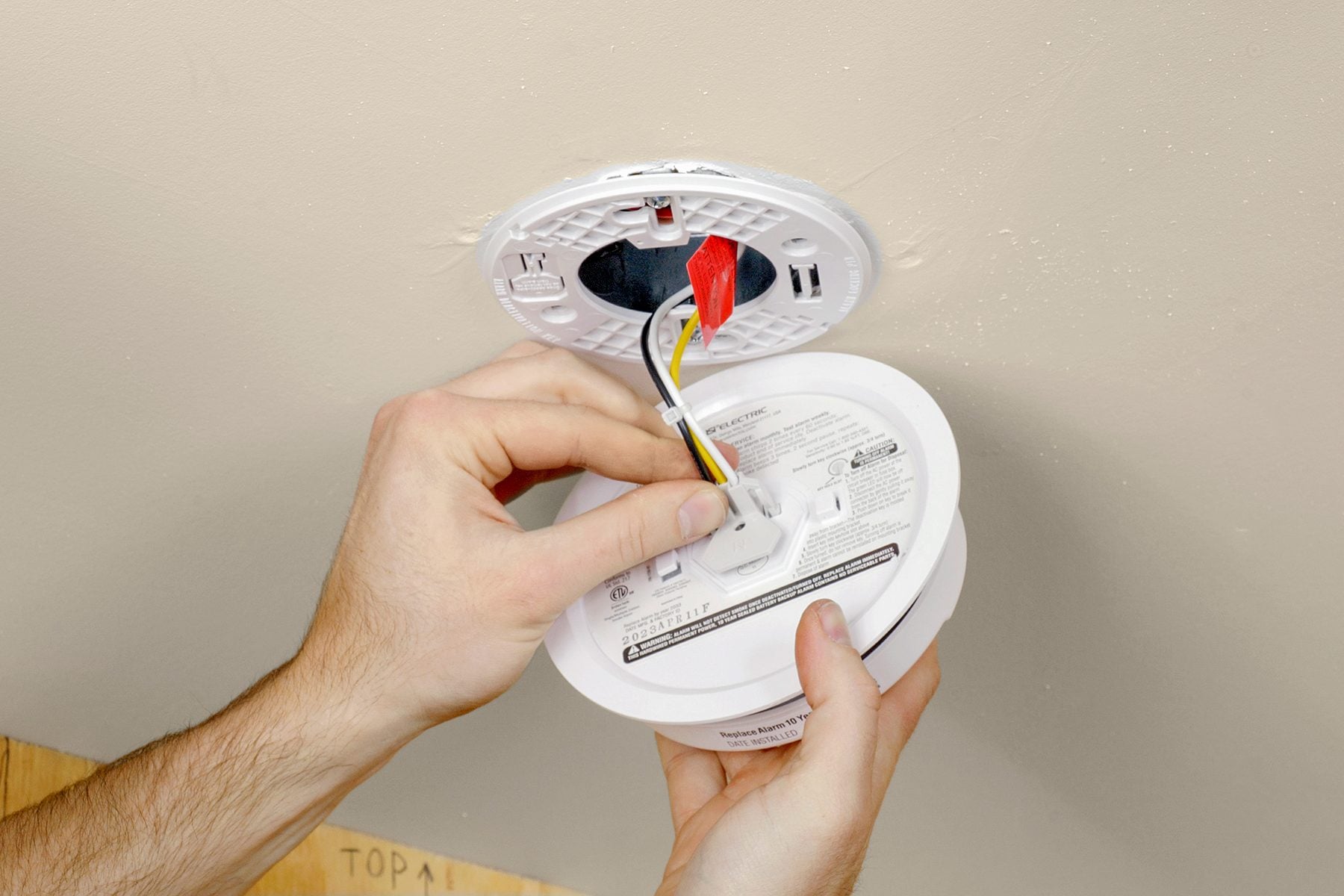
Mains-wired alarms are an electrical installation and have to be installed by a qualified electrician working under BS 7671 (the IET Wiring Regulations, 18th edition). The practical implications for an HMO landlord:
- The alarm circuit should be a dedicated lighting-rated circuit from the consumer unit, protected by an appropriate MCB and RCD. We routinely run alarm circuits on their own 6A MCB so that a fault on another circuit does not knock out the alarms.
- The signal core (for hard-wired interlink) is run alongside the live and neutral in three-core-and-earth cable. RF-interlinked installations skip this cable but still need the mains pair to every alarm.
- Every alarm head must be mounted in accordance with the BS 5839-6 siting recommendations — minimum 30cm from any wall in ceiling-mount, away from extract fans, away from heat sources, and within the manufacturer's spacing rules for room area.
- On completion, the electrician issues an Electrical Installation Certificate (EIC) for the wiring and a separate BS 5839-6 commissioning certificate for the alarm system, demonstrating that every alarm has been functionally tested, the interlink propagates correctly, the battery back-up holds the specified duration, and the alarm levels meet the standard.
- A written test schedule is attached to the commissioning certificate — weekly test by occupant, six-monthly inspection, annual service by a competent contractor.
If the property does not already have a current Electrical Installation Condition Report (EICR), the alarm install is a sensible opportunity to combine it with an EICR inspection — the same electrician is already on site, and an HMO EICR is required every five years under the Electrical Safety Standards in the Private Rented Sector (England) Regulations 2020 in any case.
Cost Guide — 2026 London Prices
Indicative installed cost for BS 5839-6 Grade D1 LD2 work in London, 2026:
- Single Grade D1 alarm point, installed and commissioned — £160–£220 per point (Emergency Repairs London typical: £180). Covers the alarm head, the mains cable run from the existing lighting circuit, mounting, wiring, test and certification.
- Whole-house upgrade, 3-bedroom HMO, Grade D1 LD2 — £900–£1,500 fully installed and certified. Typically 5–7 detection points (3 bedrooms or hallway, lounge, kitchen heat alarm, landing) plus commissioning paperwork.
- RF interlink uplift — Add £15–£30 per head over hard-wired interlink. Almost always cheaper overall on a retrofit because no signal cable has to be chased into finished plaster.
- Grade A LD2 system, larger licensed HMO — Quoted on survey, but a typical 5-bed three-storey HMO with control panel, sounders, manual call points and BS 5266 emergency lighting runs £2,800–£4,500 fully installed and commissioned.
- Annual service of an existing Grade D1 LD2 installation — £180–£260 depending on point count, includes full functional test, interlink check, battery diagnostic where available, and an updated test certificate.
Prices above assume normal access, no exotic listed-building constraints, and existing serviceable lighting circuits to extend from. A full rewire-and-alarm package on a property that also needs a consumer unit upgrade or partial rewire will be quoted differently — usually it works out cheaper to do the alarm work as part of the wider electrical job rather than as a standalone visit.
For a property that is already operating as a licensed HMO and is approaching its annual recertification, the HMO compliance check service bundles the alarm test with the gas, EICR, fire-door and emergency-lighting checks that all come due together — one visit, one set of certificates, one invoice. Our wider landlord compliance hub sets out how the alarm regime sits alongside the other PRS duties for a London landlord in 2026.
Booking an HMO alarm upgrade or annual recertification? Call Emergency Repairs London on 0207 046 1363 or WhatsApp 07456 975436 with the property address, number of storeys, number of let bedrooms and the borough — a per-point quote takes about five minutes and a same-week installation slot is normally available.
FAQs
The FAQ schema at the foot of this page covers: whether HMO smoke alarms have to be interlinked, the difference between D1 and D2 alarms, whether battery-only alarms are acceptable in an HMO, how often interlinked alarms have to be tested, and whether a separate CO alarm is required.
For the broader landlord-compliance picture across the 32 London boroughs — EICRs, gas safety certificates, EPCs and HMO licensing — start at the landlord compliance hub. For a fire-risk assessment under PAS 79 that ties the alarm specification to the rest of the fire-safety case for the property, see HMO fire risk assessment London.
Save the number now — 0207 046 1363 or WhatsApp 07456 975436. Get the grade and category right at install, and the next ten years of HMO inspections will all be paperwork-only.
John Alexander N. — Director, Emergency Repairs London
Key Takeaways
- Every HMO in England has required interlinked smoke alarms since the Smoke Alarms (England) Regulations 2022 came into force on 1 October 2022 — battery-only standalone alarms are no longer adequate
- The default specification for a small HMO is Grade D1 LD2 — mains-powered, sealed 10-year battery back-up, interlinked, covering escape routes and high-risk rooms
- Grade D1 (sealed tamper-proof 10-year battery) is the recommended default since the 2019 BS 5839-6 amendment; Grade D2 (user-replaceable battery) is still permitted but most London boroughs require D1 for licensed HMOs
- Larger HMOs — three or more storeys, or five or more occupants forming more than one household — usually require Grade A LD1 with a central control panel under the borough licence schedule
- LD2 covers escape routes plus high-risk rooms (kitchens, lounges); LD1 covers every room in the property; LD3 covers escape routes only and is not adequate for an HMO
- Heat alarms go in kitchens (smoke alarms produce nuisance alarms from cooking), smoke alarms go everywhere else, and a separate CO alarm is required in every room with a fixed combustion appliance
- All mains-wired alarms must be installed by a qualified electrician under BS 7671, with a commissioning certificate and a written test schedule issued at handover
- Typical Grade D1 LD2 installed cost is £160–£220 per detection point; a three-bedroom HMO whole-house upgrade runs £900–£1,500 fully certified
