The 2026 London Landlord Compliance Checklist — Every Certificate, Inspection & Renewal You Must Keep Current
Complete checklist of every safety certificate, inspection, and renewal a London landlord must keep current in 2026 — fire risk assessments, EICR, Gas Safety, smoke and CO alarms, emergency lighting, fire alarm testing and the documentation a council, MEES inspector or court will ask to see.
A London landlord in 2026 must hold a current Fire Risk Assessment under the Regulatory Reform (Fire Safety) Order 2005 (and Section 156 of the Building Safety Act 2022 for HMOs and blocks of flats), an Electrical Installation Condition Report (EICR) renewed every five years, an annual Gas Safety Record (CP12), working smoke alarms on every storey and a CO alarm in every room with a fixed combustion appliance under the Smoke and Carbon Monoxide Alarm (Amendment) Regulations 2022, emergency lighting tested to BS 5266-1 where escape routes are not naturally lit, and BS 5839-6 grade-appropriate alarm coverage in HMOs and shared homes. This checklist sets out every document, the renewal interval, who can sign it and the penalty for letting it lapse. Call Emergency Repairs London on 0207 046 1363, WhatsApp 07456 975436 or email [email protected].
Compliance is not a folder — it is a calendar. Every London landlord in 2026 sits inside a rolling cycle of seven safety documents, each with its own renewal interval, its own qualified signatory, and its own penalty for letting it slip. The councils that police it are getting faster, the fines are getting larger, and the Building Safety Act 2022 has quietly tightened the screws on what "kept up to date" actually means.
This is the working checklist we hand to clients on our landlord compliance service when they take on a new portfolio or inherit a problem block. It covers the statutory minimum across the 32 London boroughs — single-family lets, HMOs, purpose-built flats, and converted-house lets — and flags the borough-specific licensing items that bolt onto the base requirement.
Who This Checklist Is For
If you are the freeholder, the leasehold management company, the head-lessee, the resident landlord of a flat-share, or the agent letting a single buy-to-let on behalf of a non-resident owner, the bulk of this checklist applies to you. The legal label is the Responsible Person under the Regulatory Reform (Fire Safety) Order 2005 (RRO 2005) — and on any property with a common part, that role attaches automatically whether you signed up to it or not.
The checklist does not cover the very different regime for high-rise residential buildings (18m+ or seven storeys) under Part 4 of the Building Safety Act 2022. If that is your asset, you also need a registered Building Safety Manager and a Safety Case Report — out of scope here, but covered separately on our hub page.
The Seven Core Certificates
- Fire Risk Assessment (FRA)
- Electrical Installation Condition Report (EICR)
- Annual Gas Safety Record (CP12)
- Smoke & Carbon Monoxide Alarm compliance
- BS 5839-6 Fire Alarm system (HMOs and shared homes)
- Emergency Lighting test log (BS 5266-1)
- Energy Performance Certificate (EPC)
Each of the seven is covered below in the order an inspector will ask for it.
1. Fire Risk Assessment (FRA)
The FRA is the load-bearing document of the whole regime. RRO 2005 Article 9 requires the Responsible Person to "make a suitable and sufficient assessment of the risks to which relevant persons are exposed for the purpose of identifying the general fire precautions" needed. Section 156 of the Building Safety Act 2022 strengthened the wording in 2023 — the assessment must now be recorded in full (the previous "five or more employees" threshold was deleted) and the Responsible Person must take "all reasonable steps" to identify themselves to other Responsible Persons in the building.
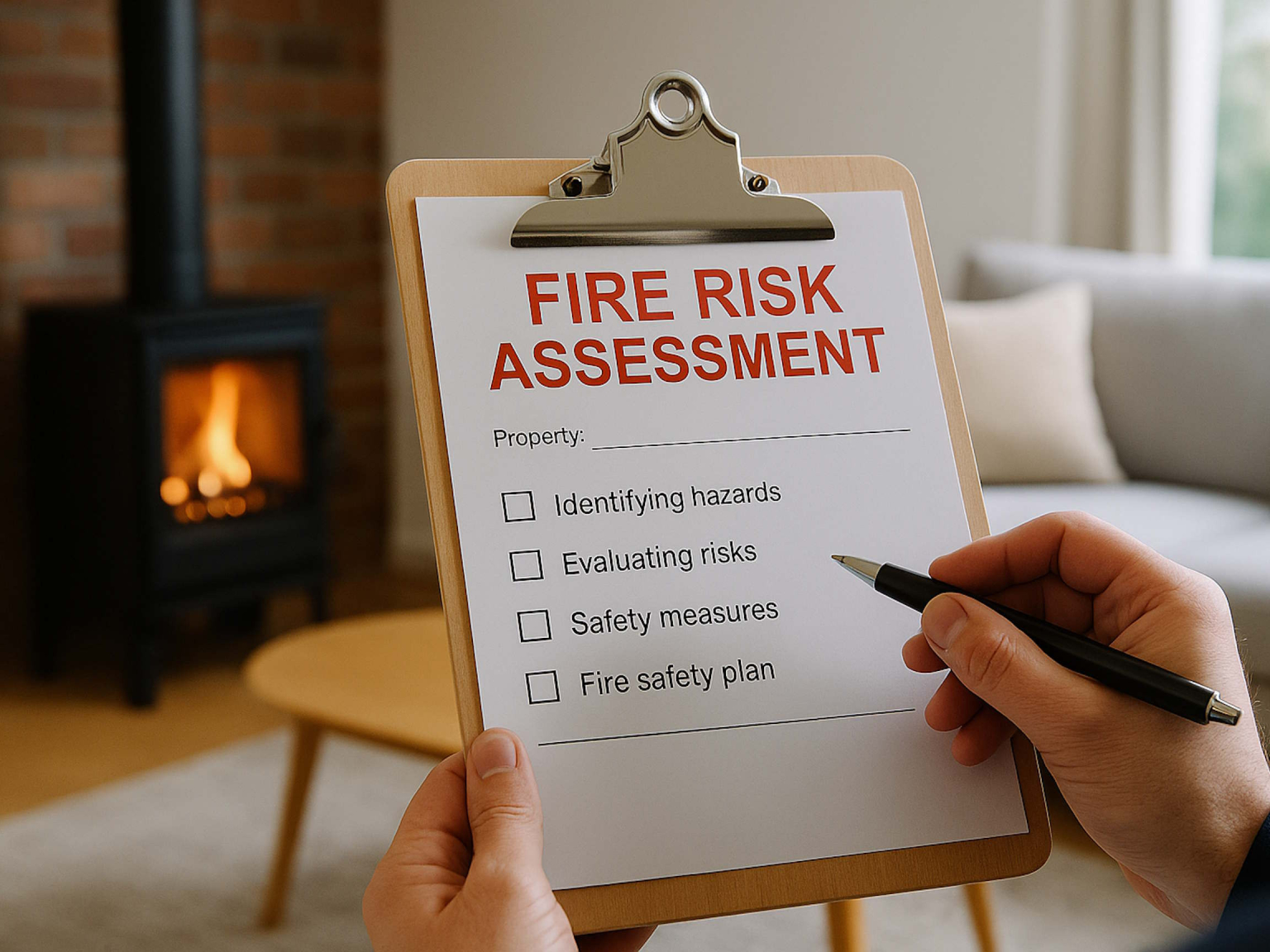
For a typical London letting, the FRA is built around the PAS 79-2:2020 methodology — the publicly available specification that London Fire Brigade inspectors use as the working reference. PAS 79-2 covers housing specifically; PAS 79-1 covers non-domestic premises. Either way, the document must identify hazards, evaluate risk, record fire safety arrangements, and set out an action plan with time-bound priorities.
Renewal interval: no fixed statutory number, but the assessment must be "kept up to date." The London Fire Brigade working standard is a full reassessment every 12 months for HMOs and any premises with a common part, with a fresh assessment immediately on any material change. For more on the practical interval, see our piece on how often a fire risk assessment is required.
Who signs it: a competent person under RRO 2005 Article 18. In practice this means a fire risk assessor on the IFE, IFSM or BAFE FRACS register. We can quote a PAS 79-compliant fire risk assessment for any London property within 48 hours — pricing breakdowns are in our 2026 FRA cost article.
If you only do one thing this week: pull your last FRA and check the date. If it is more than 12 months old, or if anything material has changed in the building, it is no longer "current" in the eyes of an inspector.
2. Electrical Installation Condition Report (EICR)
Under the Electrical Safety Standards in the Private Rented Sector (England) Regulations 2020, every privately rented dwelling in England must have a valid EICR. The certificate is issued by a qualified electrician — usually NICEIC or NAPIT registered — after a fixed-wiring inspection covering the consumer unit, circuits, accessories, earthing and bonding, against BS 7671 (the IET Wiring Regulations).
Renewal interval: at least every five years, or earlier if the report recommends it. A copy must be given to existing tenants within 28 days of inspection, to new tenants before occupation, and to the local authority within seven days on written request.
Remediation deadline: any C1 (danger present), C2 (potentially dangerous) or FI (further investigation required) code must be remediated within 28 days, with written confirmation issued to the tenant and the council. A C3 code is "improvement recommended" — not legally compelling, but worth doing if you want to avoid a C2 next cycle.
Book the renewal through our EICR London service — the report turns round inside three working days for a standard one- to four-bedroom flat.
3. Annual Gas Safety Record (CP12)
The Gas Safety (Installation and Use) Regulations 1998 require every landlord to arrange an annual safety check on every fixed gas appliance, flue and pipework run, signed off by a Gas Safe registered engineer. The output is the Landlord Gas Safety Record — commonly called the CP12. A copy must be given to existing tenants within 28 days of the check and to a new tenant before they move in.
Renewal interval: 12 months, with a 10–12 month early-renewal window during which the new expiry date is calculated from the original date (not the inspection date), so an early renewal does not shorten your certificate.
What is inspected: boiler combustion analysis, gas tightness, ventilation, flue integrity, appliance soundness, isolation valves and emergency control. A boiler that fails on combustion (ratio outside the manufacturer's spec, or a flue leak) cannot be passed on the CP12 — no exceptions.
Our Gas Safety Certificate London service covers single boilers through to multi-appliance commercial kitchens.
Need any of the above booked this week? Call 0207 046 1363 or WhatsApp 07456 975436 with the property address and we will quote and book inside the day.
4. Smoke & Carbon Monoxide Alarms
The Smoke and Carbon Monoxide Alarm (England) Regulations 2015 — as amended by the Smoke and Carbon Monoxide Alarm (Amendment) Regulations 2022 — set the floor across all tenures (private rented, social rented and now also relevant landlords' own occupied flats inside a shared block):
- A smoke alarm on every storey of the premises on which there is a room used wholly or partly as living accommodation
- A carbon monoxide alarm in every room used wholly or partly as living accommodation that contains a fixed combustion appliance — including, since 2022, gas boilers (excluding gas cookers, which remain exempt)
- Tested on the first day of every new tenancy, with the test recorded
- Repaired or replaced once reported faulty as soon as reasonably practicable
The alarms themselves are not specified by standard in the Regulations, but in practice they need to comply with BS EN 14604 (smoke alarms) and BS EN 50291-1 (CO alarms). Interlinked alarms are not yet mandatory in England (they are in Scotland) but they are best practice and a normal recommendation in any PAS 79-2 FRA.
Installation and certification through our smoke alarm installation service — typical one-bed flat fit-out is one visit, two hours.
5. BS 5839-6 Fire Alarm System (HMOs & Shared Homes)
Where the property is a House in Multiple Occupation (HMO) or a shared house, the smoke-alarm baseline is not enough. BS 5839-6:2019 "Fire detection and fire alarm systems for buildings – Code of practice for the design, installation, commissioning and maintenance of fire detection and fire alarm systems in domestic premises" sets the grade and category.
The two terms — grade and category — are not interchangeable:
- Grade = the type of system. Grade A is a fully wired control-panel system; Grade D1 is mains-wired interlinked detectors with sealed long-life backup; Grade F1 is battery-only with a sealed long-life cell.
- Category = how much of the property is covered. LD1 covers all rooms; LD2 covers escape routes plus rooms of higher risk; LD3 covers escape routes only.
The right combination depends on building height, number of occupants and the FRA's findings — covered in detail in our piece on BS 5839-6 grades explained. Getting it wrong is the single most common reason a London council issues an HMO prohibition notice.
Annual servicing and the certificate behind it run through our fire alarm testing London service.
6. Emergency Lighting (BS 5266-1)
BS 5266-1:2016 "Emergency lighting – Code of practice for the emergency lighting of premises" applies wherever an escape route is not adequately lit by borrowed daylight or street lighting in the event of mains failure. In a converted London terrace HMO, that usually means the staircase and any internal corridor without a window. In a purpose-built block, the entire common part.
The testing regime under BS 5266-1 is:
- Monthly — short-duration flick test of every luminaire, logged
- Annually — full three-hour discharge test on every luminaire, logged, with any failure replaced
The log is what an inspector asks for, not the lamps themselves. A property with perfect-looking emergency lighting and no log book fails the audit. We provide the lamps, the testing and the log book through our emergency lighting testing service.
7. EPC & MEES
Under the Minimum Energy Efficiency Standards (MEES), a privately rented dwelling in England cannot be let on a new or renewed tenancy with an EPC rating below E. The current consultation proposes raising the floor to C from 2028 for new tenancies and 2030 for all tenancies — not yet law in 2026, but worth planning capital works against.
An EPC is valid for 10 years and is issued by an accredited Domestic Energy Assessor. It is the cheapest certificate of the seven, but the one most often forgotten when a tenancy is renewed.
HMO & Selective Licensing Conditions
On top of the seven, most London boroughs operate either Additional HMO licensing (for HMOs not caught by the mandatory regime) or Selective licensing (for non-HMO lets in designated wards). Both schemes bolt extra conditions onto the base requirement — typical examples:
- Furnishings compliant with the Furniture and Furnishings (Fire) (Safety) Regulations 1988 as amended
- Water hygiene risk assessment in any property with stored hot water
- Legionella risk assessment
- Display of the licence and contact details inside the property
- Specific BS 5839-6 grade specified in the licence schedule
Pull your licence schedule and read the conditions — they vary by borough and the council will inspect against them, not against the national baseline.
Renewal Calendar at a Glance
- Annual: Gas Safety Record (CP12), Fire Risk Assessment review, BS 5839-6 alarm service, full BS 5266-1 emergency lighting discharge test
- Monthly: emergency lighting flick test (logged)
- Every 5 years: EICR (and on every change of tenancy)
- Every 10 years: EPC
- Every tenancy: smoke and CO alarm test on day one, copy of every current certificate issued to the incoming tenant
- On any material change: new FRA, refreshed BS 5839-6 design check, EICR review if the consumer unit or major circuits have been touched
What an Inspector Actually Asks For
A council inspector — Environmental Health, Trading Standards or the Housing team — turning up unannounced under a Housing Act 2004 inspection power will ask, in this order: the current FRA, the EICR, the last CP12, the alarm install/test records, the emergency lighting log, the EPC, and the licence schedule if the property is licensed. Anything missing or out of date triggers an Improvement Notice at best, a Prohibition Notice (closing the property to new lets) at worst, and a civil penalty under Schedule 9 of the Housing and Planning Act 2016 up to £30,000 per breach.
Keep them in one folder, paper and digital, with the renewal dates on the front. An inspector who can be handed the file inside two minutes is an inspector who leaves quickly.
Penalties for Letting It Lapse
- Missing FRA / RRO 2005 breach — unlimited fine on indictment; up to two years' imprisonment for the Responsible Person on the most serious cases
- Missing EICR — civil penalty up to £30,000 per breach under the 2020 Regulations
- Missing CP12 — unlimited fine in the Magistrates' Court; voids a Section 21 notice; bars licence renewal
- Smoke/CO alarm breach — civil penalty up to £5,000 per breach
- HMO licensing breach — unlimited fine; Rent Repayment Order up to 12 months of rent; selective-licence revocation
- MEES breach (EPC below E on a new let) — civil penalty up to £30,000 per dwelling
The cheapest compliance is the compliance you do on a calendar, not the one you do under a Section 11 inspection notice. Email [email protected] with your address list and we will produce a single-page renewal schedule for your portfolio inside the working day — no charge for the schedule itself, and a 10% discount on bundle bookings of three or more certificates.
FAQs
The FAQ section at the foot of this page (rendered from the schema above) covers: the seven core certificates a London landlord needs in 2026, the working interval for a Fire Risk Assessment, smoke-alarm testing duties between tenancies, the five-year EICR cycle, the difference between BS 5839-6 Grade A and Grade D1, and the financial penalty for a missing CP12.
Save the number now — 0207 046 1363 for the dispatch desk, WhatsApp 07456 975436, email [email protected]. The earlier you book the renewal, the easier the calendar gets.
John Alexander N. — Emergency Repairs London
Key Takeaways
- There are seven core certificates a London landlord must keep current in 2026 — Fire Risk Assessment, EICR, Gas Safety Record, smoke and CO alarm records, emergency lighting test log, BS 5839-6 alarm certificate (HMOs and shared homes) and the EPC
- The Regulatory Reform (Fire Safety) Order 2005 and Section 156 of the Building Safety Act 2022 make the FRA a non-negotiable legal obligation for the Responsible Person on any property with a common part — including a two-flat conversion
- EICRs are mandatory every five years for the private rented sector in England under the Electrical Safety Standards in the Private Rented Sector (England) Regulations 2020 — and every change of tenancy
- The Gas Safety (Installation and Use) Regulations 1998 require an annual gas safety check on every fixed gas appliance — only a Gas Safe registered engineer can sign the CP12
- Smoke alarms on every storey and CO alarms in every room with a fixed combustion appliance have been mandatory across all tenures since the 2022 amendment to the Smoke and Carbon Monoxide Alarm Regulations
- HMOs and shared houses fall under BS 5839-6 Grade A, D1 or LD1/LD2 systems depending on layout and occupant numbers — the wrong grade is a common council prohibition-notice trigger
- Emergency lighting under BS 5266-1 must be installed and tested on any escape route that is not adequately lit by borrowed daylight or street lighting — the monthly flick test and annual three-hour discharge test must be logged
- Fines for non-compliance in 2026 routinely reach £30,000 per breach under the Housing Act 2004 civil penalty regime, on top of Rent Repayment Orders and selective-licensing revocation
